A company follows the vision of two NASA astronauts to protect Earth against space rocks
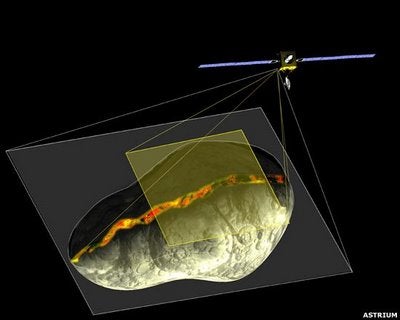
Gravity Tractor A gentle nudge to spare a world of hurt EADS Astrium

NASA astronauts Edward Lu and Stanley Love first proposed using a robotic spacecraft to nudge space rocks away from Earth using the gentle force of gravity a few years ago. Now a European aerospace giant has begun seriously investigating the concept.

The 11-ton "gravity tractor" would have to launch 15 years before a predicted collision between an asteroid and Earth, according to the BBC. But the company, EADS Astrium, noted that no spacecraft prototype has emerged just yet.

Any defense against asteroids smacking the Earth currently relies upon a loose surveillance network of ground-based telescopes and volunteer observers to keep track of potential dangers. The National Research Council released a report earlier this month on how NASA lacks the funding to meet its goals for detecting nearby space rocks.

Still, it's good to see someone taking semi-concrete steps to move the asteroid defense debate beyond just talk. EADS Astrium previously dipped its toes into space tourism with a rocketplane concept, and one of its French engineers recently constructed an aerobraking sail to bring down old satellites. After all, there's plenty of natural junk flying around in space without the manmade cloud of debris surrounding Earth.

[via BBC]

Want to read more articles on the military, aviation, and space? Subscribe to Popular Science today, for less than $1 per issue!

9 Comments

Um...I know I'm new here but did I miss the memo on the discovery/invention of artificial gravity? I mean, I now they can synthesize it on the space station but a "ray of gravity?"

DJC
I believe the idea is to create a craft with sufficient mass so that it would have a gravitational effect on the meteor. It would not have to be a large effect if the meteor was detected early enough. By placing the craft in the correct spot next to the meteor, its small gravitational field would nudge the meteor little by little out of its trajectory and would eventually miss the earth (probably smacking it into Mars)

Click the embedded link: "nudge space rocks" for an older article with better description of what is going on. The ship would essentially pull along side and park itself next to the asteroid and only use thrusters every so often to get into and keep it's position in the right spot. The asteroid would try to pull at it with it's own gravity and thereby be pulling itself toward the ship and off course. It would over a painfully very long time but it would change course.
It's clever, but it relys heavy on the luxury of detecting the objects early. Also getting a ship to it would be less expensive if you could do it like when the asteroid is passing the Earth on a previous orbit before impact.

At least we are thinking about this and not ignoring the real possiblity of a serious impact sometime in the future.

Sounds iffy. Gravity attracts both ways, and the center of mass stays the same. What you would need to do would be a slingshot maneuver, exchanging orbital momentum between the spacecraft and the asteroid. When we do them around Jupiter, it barely budges, but an asteroid's orbit could be significantly affected.

Killer rock might be more accurate than you think. Rocks that would miss the Earth could also be retargeted to strike certain countries and look like an "act of god".

11 tons is not much of a gravitating mass but is a fair chunk to lift from Earth. What we need is an orbiting trash compactor to collect up all the dead satellites and bits of space junk and send that mass out to drag asteroids around with. Getting rid of thousands of pieces of garbage also might help relieve some of the tracking resources to be available to look for earth impactors? Yeah, I watched "Quark" and "Wall-E"...

I personally think the gravity tractor is a waste of money and time they are far better ways to move asteroids around that they should be spending our money on testing.

before saying anything definate:

Show Me The Physics

@Wizzard of Oz
rock-tossing is far more realistic than you think...
Food For Thought: the only reason those sand grain sized rocks dont penatrate the atmosphere for the most part is they hit the earth at an angle or have such a small mass the earth is able to "deflect" them...wouldnt be so if it was 10-20 tons going for a direct hit at some 20mps
(future warfare)...There is a lack of comprehensive studies about these kind of realistic threats such as
"artifical asteroids"...mabye in some 20 years ll take the time to write a book of my own on this subject

@Timemachine
you just cant say that for sure unless youve done the math...if so can you show it to me?

@Mars
if you read articles about "space trash compactors" you would see what kind of engeneering nightmare it could be like the "trash net" idea

my thoughts? noone is taking it seriosly...what you beuracrats out there need is a good whack in the head to straighten them out every couple years. Whatever anyone says (with Obama like, big smiles and reassurences)
about progress...I can bet with any one of you that no effective mesure will be taken in the next 30 years unless we get hit


June 2013: American Energy Independence

Five amazing, clean technologies that will set us free, in this month's energy-focused issue. Also: how to build a better bomb detector, the robotic toys that are raising your children, a human catapult, the world's smallest arcade, and much more.


Online Content Director: Suzanne LaBarre | Email
Senior Editor: Paul Adams | Email
Associate Editor: Dan Nosowitz | Email
Assistant Editor: Colin Lecher | Email
Assistant Editor: Rose Pastore | Email

Contributing Writers:

Kelsey D. Atherton | Email
Francie Diep | Email
Shaunacy Ferro | Email

circ-top-header.gif
circ-cover.gif
bmxmag-ps