Beleaguered, outsize traveler Eric Hagerman investigates

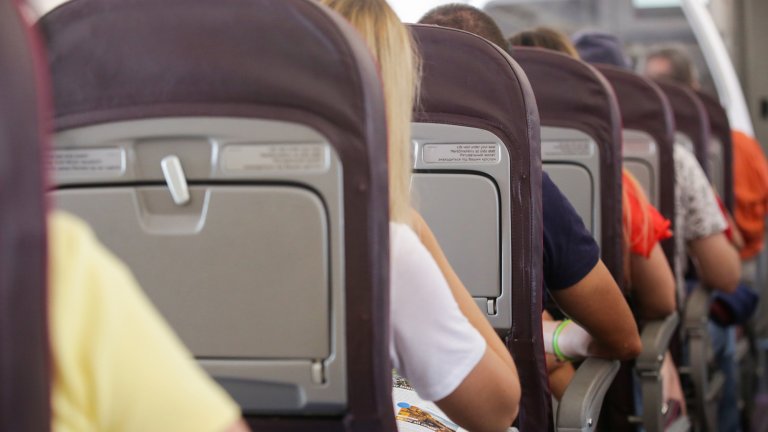
Leg Up, Tray Table Down Watch out for the reclining seat back Bland Designs

I am not normal. Not even close, I am told. Apparently, my height, which at 6'4" has always seemed to me to be just this side of freakish, puts me in the 99th percentile of American adults. That is, statistically too tall to fly comfortably in coach.

Or at least that's the explanation I was given by Klaus Brauer, Boeing's immaculately articulate guru of airline interior design, whose conflicted job title is Director, Passenger Satisfaction & Revenue. "There are many good things about being 6'4", Brauer told me over speakerphone, from what I imagined to be a cushy office chair in Seattle. "Flying economy class is not one of them."

Assume Position:  Bland Designs

Pithy. But my towering frame doesn't explain why most people I know — who reside in that bulge of the anthropometric bell curve known as average — find seating in coach class to be nearly as miserable as I do. Is it such a monumental challenge to make a comfy airplane seat? The typical cushion is so hard that I no longer travel in my favorite jeans because the compressed pocket stitching leaves me with painful welts. As for legroom, flying on certain planes makes me wish I could gate-check my femurs. Would comfort somehow compromise my safety? (I might better tolerate the leg edema knowing that my constricted posture was for a greater cause — like surviving a crash.) Or does it boil down to cold, hard economics: The leaner and meaner the seat, the easier it is to cram more customers onto a plane.

While we've watched from behind the curtain as first class got flat-lying beds, coach-class seating has barely evolved in 30 years. Boeing now makes entire planes out of carbon fiber, yet advances in engineering don't seem to have trickled down to where it counts — beneath my behind. Are they even trying?

Armed with such urgent questions, I pressed Brauer. To be fair, our discomfort is not exactly his fault. Boeing, like Airbus and other manufacturers, doesn't even make the seats that go on its aircraft; airlines buy them from specialty suppliers. But Brauer, a former Air Force officer and mechanical engineer, still has a lot to do with our in-flight comfort. He's been researching it almost since he started at Boeing in 1979 and consults with airlines on how seat configurations balance comfort against the bottom line. His calculations largely led to the 777's shift to three rows of three, from the "2-5-2" configuration, which allows everyone to have a free seat next to them when the plane is 67 percent full (versus 44 percent).


Page 1 of 3 123next ›last »
Want to read more articles on the military, aviation, and space? Subscribe to Popular Science and enter to win $5,000!

22 Comments

Could the reason coach seats have been uncomfortable for so long have more to do with economics than ergonomics (or short people)?

A possible reason that coach seats remain slightly uncomfortable may be to incentivize passengers that can afford to pay a higher fare to purchase a more roomy and more expensive business-class seat. If coach was more comfortable, then fewer people would pay extra to "trade up."

It is no secret that most airlines are barely profitable today. Could any major full-service airline afford to have business-fare passengers trade down to coach? If they all did that, wouldn't coach fares rise across the board to cover the lost profit? Next, coach passengers would demand cheaper fares and then we would be right back to the equilibrium we have today with a 2-fare system where roomier business-fare tickets subsidize cheaper (and more crowded) coach tickets.

JetBlue may be able to have roomy, single-fare planes because has it has a different business model and only serves high-volume routes. The full-service airlines with their full-service cost structure can't afford to forego business-fare revenue.

I'm also 6'4" and have found only 1 airline that actually took this into account when they assigned my seat. BMI (British Midland.) The woman at the check-in counter gave me a seat on the first row with about 4 feet of leg room.

Every other airline has only ever had cramped spaces and barely enough room for me to stand.

First of all, if you're 6'4", I'm sorry I have little sympathy for the few hours a year you have endure the little additional discomfort when you fly. I have flown approximately 4-500 flights in my life, and at 5'7", I would gladly have taken the discomfort during those flights if I were taller.

Secondly, why would the author assume 225lbs would be a reasonable figure to count as a baseline to pay additional. For those of us shorter guys, I think 200 lbs would be adequate. Would the author be willing to pony up more money if that were the case?

Finally, tall guys generally have to buy more food (while not gaining as much weight), pay more often on the more frequent dates they go on (as women generally refuse to go out with men shorter than they are but rarely having a "too tall" restriction), and have to pay more to their accountants to take care of the higher salaries they they have been shown statistically to receive. Why shouldn't they be willing to pony up more for a business class seat?

I agree that airline seats are uncomfortable and it would be nice to get more room without paying any more money, but a tall guy complaining that the world isn't built for people like him? That's just a load.

I'm 6'3" and even at average build I tip the scales close to 200 pounds fully dressed. Give me a total weight limit and you put me at a double disadvantage. My clothes are heavier than any one shorter than me, they take up more room to. I didn't choose to be tall although I would never complain about it. But with height comes weight, and larger clothes.

I reckon my jeans alone way over a pound more than some of my friends.

I think if everyone flew coach the airline would actually make more money, maintaining seperate ground facilities, plane space and flight crews for first and business must out weigh the extra money from business class tickets.

Cruise liners of old (Like the Titanic etc) could not profitably sail with only first class passengers, cramming "steerage" into the hold covered most of the costs.

Absolute

HenryT2: quit your whining. This article wasn't put here for you to complain about your inadequacies or insecurities. Some of the most powerful men in history were short. Let it go. Maybe those harsh words about dating stem more from your overall demeanor.

As for the seats. I work in aviation and you get what you pay for. I'm 6'2" 280lbs with big shoulders. Coach flights aren't easy for me, but I deal with it because of the cost of first class. Many of the seats are built in foreign countries where, traditionally, the average person there is much smaller than the average American. And, since Americans are usually more overweight than other nationalities, they may feel like a tight fit. That's life. I'd love to have my own private jet with all of the room in the world but that's not going to happen.

Panther50

How does the fact that seats being built in other countries contribute to their small size? A united states airline company will purchase seats to their specs, not some other country's specs. That is a terrible argument

HenryT2, quit whining because you're short. No one's complaining that they're too tall, it's just that flying coach is uncomfortable. And it's not just for tall people, either. I'm sure the seats could be a lot more comfortable for everybody.

I'm 6'8" 280 lbs...Yeah I have to pay more for clothes, beds, cars, furniture, airline tickets, seats in stadiums and theaters, etc, etc, etc...But you know what, I don't mind. Its worth the inconvience of having to jam myself into small seats or cars for a few hours to save a couple of bucks...heck I've clobbered my head on the dang overhead compartment doors more times than I would like to admit. I wouldn't give up my stature as a larger man for anything, plus I like standing out in a crowd and looking down on all y'all short folks! ;)

If you read the last two paragraphs of this article, you'll see this guy IS saying that heavy people should be penalized, but tall people should be accommodated. Maybe weight should be a factor, but so should the dimensions of the majority of your passengers.

I agree 100% that airline seats are uncomfortable for everyone. More so for people who are in the the extremes of body proportions. And, if enough people were uncomfortable enough, I'm sure some airline would serve that need and become very successful. I don't, however, think that any airline will become successful forcing 99% of the people to pay so that the top 1% is more comfortable.

The author of this article, by his own admission, is not in the standard range of heights for normal people. I don't disagree with his premise that seats are uncomfortable. But his whiny complaints about how seats are particularly uncomfortable for a person whose physical characteristic is beneficial 99% of the time is just stupid.

As for the posters attacking me and saying that it's my inadequacies that make me say a tall guy shouldn't be complaining about this particular hardship of his height, I'm comfortable with who I am. I retired at 40. I don't know what percentile that would put me in, but I wouldn't trade that for being 6'4" or 6'10".

DLA

from Jones, OK

Big people aren't the only ones who find the seats impossible. I'm short - my feet don't reach the floor. Having ones feet dangle in mid air for hours with the seat pressing in the back of ones knees isn't healthy = especially if you're old. I try to compensate for this by putting my carry on under my feet but almost always the steward/ess comes along and makes me shove it under the seat in front of me, leaving my feet to dangle and legs to go to sleep. The big planes are bad enough but those little, RJ whatevers that a lot of the airlines are using are a night mare. Small as I am, I barely fit in them (but my feet still dangle) - how you big people get in them is beyond me.

We flew to Australia in January 2009. The seat room on the long international legs on the Quantas 747 made the Delta and American legs going and returning seem giant!!! My fiance is 5'0" tall, she had no "wiggle" room on the Quantas flights. Both international flights were sold out and the return flight seats were the center two of the middle four seats towards the rear of the cabin.

On the bright side we got to go to Australia and coach is the only affordable option...

Paying by weight sounds like a good idea until you actually bother to compare the passenger weight of the airliner to its overall takeoff weight.

Warning: math ahead. This is Popular Science, after all.

Let's use a basic example: the Boeing 737-700 in a two-class configuration. Maximum takeoff weight is 154,476 pounds. The total weight of 126 passengers, averaging 150 pounds per, yields a total biomass of 18,900 pounds. Let's further impose the rule that every 150 pound passenger pays $200, and each passenger has to pay in proportion to the impact of his weight on the overall takeoff weight (you pay to help put the entire plane in the air).

The 150-pound passenger is responsible for an average amount of overall weight: 1226 pounds. A 225-pound passenger is responsible for 1301 pounds, 6.11% more. The airline shouldn't charge the big guy 50% more, but only an extra $12.22.

Pay-by-weight looks even weaker when applied to long-haul mega-planes. For an A340-600 in a three-class configuration, the takeoff-weight bump for being 50% heavier is 3.78%.

Is that method of pricing really worth the hassle of another line at the airport, pricing issues, and bad press? Can you see why the airlines, which have been known to pull olives from drink carts to save money, have taken a pass?

Please feel free to, you know, use math and logic before publishing suggestions like this.

The article made it clear why airplane seats are uncomfortable: they're designed under the assumption that the plane will have empty seats upon departure. When was the last time your plane was anything but completely full?

I agree with the math, except that I don't think the average person on a plane weighs 150 pounds. The average woman in America weighs 164.3 lbs, while the average man weighs 191. If you average it out, it comes to 177.15 lbs. Please feel free to, you know, make sure you use the right numbers, Balthar.

I agree with the math, except that I don't think the average person on a plane weighs 150 pounds. The average woman in America weighs 164.3 lbs, while the average man weighs 191. If you average it out, it comes to 177.15 lbs. Please feel free to, you know, make sure you use the right numbers, Balthar.

tricerw

from Boerne, TX

I think seats are build for the average, which at 50% leaves at least half of us with discomfort

bdhoro87

from coral gables, fl

I'd have to agree with the guy quoted in the article, those airplane seats are generally nice, comfortable seats, its being around all those people that sucks, and the rest of the flying experience - waiting at security etc that causes discomfort.

Mike Cook

from Kent, WA

If you fly in Asia, be aware that Japanese and Chinese domestic airlines for many years specified seating density that could squeeze 750 souls on to a 747. They were figuring their average citizen to be much below 150 lbs. Newer airplanes have to take into account that Asian people are getting physically bigger due to changing diets and lifestyles.

In 2002 I was traveling in Eastern Europe on a single-class 737. A British crew of oil well roughnecks was traveling into Ukraine and one of them was a huge man--easily 6'8" and in excess of 350 lbs. The flight attendants didn't blink but produced a kind of box they put in his seat that made the seat bottom for him even with the tops of the armrests. He actually sat on the armrests and they produced a seat belt extender that buckled him in. He sat with his head snug against the overhead luggage bin between the little ventilator knob and the overhead light. The arrangement actually made room for his legs, but he really wasn't so much sitting as leaning uncomfortably.

In the seat next to him they put a child whose protests were not in English but I think they paid his mother some type of bribe and she shut the lad up.

The worst part of the journey for the Big Guy was mid-way through the flight when he had to go to the john. He crammed himself in there somehow but two of his mates had to force the door shut from the outside and then reverse the procedure to get him out again. It was quite a spectacle and amused everyone.

I have a fly a lot in my job and I'm 6'5"! I always use United Air with their Economy Plus seating. As a frequent flier, I get free upgrades to these seats as well as first class from time to time.

I agree with the writer of the article it's not the seat but the surroundings that dictate if you're comfortable.
Wiggle room is very important if you can't move around or stretch you will be very uncomfortable even if you're sitting in a lazyboy.
I think the whole reason why coach is miserable is economics and to encourage you to pay for a higher class seat.
Also I don't think they spend much on ergonomics that or the accountant wins out over the engineer.
They also likely arrive at a seat spacing on coach via modeling but no real world testing other then seeing if you can enter and exit.

Hi Eric,

There is a solution: using vertical space through a system of steps - concept known as Flex-Seat.
Please see Jacob Innovations LLC for more info on the subject, and other articles available at our website.

Sincerely,

E Jacob

I'm 6'4" , Virgin Atlantic wanted an extra GBP50 for an emergency exit seat which stood empty . Told them to shove it and walked about the plane all night .(UK to South Africa)


Download Our iPhone App

Stay up to date on the latest news of the future of science and technology from your iPhone with full articles, images and offline viewing


Follow Us On Twitter

Featuring every article from the magazine and website, plus links from around the Web. Also see our PopSci DIY feed


Become a Fan On Facebook

Share links with friends, comment on stories and more


December 2009: Best of What's New

In our December issue, Popular Science names the 100 best innovations of the year: bombproof wallpaper, self-parking cars, the fastest helicopter, and 97 more. Plus inventor profiles and videos.

Check out the best of what's new here.

Popular Science Photo Pool


Share your photos in the Pop Sci pool at www.flickr.com!
tags_sprite.png
POP_embeddedForm_cover_May09.jpg