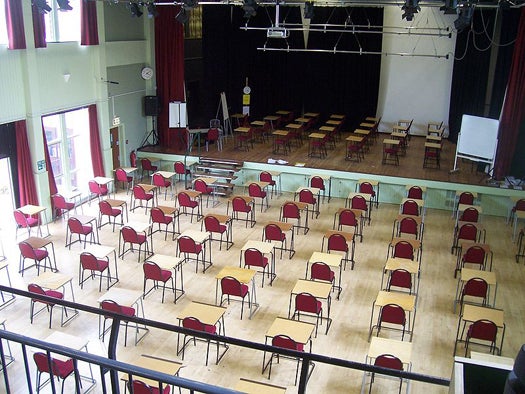
Anti-cheating Software A new system allows for students to take exams remotely while giving administrators the ability to monitor them for academic misconduct, making exam halls a thing of the past for some classes.

It seems like so many technological advances these days are aimed at figuring out how to do absolutely everything -- from attending a staff meeting to hunting for terrorists in foreign lands -- without having to actually be there. Extending that luxury to college students, at least one UK university and a handful of American institutions are experimenting with telecommuting tech armed with anti-cheating software, allowing students to take important exams at home while at the same time keeping them honest.

Packing a 360-degree webcam and a microphone, the setup ensures students are not receiving help from others during the exam. It also locks the computer down, restricting Internet and file access for the duration of the exam so the student cannot attempt to access information on the Web or on his or her hard drive.

University invigilators -- the equivalent of test proctors in the US -- then can review the tape later on their own time, watching it in fast forward or choosing to watch a sample of students to screen for cheating. For universities, it spells lower costs. And it helps college students pursue their own lofty goals of never getting out of bed.

Apparently universities that have tried the software, known as Securexam Remote Proctor, like the flexibility it provides and the reduced need to compete for large exam halls during midterm and final exam weeks. But it also seems likely that in a world where each generation is more tech-savvy than the one before it, students who want to engage in academic misconduct are going to find a way to do so, even with Big Brother peeking over their monitors.

Let's just hope it's not a sign of a larger trend away from classroom learning and discussion. Universities are centers of not only learning, but individual development. That kind of atmosphere forges social bonds as well as academic fortitude. If we get to the point where students no longer have to check into regular classes or exams, will the inclination to smash a beer can on one's forehead or sprint naked through the quad even remain?

Lack of classroom discussion and student-teacher interaction notwithstanding, such a system could be a boon for remote learning of the study abroad type, and given the way the world is shrinking in a technological sense, Securexam could make higher education more mobile. More education in more places certainly is not a bad thing.

[Guardian]

14 Comments

Dear god, these people are stupid.

Surreptitious kvm switch ftw.

to go beyond that you could always just run the test-taking computer in a virtual machine, release the cursor to your main computer to look up the answers. It'd be easy, you'd just have to download something like virtualbox, then some free OS like linux or a windows install disk, load up the virtual machine and connect it to the webcam and mic and take the test on that. Since the guest machine is totally separate from the host, there is actually no way any software installed on the guest machine could influence the host (the one you look up the answers on) in any way.

360 degrees is 2 dimensions. It won't see everything above you. Sit on the edge of your bunk bed. Have your classmate on the top bunk looking down at the test and looking up answers.

Systems like this just encourage people to try to be clever enough to cheat the system.

Just how fine a print can that camera see at a distance? Pretty sure I can make this receipt on my desk read a little differently.

There's two ways this would be implemented that I can imagine:

1. They have a testing center with rooms filled with cameras and computers that have this software installed. This is dumb because if a student is going to go to a testing center, why don't they just go to class in the first place? No time is saved.

2. Cameras are installed in ALL AREAS of the campus that a computer could access the internet, making personal privacy a thing of the past. Also, ALL COMPUTERS on the campus, private computers included, would have to have this software installed, which would be impossible to enforce.

I don't understand how this would work and still be helpful, in all honesty. Maybe the article wasn't as complete as it could have been...

I am an IT manager at a US school that is about to roll out this technology (we havent signed the contract yet or I would tell you the school) and I have personally reviewed it extensively.

To answer some of the uninformed posters:

The software has to be installed in order to enter the exam - after you are authenticated, the password is automatically entered. No software = no password = no exam.

Students must also sit at their desks and replicate traditional exam conditions. Nothing on the desk, fully lit room, no phones etc

The software will not run in a virtual environment. It wont even load. I have tried it with vmware and virtualbox.

KH your method could easily be used in a traditional proctored environment just the same. Our goal as a school was to offer the same integrity/security of traditional proctors, with the extreme convenience of home testing.

You could just tape answers somewhere out of the line of sight of the camera. For instance, glue them on the ceiling or below the desk on the floor. Pretend like you're stretching or something to take a quick glance at the answer.

dwilson:
Does it record audio? Or could you ask questions while keeping your lips still or by resting your head on your hand in a way that hides your lips?

I would buy a KVM switch. My dad used to have one that you pressed a key combination to switch between the computers. Just use a second computer to look up answers.

I am sure they could have a simple rule that is the same as what you find in a class environment... keep your eyes on your test no looking around.

Not to mention if you are intently looking up info on another monitor that is out of view it would be noticed by the reviewer... I had to watch cameras for a long time. People become very easy to read when you know what to look for.

Regardless. I would rather take classes in a class. This online stuff just seems like a way for highly paid educators to become half arsed at instruction. More over I would concern myself if I was them. Things like this are the mechanical are that replaced the people at automobile plants. soon they will be like the rest of us.

which brings up a long time question I have had. Once you get automated enough that virtually no one is needed for production how do you make a profit from the unemployed people. Hmm guess we will have to pay machines in order to stimulate economy. ;P

Sorry bout the last unintelligent bit, just one of my musings.

@ dwilson23
I'm sorry but I must point out a fatal flaw in your reasoning. A virtual machine, properly configured, does not 'know' it is a virtual machine; though you _really_ have to edit the configuration files. simply put, since virtualbox and other emulators are completely open source, though it may take any amount of coding, it is completely possible to modify them to adapt to any one of your methods of security. Not meaning to insult you but computers are my area, and I'm sure I could whip up some program or modification to avoid the security in less than a day. Seeing as I may be taking an online course soon though, and I don't intend to cheat, I must ask; will the software run on any operating system, or in an emulator/compatibility layer? If not, screw the online course, I'll take it in person. I'll not have some sub standard operating system on my computer. And KH's method could foil any system. ;)

Just put post-it notes on everything you need to know behind the computer!

@dwilson23:

You still haven't responded to my suggestion of a kvm switch, perhaps attached to the underside of a desk or arranged as a foot pedal (hands above desk at all times!).

@Dustin2127:

That would work, but so would reverse-engineering the software and screwing with its network communications. Nearly anything is possible in theory.

@paulcrosoft:

Yes it does.

Popular Tags

Regular Features


138 years of Popular Science at your fingertips.

Innovation Challenges


Popular Science+ For iPad

Each issue has been completely reimagined for your iPad. See our amazing new vision for magazines that goes far beyond the printed page


Download Our App

Stay up to date on the latest news of the future of science and technology from your iPhone or Android phone with full articles, images and offline viewing


Follow Us On Twitter

Featuring every article from the magazine and website, plus links from around the Web. Also see our PopSci DIY feed


February 2012: The Future of Fun

Science is reinventing play, from extreme sports to gamification to ridiculous roller coasters to the playgrounds of tomorrow, and this issue is chock full of fun. Also, on a less fun note: Did global warming destroy my hometown?


circ-top-header.gif
circ-cover.gif