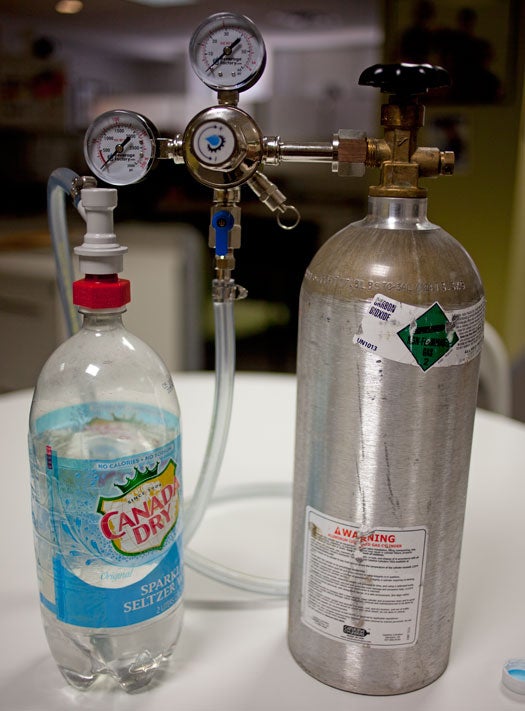
If your friends and family are anything like mine, you've observed that home beverage carbonation is experiencing a bit of a renaissance lately. Perhaps you've seen the increasingly ubiquitous Sodastream machine on a countertop near you—or, more likely, heard its syncopated honk and pop-fizz release from across the room, announcing another fresh liter of water made bubbly.
The Sodastream is a nice machine in a convenient package, but for the true fizz addict with a tinkerer's predilection, it's possible to build your own home carbonator that's cheaper, more flexible, and ultimately more satisfying. Here's why you might want to consider your own DIY rig, and most importantly, how to put it together. It's easy!
The Sodastream machine's Achilles heel is its tiny, proprietary CO2 tank. The company (formerly known as Soda Club) sells seven different home carbonation machines ranging from $80 to $200 (enhancements along the line are mostly cosmetic), but only offers CO2 canisters in 14.5 and 33-ounce sizes. (The measurements refer to the weight of the gas.) Sodastream claims somewhat optimistically that these are good to make a total of 60 and 130 liters of seltzer respectively. What's worse, these tanks have a proprietary cap which can only be filled by the company. My local kitchen supply store charges a hefty $15 to swap an empty 14.5-ounce tank for a new one. Compare that to the $15 charged by my friendly neighborhood welding supply shop to fill my new five pound tank, and the economics start to come into focus. With luck, my five-pounder won't need a refill until early 2013, and if you've got the room, you can go even bigger on the tank. Web carbonation guru Richard Kinch yields over 1,000 liters from his 20-pound tank—and he likes his seltzer extremely fizzy (more on that in a minute).
The Sodastream is an appealingly simple gadget. But once you develop a refined taste for on-demand seltzer, you may find it somewhat limiting. Sodastream's CO2 regulators come factory-set and aren't adjustable, meaning it's impossible to go beyond its pre-defined pressure limit. But with your home-built model's adjustable regulator, you can fine-tune the level of carbonation applied to your liquids. Mr. Kinch favors a tongue-blistering 45-50 psi fizz on his soda water, but if you want a milder 30 psi pop, you can adjust your gas regulator with the quick turn of a screwdriver or wrench. Adjustable pressure also allows you to apply the ideal amount of carbonation to different types of liquids. If you're charging up a batch of tasty gin fizzes (or starting your own modernist cocktail bar), you'll want to dial up the pressure to 45 psi, since alcohol can dissolve more carbon dioxide than plain water. I don't know the ideal pressurization level for cream gravy, but with your bountiful supply of cheap CO2, you're welcome to experiment (please report back with your findings).
With a home rig you can also ditch the Sodastream's proprietary one-liter plastic (or puny 620ml glass) bottles and use anything with a standard plastic soda bottle cap. One liter, two liters—even those cartoonishly obese three-liter bottles—all will work with your DIY carbonator. Just make sure it's plastic—a blown plastic bottle is much preferable to flying glass shrapnel in the unlikely case of rupture.
If you've gotten this far, I probably don't need to explain to you how satisfying it is to improve on a commercial product with a more economical machine of your own construction. But even if this isn't typically your thing (I'm by no means a handyman), a home carbonator is an exceedingly easy project that just about anyone can handle. So let's get started.
• A CO2 tank of any size. Empties can be found on eBay and filled at welding shops, paintball facilities, homebrew hobby shops and elsewhere. My five-pound tank was $100 filled at McKinney Welding Supply in Manhattan and fits into a small cabinet in my kitchen.
• A gas regulator ($39.95, Amazon). The regulator tames the high-pressure inside the CO2 tank and outputs an even flow of gas at constant, adjustable pressure into whatever you connect to the other end. Nicer ones will have two gauges—one for the gas tank's pressure which will hit zero when empty, and one that measures the output pressure into whatever you're gassing up.
• A length of vinyl tubing (Five ft. with hose clamps, $5.49, Amazon). Tubing rated for pressurized applications is required—you'll want about a 1/4" thickness. You can also get braided vinyl line for a bit more durability. The barb fitting of a CO2 regulator typically has an outer diameter of 3/8 inch, so tubing with an inner diameter of 5/16 inch is what you want.
• A ball-lock keg coupler ($7.50, Amazon). This piece connects to the other end of your tubing and holds back gas flow until the little inner valve button is depressed by the tip your Carbonator bottle cap.

• The Carbonator bottle cap ($11.43, Amazon). This ingenious cap screws onto your soda bottle and provides a valve on the other end that engages with the keg coupler to connect your bottle to the gas supply without leaks.
• A standard soda bottle filled with cold liquid (warm water doesn't dissolve CO2 well). Any size bottle will work, so long as it has the common cap size found on a typical two-liter bottle of Coke. I can't resist quoting Kinch again here, who very admirably takes nothing in his system for granted: "If we could send a few back through time to the ancients, these bottles would be considered precious jewels reserved for the king's use."
Total cost: $163.94. It's a little more money up front than all but the most pricey Sodastream machines, but those $15 canister refills add up quickly. After a few months you'll be saving money (ultimately, the system produces seltzer at three or four cents per liter—not bad!). You can also lower your initial spend on the CO2 tank by shopping eBay.
Once you have all your parts, final assembly can be done in 10 minutes or less. Here are the connections you make:
Now, for the grand finale. There are three points of gas control in our system: the tank's main on/off knob, the regulator's cutoff switch (right above the barb end (some regulators don't have this)), and the valve on your keg coupler. Gas only flows through the system when the Carbonator cap is snapped into the keg coupler (you can also reach inside the coupler and depress the valve with your finger if you want to torment the cats with a gust of CO2). If you fill bottles frequently, you can leave the tank's main on/off valve open and use the regulator's cutoff switch to turn the gas on and off.
And that's it! May you enjoy a long life of flexible, thrifty carbonation with your own home rig.
Five amazing, clean technologies that will set us free, in this month's energy-focused issue. Also: how to build a better bomb detector, the robotic toys that are raising your children, a human catapult, the world's smallest arcade, and much more.


Online Content Director: Suzanne LaBarre | Email
Senior Editor: Paul Adams | Email
Associate Editor: Dan Nosowitz | Email
Assistant Editor: Colin Lecher | Email
Assistant Editor: Rose Pastore | Email
Contributing Writers:
Kelsey D. Atherton | Email
Francie Diep | Email
Shaunacy Ferro | Email
I,m guessing this works well on those store bought in a day flatties of coke and pepsico junk. Do you know why the cap on sodas a few years ago was really redesigned. They claim the empty spots space in the threads save material and money. BULL! If not screwed on to its tightest that most women or men can,t after I tighten one uncap. They were and all are now redesigned to go flat sooner. Thereby buying another one at a sooner rate and pouring yesterdays two liter out. They actually added more threads to keep them from going flat until bought. Meaning more material and more machine and money in pout of making you spend more time and gas to buy your next one while the other is only a day old and still half full and flat as the taste of unsalted paper. Next up! Why is some store bought bread made by the same company yet sold as a non name brand staler than others. I know! Oh yeah!
I am the odd man out here.I have NEVER liked carbonated beverages-really hate the bubbles.Maybe carbonation will be shown to cause cancer or some other disease!
would a co2 fire extinguisher be ok to use?
This is a really verbose article towards a gas... :\
Joseph Priestley was one of the inventors of carbonated water when he discovered how to inject carbon dioxide into water. Born in England in 1767, Joseph was working at a brewery in Leeds when he worked out how to create ‘fixed air’ and impregnate the same into water. His Swedish counterpart, Torbern Bergman developed another solution when in ill-health; he discovered a method of recreating naturally occurring sparkling water which back in 1771 was believed to aid good health
If you take two samples of water with the exact same composition but add CO2 to one of the samples then there will be no discernible difference to health benefits or otherwise.
The carbon dioxide forms very small bubbles which generate an effervescent ‘fizz’ effect which people either love or hate in unflavored water. Some liken it to drinking a remedy for hangovers rather than an enjoyable and refreshing glass of water. Whatever you call it – sparkling water, carbonated water or club soda, it is essential the same as non-carbonated or still water except for the bubbles.
It basically comes down to taste and personal preference.
Is it Monday yet..... sigh!
newbeak5,
i don't know about cancer,but carbonated water is known to dissolve tooth enamel and cause tooth decay and sensitive teeth,( with excessive use that is,which can be assured if one has a cheap home-water-carbonation system).
also ,its really not that good for digestion either.
Once additional consideration regarding Sodastream...the company's main production facilities are in an Israeli settlement built illegally in the Occupied Palestinian Territories. Google the report from the Israeli organization Coalition of Women for Peace, Production in Settlements: The Case of SodaStream.
Realeco:
You just gave me a good reason to buy one.....
new -
you are actually mistaken on both accounts.
carbonated water does not promote tooth decay (sugars in carbonated beverages do)
http://www.ncbi.nlm.nih.gov/pubmed/11556958
and carbonated water has been shown to be **beneficial** for indigestion and constipation
http://bastyrcenter.org/content/view/899/
Nice! Just ordered all the goodies off of Amazon, thanks for the great post!
Unfortunately, my wife wouldn't let me keep this on the counter because it isn't pretty. :) It is definitely cool, though!
For those non-DIYers, I recently received a SodaStream as a gift, and I am very happy with it. I was worried about the taste, but myself and others have been surprised that it is actually pretty good.
Kryo, I hope you are joking. I sure as hell wouldn't want to pump lots of baking soda (Sodium Bicarbonate is what most home Dry chem fire extinguishers use) into any of my beverages. But hey tastes vary, give it a shot (sarcasm). At least its relatively non-toxic (assuming you are referring to the standard Class A-B). OTher types, you are in for a very nasty painful (or explosive) death. So overall i would recommend avoiding such a prospect and go with the basics.
@ nighthwkich, Kryo question is quite legitimate, you get dry powder extinguishers that you are referring to, and, at least locally, you get CO 2 gas extinguishers which leave no powder and no mess after use. I think they are especially designed for electrical fires and ice up during use.
There must be a couple of spare ones where I am working, must check if I can have one.
If using Red fitting above, get a simple CO2 carbonater, there is going to be a learning curve to figure how much burst is needed to carbonate, but it would be much cheaper then investing in regulator and tank. Make sure to only use food grade CO2, as airgun CO2 has piston oil.
Second option if you have regulator and tank is to use Bolt thru Schrader Valve on pop bottle instead of fancy fittings. 3 are less than $10 on Ebay. Drill right size hole and tighten down till gasket smashes. Put bard on schrader tire filler and your all set for less than $20.
I used this setup on my growlers to keep beer fresh for several days if I can't finish before going flat.
Had to sign up to leave a brief comment regarding the safety of this setup.
Gas supply regulators will always have the possibility of failure which can, in some cases, prevent them from properly regulating the pressure downstream of the regulator. If a regulator were to fail, and/or become inaccurate in it's ability to regulate pressure properly, there is a good chance that the bottle you are attempting to pressurize will rupture which could cause a major injury.
The good news is that you can help to prevent such a danger by installing a pressure relief device downstream of the regulator before the soda bottle. They are set to release gas pressure at a specific PSI in order to prevent damage caused by over pressurization. For a soda application I would recommend at the very least a 75 PSI pressure relief safety but 65 PSI would be even safer. In my opinion, the welding supply company that set you up with this equipment should have mentioned this and insisted on it as part of the package.
I would advise you guys at PopSci run a correction to this article outlining the possible dangers involved. The reason the Soda Club is limited in pressure and uses such a small thick plastic bottle is to protect against this danger. If you want to see the force of a soda bottle exploding search "Co2 bomb" on YouTube. Also remember if you were to reuse the same bottle over and over there is a chance it will weaken over time from repeated stress of pressurization.
Source: I've worked for a welding supply company for 20+ years.....
PS. Since I can't link to the recommended equipment search "1/4" 75 psi cryogenic pressure relief valve" and click to the link from Ratermann Mfg. That is one example of a relief device that would help make the setup more safe and all gas suppliers should have them in stock.
**Correction**
The regulator that you linked to on Amazon does in fact have an integrated Pressure Relief safety set at 45 psi. Still, the dangers of over pressurizing should probably be addressed in this article as it would be very easy for someone to remove the 45 PSI safety to attempt to Pressurize up to the 50PSI that you mention in the article.
Other similar regulators come with an integrated 65 PSI relief. Those may be more suitable for the alcohol applications that you mention.
so is the welding variety "food grade" and how can we tell if it is or not
Just set up the system last week and am enjoying the carbonated beverages. I'm using sugar-free powdered drink mixes for 2-liter jug flavoring with much success.
I upgraded my regulator for about $5 so I could adjust the exit pressure by hand rather than have to use a wrench.
Note: seating the ball-lock keg coupler to the cap takes more strength than I have in my hands. I tapped it on with a small rubber mallet and leave it attached. Screwing down the cap is a bit less convenient, but much more do-able for me than attaching the coupler each time.
The home-made soda pressurized to #45 is more like commercial pop than those at lower pressure.
I bought my CO2 from a local AirGas distributor for $80 [plus tax] and refills are $18. A full steel tank weighs in at about #30.
Users may not want to purchase a new aluminum tank since many gas suppliers just exchange full tanks for empties, so the investment in a new pretty tank goes away when swapped for a veteran steel bottle.
PS to my 08/08/12 at 11:53 am post: Squeezing the soda bottle creases it. To be on the safe side, I'm only using a bottle five or six times before starting a fresh one.
To make CO2 dissolve better, you should bubble the CO2 through the water. I took my cabonator cap and just stuck a straw in the hole ( on the underside ) and it stuck. So now, I can let the co2 bubble through the water either on initial pressurization ( slowly ) and then shake the bottle. Since the straw is in the whole and the liquid will not shake in the straw, there should be little chance of liquid getting into cap/tube. ( Germs issues ).
So I suggest that you add the straw.
This looks awesome, and I think I'll build one tomorrow! Couple questions though-
1) I'll re-ask the above question, are there any food safety concerns due to CO2 being in tanks not meant for food usage? I suppose kegs use them, but do they use certain tanks meant for that purpose?
2) Does anyone know of a more durable and reusable plastic bottle that could be used over and over again instead of a regular soda bottle?
3) Does anyone have any experience putting lime or lemon or other natural flavoring into the water before carbonating? How does it come out?
Question: Is the method of compressing CO2 for industrial uses different than the compression method for CO2 used in food service? I plan to use the more readily available CO2 used in carbonating soda drinks, in my aquariums....for plant growth. When I asked the "fish guy" at my pet store he warned against using welding supply CO2, as it would kill all the fish and plants in my tanks. He said it was due to oil used in the gas compressors for industrial use. My question is, Is this CO2 from my welding supply store ingestable?
Question: I've setup the apparatus as shown, and tried making a bottle of soda water several times. Each time, the pressurization of the bottle is extremely quick, and the CO2 stays mainly in gas form in the bottle. The CO2 in the water is very limited. I've tried suggestions of shaking the bottle while holding pressure for 30s, and also inserting a straw in the Carbonator to allow it to bubble through the water during pressurizing. What I think maybe necessary is to slow the introduction of CO2 into the bottle, but; I'm not certain how to do this. Any suggestions? I'd like to produce soda water similar to a Club Soda, and at the moment I can produce a very light effervescence.
I use the Kent Systems bottle cap and quick disconnect. Its cheaper ($10 for both) than buying a "Carbonater" (sic) cap and keg connector.
@lisanke - the water has to be very cold. Your pressure may be too low also. I have step by step for perfect soda. You can see my video on youtube (same name as here). I would not put a straw in the water or hold it upside down unless you have a check valve on the tank (I have one). Don't slow the introduction of Co2, but rather increase pressure. Perhaps your Carbonater cap leaks. Keep the gas open while shaking
@chimbley_sweep, @folma7 - As far as I know there is no such thing as food grade, there are just different purities. I like most people buy from a welding supply shop.
@Chimbley sweep - I've been looking for reusable bottles for a while, haven't found anything yet. Stainless would be nice (clearing the headspace air is not critical, just requires more shaking). You can carbonate wine and juice and whatever in this. Wait for an hour before opening or you will have a fizzy mess if you carbonate juice this way.
@DrSpyn. Squeezing is NOT critical, the amount of gaseous Co2 dissolving is almost 3 times the water volume. If you want to keep bottles longer just skip this step. It would just mean shaking the bottle longer
I have the Identical set up shown here with a 20lb cylinder. I am not happy at all with It. I end up with weak seltzer even when I add CO2 a few times. Also the seltzer I make goes flat really quick. I've done what I'm supposed to do.The water Is near 32F with Ice crystals. I shake It and shake and shake and all I get It flat seltzer. Even my ball valve tends to stick. Maybe I'm jinxed or something, I don't know but I'm really down over this bs. I may do another rig like adapt the sodastream to fit the large CO2 tank.
That may be the best way to go.
One reader said he wonders If we will get cancer from drinking CO2. Does he know how much CO2 exists and that we "breath" It? Somebody help this dude before he OD's on CO2. Geez man!
@chumsly.
What pressure are you using?
Do you keep the gas open while shaking? You should hear and see gas flow in since about three times your liquid volume of gaseous CO2 will dissolve in it.
Do you hear any pressure leaks from your cap or connector?
Have you tried resting the bottle under pressure in the refrigerator?
Unpressurized soda goes flat quickly at room temperature. Serve cold or over ice.
The soda stream takes full 700-800psi and just uses a flow control and a pressure release. So you can connect the tank directly with strong enough hose and correctly threaded connections (no regulator needed). The high pressure gas acts as the agitator (no shaking). Its hard to beat the fizziness of soda stream, but then again I love fizzy fruit juice (sparkling grape is awesome). You cannot make fizzy juice in a sodastream.
Soda stream has a custom thread, anti-refill valve and charges $15 for a pound of CO2, Primo on the other hand uses a standard thread and standard CO2 tanks. Rather buy a Primo and don't reward Soda Stream's traps. Since the Primo comes with a Soda Stream tank adapter you can use the direct connect kit on that too.