
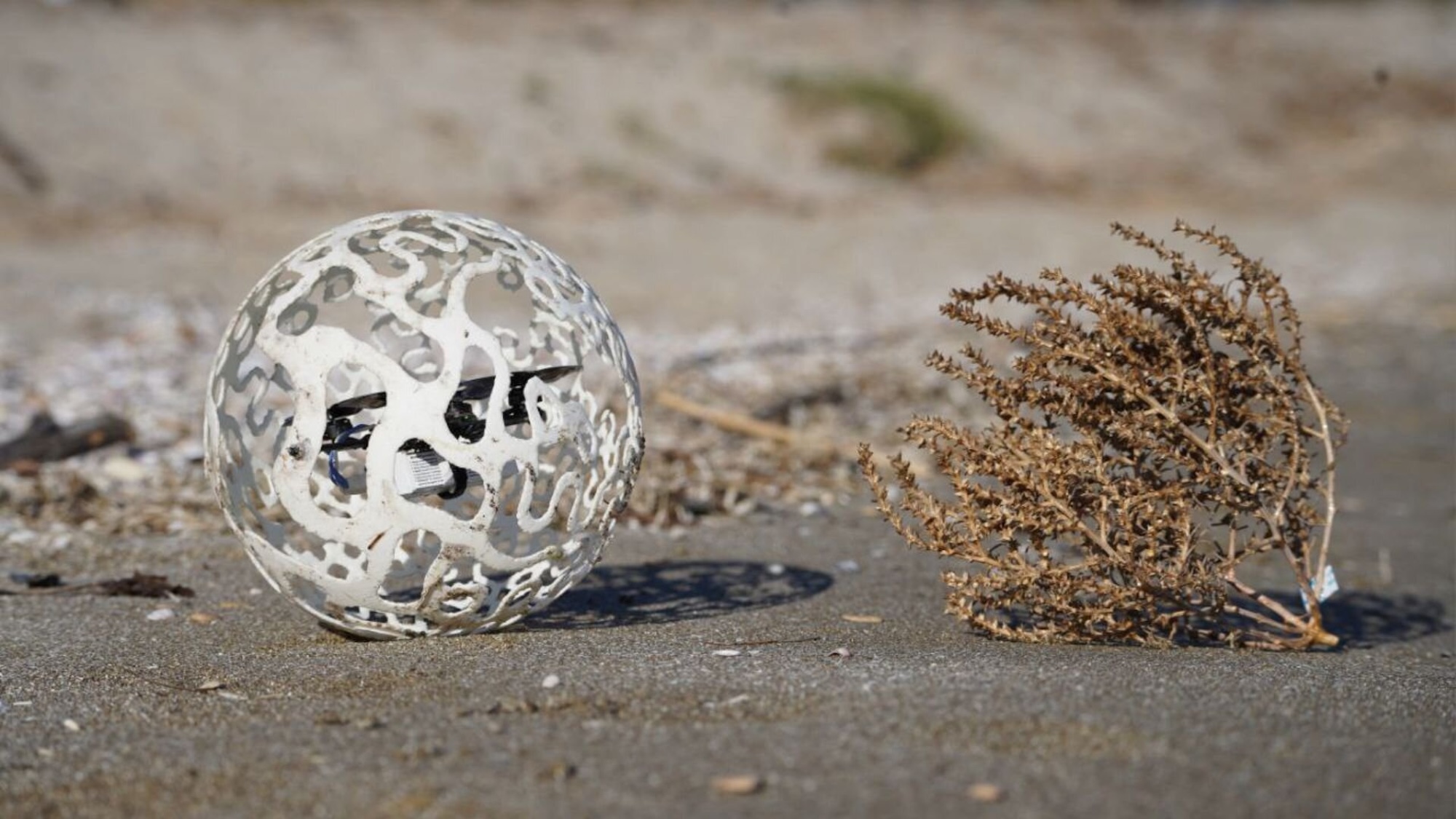
A robot inspired by desert tumbleweeds may be the first of a new generation of energy-efficient explorers rolling into future disaster zones. While the Hybrid Energy-efficient Rover Mechanism for Exploration Systems (HERMES) described in the journal Nature Communications recalls the desert ramblers, its creator initially envisioned the idea while watching humans enjoy wind simply for the thrill of it.
“The inspiration struck on a windy winter afternoon along the shores of Lake Neuchâtel [in western Switzerland],” said Sanjay Manoharan, a study co-author and researcher at the École Polytechnique Fédérale de Lausanne (EPFL). “I was watching kite surfers harness the wind to carve sweeping arcs and achieve effortless lifts…Yet, I realized nature had already perfected this art long before us.”How do tumbleweeds work?
The tumbleweed is as iconic as they are efficient. Despite appearing like a seemingly random mass of twigs, the nomadic plant husks harness ambient wind to travel large distances. However, these desert staples aren’t pointless plant byproducts. Tumbleweeds often disperse seeds as they mosey along on their journeys. In fact, they’re so good at what they do that ecologists are trying to rein them in due to their propensity to turn into wildfire hazards.
Intrigued by these aerodynamics, Manoharan and his research group investigated how the twiggy formations were so maneuverable, despite generating more drag than a solid sphere. From there, they conducted wind tunnel experiments based on computational fluid dynamics to analyze these dynamics.

HERMES tumbleweed inspired robot
The results revealed an unexpected, previously undocumented structural facet to tumbleweeds. Simply put, the plant remnants are more porous on the “top” than they are on their “bottom.” This asymmetry changes the wake dynamics, while also enhancing the pressure drag on a tumbleweed. Once tipped over, the denser section of the tumbleweed directs air across its exterior. This works similarly to how a solid sphere rolls, but the porosity in the tumbleweed still produces two wakes.
“In the upright position, the upper half, being more porous, allowed airflow to pass through freely. In contrast, the lower half was denser and thus offered greater resistance,” the study’s authors explained.
HERMES on a roll
Engineers incorporated these findings into a robotic design printed using 3D laser molding. The final product involves a lightweight shell that features an asymmetrical porosity. In the end, the final iteration of their creation dubbed HERMES was far more efficient than either natural tumbleweeds or artificial spheres. Even with a higher drag force, HERMES easily rolled along with only a 3.28 mile per hour breeze.
In field testing, the robot successfully navigated steep inclines and mapped GPS networks. HERMES moved around this terrain, while simultaneously transmitting geotag data at long range.
Wind isn’t a guaranteed fuel source, however. There are plenty of times when breezes dissipate to leave tumbleweeds—and their robotic imitators—at a standstill. To address this inevitability, Manoharan’s team installed a lightweight quadcopter inside the sphere designed to run in four modes: reorientation tumbling, directional spinning, gliding, and even a hopping aerial.
The end result is a robot that builds from one of nature’s most elegant designs. During maze tests, HERMES not only used 48 percent less energy than a robot requiring constant control,it finished the maze 37 faster than its counterpart. Even when it required quick, motorized course corrections, the robot still saved 90 to 95 percent of the energy used in the continually powered control machine.
“If the wind is blowing and the robot is rolling, it remains perfectly passive, spending zero energy. If motion stops for a set period, it attempts a low-energy nudge—a quick motor pulse to reposition. Flight is always the last resort,” said Manoharan.
With additional advancements and fine tuning, robots like HERMES could one day be deployed in hazardous disaster zones, deadline minefields, and even on windy neighboring planets like Mars.
“The guiding philosophy is beautifully simple and energy-aware,” Manoharan explained.
