

Archivists at the Library of Congress believe they may have discovered the first depiction of a robot in cinemas, thanks to a 127-year-old reel that had been gathering dust in a garage for decades. The artifact in question is called Gugusse And The Automaton, a 45-second-long reel made by pioneering French filmmaker Georges Méliès sometime around 1897. Though appearing more than 20 years before the word robot was officially coined, it still manages to touch on an enduring theme reoccurring in sci-fi movies to this day. A fear of the robots fighting back.
“This is one of the collections that makes you realize why you do this,” Library of Congress archive technician Courtney Holschuh said in a statement.

Gugusse et l'Automate
In the brief silent film, Méliès portrays a magician named Gugusse who is showing off an “automaton” in what looks like a proto–robot manufacturing facility. The automaton is dressed as a clown and stands on top of a pedestal. After some exuberant jumping, Gugusse begins twisting a crank at the bottom of the pedestal, apparently winding up the automaton like a toy. Once wound up, the robot moves its arms up and down, much to Gugusse’s delight. That delight, however, doesn’t last long.
In the next scene, the automaton is replaced by a larger humanoid figure. Gugusse once again winds it up, and the machine again responds by moving its limbs. But this time, after a few sporadic gyrations, the automaton reorients itself toward the magician and begins using the walking sticks in its hands as weapons, aggressively beating its creator. In a fit of rage, Gugusse grabs the robot by the legs and hoists it off the pedestal. He then pulls out a comically large hammer—Looney Tunes–style—and bashes the automaton over the head. With each blow, the machine grows smaller and smaller until it disappears entirely. And just like that, the clip ends.
In a blog post revealing the discovery, The Library of Congress says the find is “a small but important addition to the legacy of world cinema and one of its founders.”
From a farmer’s garage to the Library of Congress
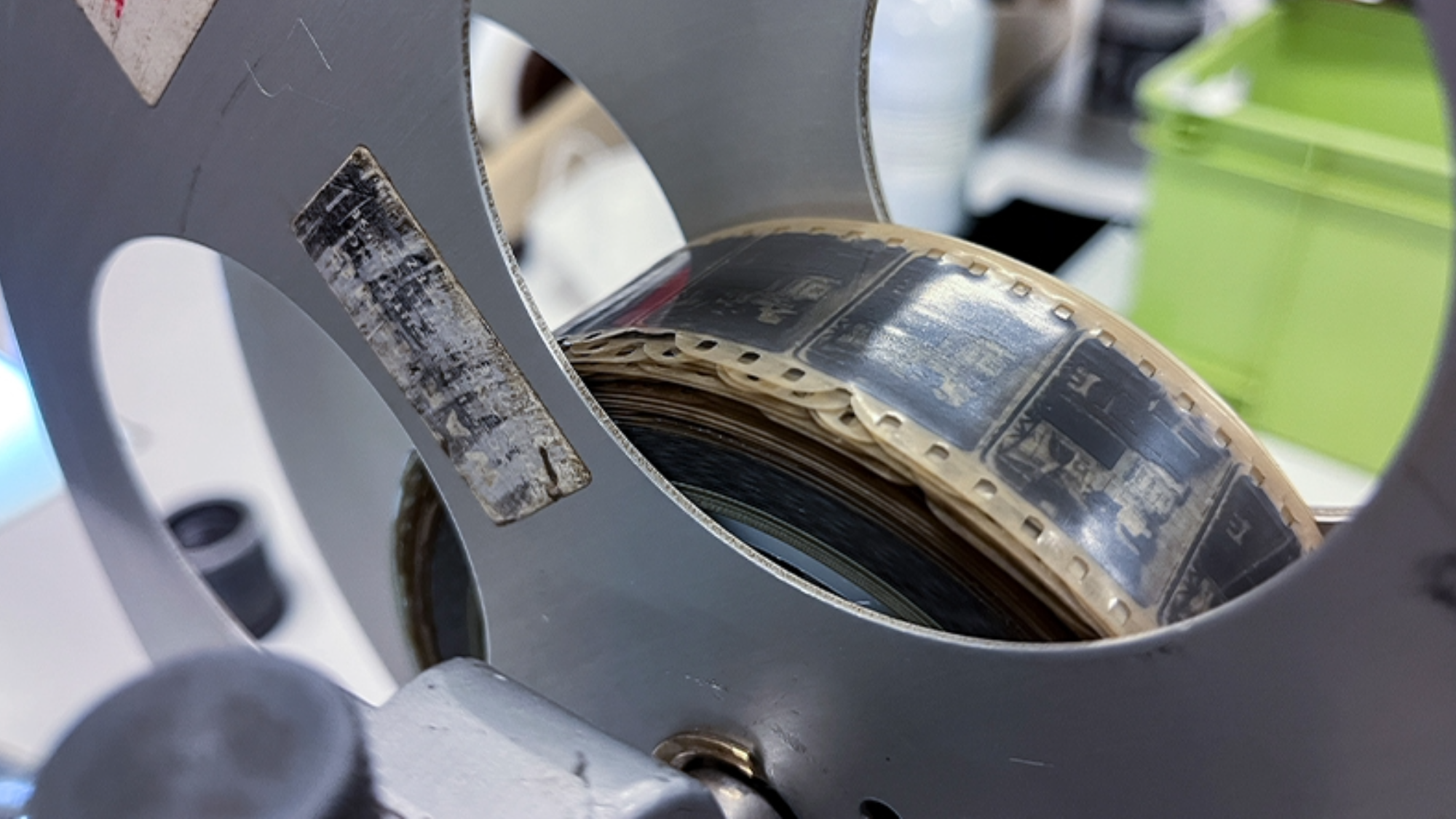
Silent film experts had long known about the short film, but believed it had been lost to time. In all likelihood, the Library of Congress technicians note they were the first people to lay eyes on the film in over a century. And that discovery came about largely by chance. The film was part of a larger collection donated by the descendants of William Delisle Frisbee. The late 19th century potato farmer who spent his free time traveling by horse and buggy from town to town, showing films on his projector—still a rarity at the time. Frisbee passed his film collection on to his descendants, who eventually donated them to the Library of Congress.
Technicians at the Library of Congress were examining the film reels when they began noticing telltale signs of Méliès’s work. After consulting a Méliès expert, they received confirmation that they were looking at a coveted, long-lost film. They then spent more than a week scanning and stabilizing the footage in order to convert it into a digital format. It is now available to view for free in 4K.
“This movie has made it form a buggy in rural Pennsylvania, to a [Toyota] Camry in Michigan to Culpeper [Virginia] into the hands of our technicians at The Library of Congress, and now, with the work we can do on it here, we can share it with the entire world,” Jason Evans Groth, curator of the moving image section at the Library of Congress said in an Instagram Reel on the findings.
Méliès sparked a long line of movie robot villains
Though he may not be a household name today, Méliès was a juggernaut of early cinema. He began his career as a stage magician before pivoting to film, which many regarded as a kind of magic in itself at the time. Méliès went on to create around 500 films and pioneered early filmmaking techniques such as double exposure and forced perspective. He also reportedly had a deep interest in early science fiction writers like H. G. Wells and Jules Verne, which helps explain his use of the automaton. And while these figures were not strictly robots in the modern sense, real-world wind-up “automatons” did exist, dating back at least to the early 17th century.
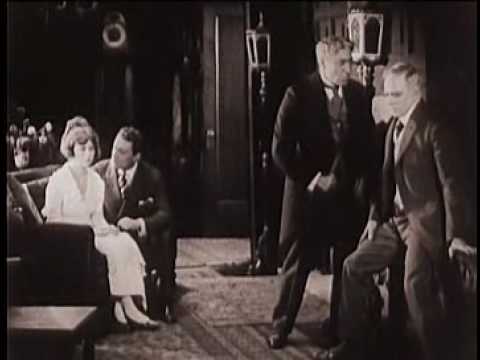
Despite being lost for nearly a century, Méliès’ early sci-fi lived on in spirit through a long line of films starring hulking robots, typically as villains. The earliest known example following Méliès reel may be in the 1919 silent film The Master Mystery, starring Harry Houdini. There, an actor dressed in a bulging robot costume is described as, “a mechanical figure with a human brain.” Naturally the automaton commences to chase the panicked humans.
Houdini: The Master Mystery (1920) (Part 2 of 20)
For archivists working on the Library of Congress, the findings reveal another often overlooked quality of film. It’s longevity.
“I’ve worked with nitrate for decades now and it never ceases to amaze me how sturdy and long lasting this material can be,” Nitrate Film Vault Leader George Willeman said in an Instagram Reel detailing the findings. “We have video tapes that are no longer usable and yet here is a nitrate print from 1895 that we were able to identify just by looking at it.”
