

Thanks to some powerful lasers, a fleet of ancient ships hidden in plain sight for over 40 years has resurfaced inside a Bronze Age temple in Cyprus. However, it’s understandable why archaeologists overlooked them for decades. As researchers explain in a recent study published in the International Journal of Nautical Archaeology, high-resolution laser scans revealed as many as 23 vessels etched into the walls of Kition Kahthari. But the more than 3,000-year-old images weren’t created by a single artist. Instead, contextual evidence indicates that the ships were etched into stone over a period of 300 years.
Established by Phoenicians around the beginning of the 10th century BCE, Kition was a city-kingdom located on the southern coast of Cyprus, later annexed by Rome in 58 BCE. The city endured for nearly another 400 years before successive earthquakes in 322 and 342 CE ultimately destroyed the settlement.
In 1959, archaeologists began excavating a complex of five stonework temples now known as Kition Kathari. The work has since spanned decades, including the discovery of 21 ships engraved on a temple wall and nearby altar in the early 1980s. While already eroded by time, excavations unfortunately exposed the stonework to further deterioration.
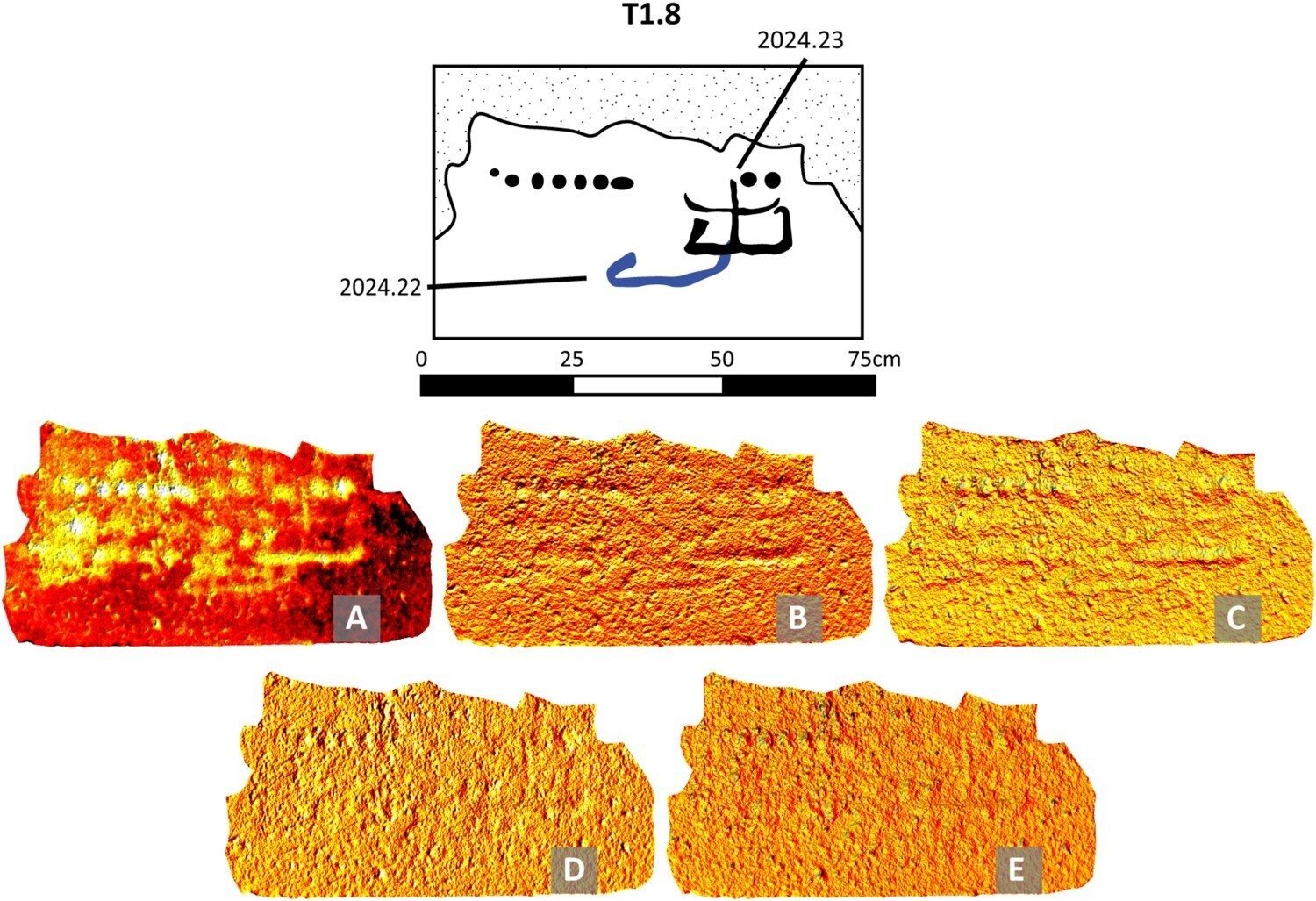
This eventually led archaeologists to return to Kition Kathari in 2024 to survey what remained of the Bronze Age architecture. Researchers utilized high-resolution lasers to scan the stone surfaces, which they later reconstructed in 3D. They initially intended to gain a better understanding of Late Bronze age masonry, but what they saw in the scans took them completely by surprise.
“When we noticed all the ships, I felt tremendously excited. We had not expected to find them,” Caroline Barnes, an archaeologist at the University of British Columbia and study co-author, recalled in a statement to Phys.
Barnes and her colleagues ultimately tallied 23 ship illustrations that are practically invisible to the naked eye. In one case, a repair stone added 150 years after the initial wall’s construction also showcased a boat, suggesting the artwork was created in phases over centuries. The study authors believe they can group the ships into six categories that align with contemporary eastern Mediterranean vessel imagery. These included designs from the Levant, Minoa, and even hybrid galleys potentially from the Carmel Coast. Like the repair stone’s art, these all are traceable to various centuries both before and after the Bronze Age collapse.
The exact purpose behind the etchings remain unclear, but researchers said they underscore a common misunderstanding of the Late Bronze Age. Although the era did precede a cultural “dark age” collapse, knowledge preservation didn’t disappear entirely.
“The conclusions presented here support the idea that there was a high degree of continuity that both persisted through and accompanied the important changes that occurred at the end of the Bronze Age,” the study’s authors wrote.
