
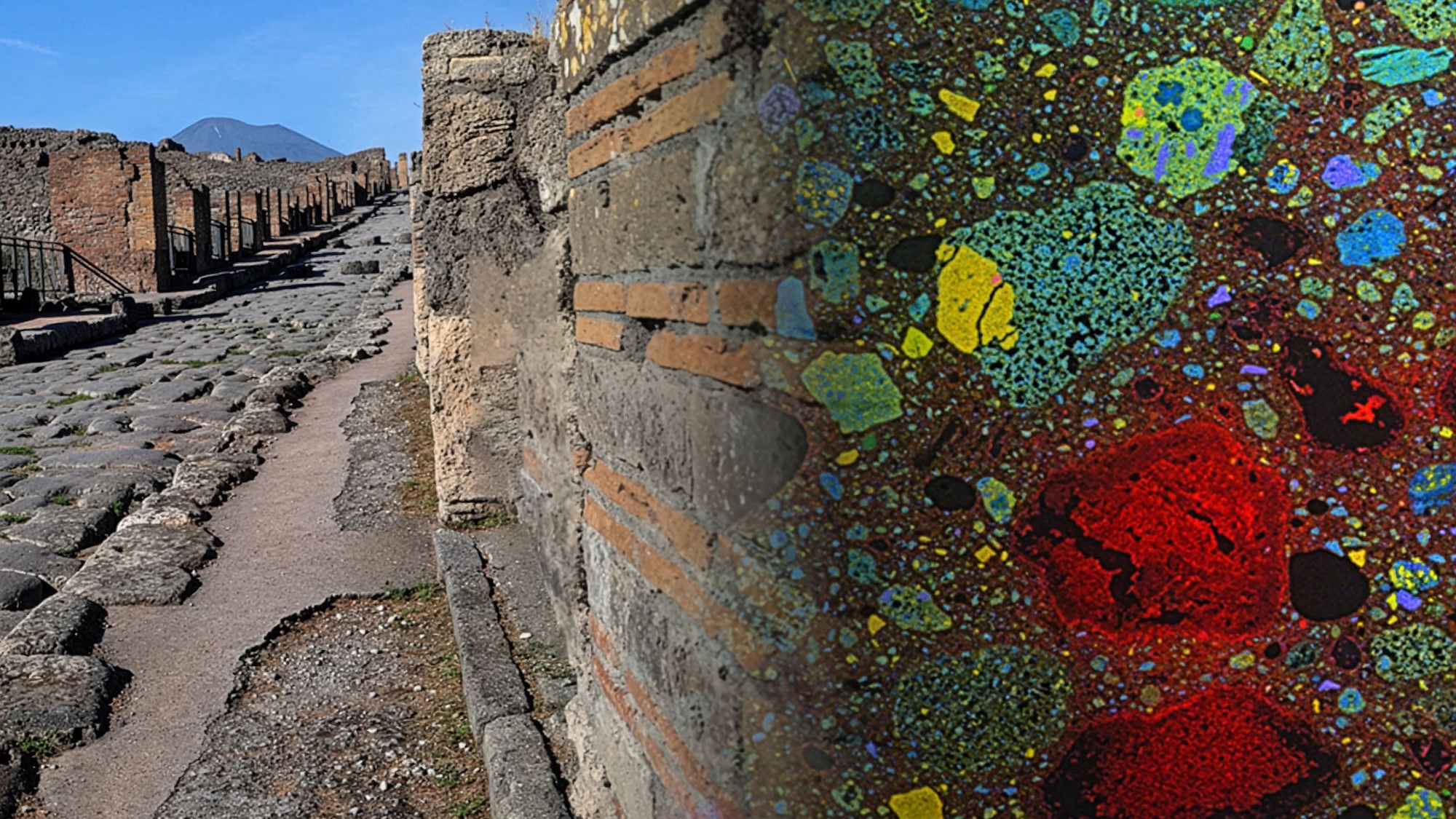
For once, new research on the ruins of the Roman city of Pompeii is not focusing on the destructive aftermath of the infamous Mount Vesuvius eruption in 79 CE. Instead, it centers on the creative acts preceding it. After taking a closer look at the city’s construction projects, a team from MIT believes that ancient Rome’s legendary concrete recipe might need a major historical revision.
When ancient Roman architecture comes to mind, the columns and coliseums are generally the first things that pop into your head. These structures were often built using Roman concrete—and that material traces back to a single man named Vitruvius. The 1st century BCE engineer is widely credited for authoring De Archtectura, the only architectural treatise to survive from antiquity, and his recipe for concrete helped construct some of the empire’s most iconic buildings.
A hot-mixing hot take
In 2023, MIT engineer Admir Masic and colleagues published the results of their research into surviving Roman concrete. They confirmed that the composite was manufactured by first mixing lime fragments with volcanic ash and other dry materials. Adding water to this blend then produced heat at a chemical level in a process known as “hot-mixing.” As the concrete set, it preserves bits of the reactive lime as tiny, gravel-like stones. When the concrete inevitably cracked over time, the lime then redissolves and fills in the fissures—granting the material its famous self-healing properties.
While the team’s conclusions were sound, there was a glaring conundrum: this isn’t the recipe offered by Vitruvius. According to De architectura, the best concrete requires first making a paste from lime and water before combining it with other ingredients.
“Having a lot of respect for Vitruvius, it was difficult to suggest that his description may be inaccurate,” Masic said in a statement. “The writings of Vitruvius played a critical role in stimulating my interest in ancient Roman architecture, and the results from my research contradicted these important historical texts.”
Nevertheless, a follow-up study published on December 9 in the journal Nature Communications reinforces Masic’s potentially Vitruvius-contradicting argument. The evidence resides at an ancient Roman construction site preserved in great detail by the Mount Vesuvius eruption.
“We were blessed to be able to open this time capsule of a construction site and find piles of material ready to be used for the wall,” said Masic. “With this paper, we wanted to clearly define a technology and associate it with the Roman period in the year 79 CE.”
Related Pompeii Stories
A volcanic secret ingredient
Isotopic analysis confirmed that the workers in Pompeii relied on hot-mixing when making their concrete. Samples from the site contained both the lime clasts Masic previously described in 2023, as well as the dry composite materials needed before hot-mixing.
“These results revealed that the Romans prepared their binding material by taking calcined limestone (quicklime), grinding them to a certain size, mixing it dry with volcanic ash, and then eventually adding water to create a cementing matrix,” Masic explained.
The team also concluded that the volcanic additives(known as pumice)weren’t only selected because of their local convenience. Chemical observations confirmed that pumice particles reacted over time with the porous solution surrounding them. The results from this reaction are new mineral deposits that reinforced the concrete even more.
Although the construction materials are over 2,000 years old, they remain as important as ever. Today, engineers are frequently re-evaluating the uses of self-healing cement methods in their own projects.
“This is relevant because Roman cement is durable, it heals itself, and it’s a dynamic system,” said Masic. “The way these pores in volcanic ingredients can be filled through recrystallization is a dream process we want to translate into our modern materials. We want materials that regenerate themselves.”
But when it comes to Vitruvius, Masic promised that his team’s latest discoveries won’t erode the architect’s legacy. While Vitruvius may have simply misinterpreted the era’s primary concrete recipe, De architectura still describes a strategy that strongly echoes the hot-mixing method seen in the authors’ studies.
“We don’t want to completely copy Roman concrete today,” said Masic. “We just want to translate a few sentences from this book of knowledge into our modern construction practices.”
