
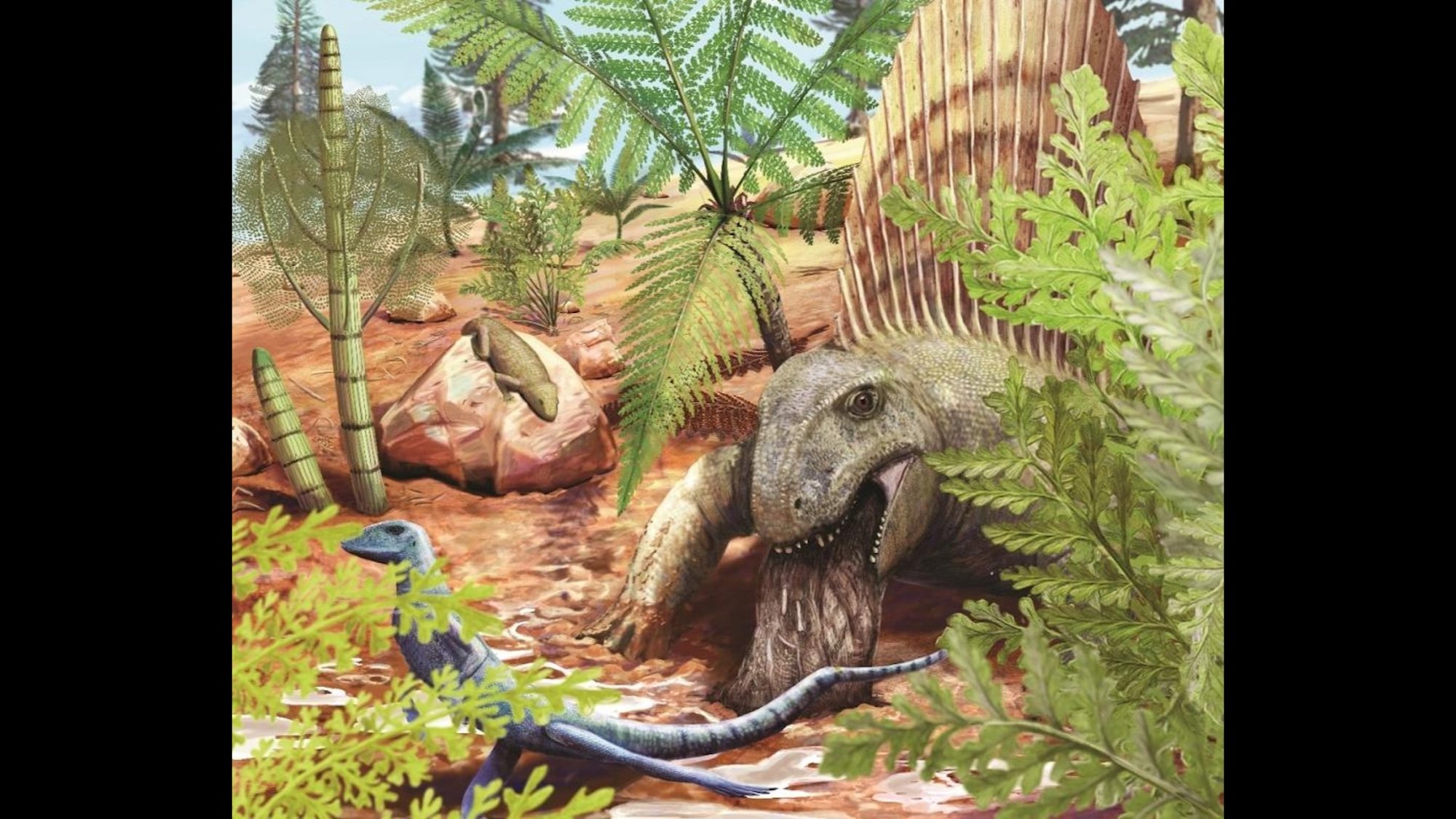
Approximately 290 million years ago, a carnivorous dinosaur stomping around present-day Germany had a tummy ache. The Paleozoic predator eventually vomited up its stomach contents, and then hopefully continued to live its best dino life. Unlike most ancient regurgitated meals, this particular mixture of half-eaten prey and digestive bacteria successfully fossilized into what’s known as a regurgitalite.
In 2021, paleontologists discovered the extremely rare find while working in the famous Bromacker Permian dig site, about 155 miles southwest of Berlin. As they detail in a study published on January 30th in the journal Scientific Reports, the fossilized regurgitation is the oldest specimen of its kind, and contains a wealth of insights into the still frequently mysterious food chain of terrestrial dinosaurs.
What is a regurgitalite?
Bones tell researchers a lot about ancient species, but they can’t provide the whole picture. In addition to anatomical remains, paleontologists often focus on other biological samples such as coprolites, aka fossilized poop. But due to their composition, most coprolites are only preserved in aquatic settings like oceans and lakes, meaning it’s easier to reconstruct marine life menus compared to land dinosaur food webs.
This is partly why a team from Humboldt University of Berlin’s Natural History Museum and the French National Centre for Scientific Research initially suspected their fossil-in-question (known as MNG 17001) to be a coprolite. However, further analysis and morphological clues proved otherwise. Fossilized poop is usually preserved in comparatively regular cylindrical or conical shapes, with any residual bones suspended in an organic sedimentary matrix. This mineralized casing is also generally high in phosphorus—a consequence of bacterial bone digestion.
But MNG 17001 doesn’t look anything like a coprolite. The bone fragments aren’t housed in a sedimentary matrix, and it had very low phosphorus levels. Taken altogether, the team knew they were looking at a regurgitalite, or fossilized vomit, likely preserved due to the Bromacker site’s origins as a wet floodplain.
An ancient survival trick
Carnivorous dinosaurs are far from the only animals to ever regurgitate after a hefty meal. Even today, many predators frequently throw up harder-to-digest material like teeth, bones, and hair as a means to conserve overall energy. But MNG 17001 marks the first instance of a confirmed regurgitalite from a completely terrestrial Paleozoic predator.
Although paleontologists aren’t entirely sure about the identity of vomit’s creator, they have narrowed down the possibilities. Computed tomography scans allowed them to reconstruct the fossil’s dozens of half-digested bones in 3D, which they then matched to known species. These included the nearly complete maxilla (upper jawbone) of a small ancestor of today’s reptiles, Thuringothyris mahlendorffae, as well as the humerus belonging to the oldest known bipedal vertebrate, the bolosaurid Eudibamus cursoris. The final evidence—a bone from a diadectid—proved the most telling. Members of the Diadectidae were the first fully herbivorous tetrapods, as well as the first truly large land-based animals. Diadectes, for example, easily grew as big as 10-feet-long.
Potential suspects
Paleontologists aren’t sure about the specific diadectid species, but they do know that whatever feasted on it must have been equally sizable. In the Bromacker region, only two predators fit the bill. The first contender, Tambacarnifex unguifalcatus, isn’t widely known and likely resembled a huge monitor lizard. The second, Dimetrodon teutonis, is much more recognizable with its distinct sail-fin along its back.
No matter its true identity, the ancient predator’s upset stomach yielded a remarkable time capsule into Paleozoic life, death, and regurgitation. The first-of-its-kind fossilized vomit also hints at opportunistic hunting behaviors among apex land predators, and illustrates just how long carnivores have relied on the (admittedly unseemly) digestive trick to maximize their survival odds.
