
What’s the weirdest thing you learned this week? Well, whatever it is, we promise you’ll have an even weirder answer if you listen to Popular Science’s hit podcast. The Weirdest Thing I Learned This Week hits Apple, Spotify, YouTube, and everywhere else you listen to podcasts every-other Wednesday morning. It’s your new favorite source for the strangest science-adjacent facts, figures, and Wikipedia spirals the editors of Popular Science can muster. If you like the stories in this post, we guarantee you’ll love the show.
FACT: A footless goose was at the heart of a 1990s murder mystery
By Rachel Feltman
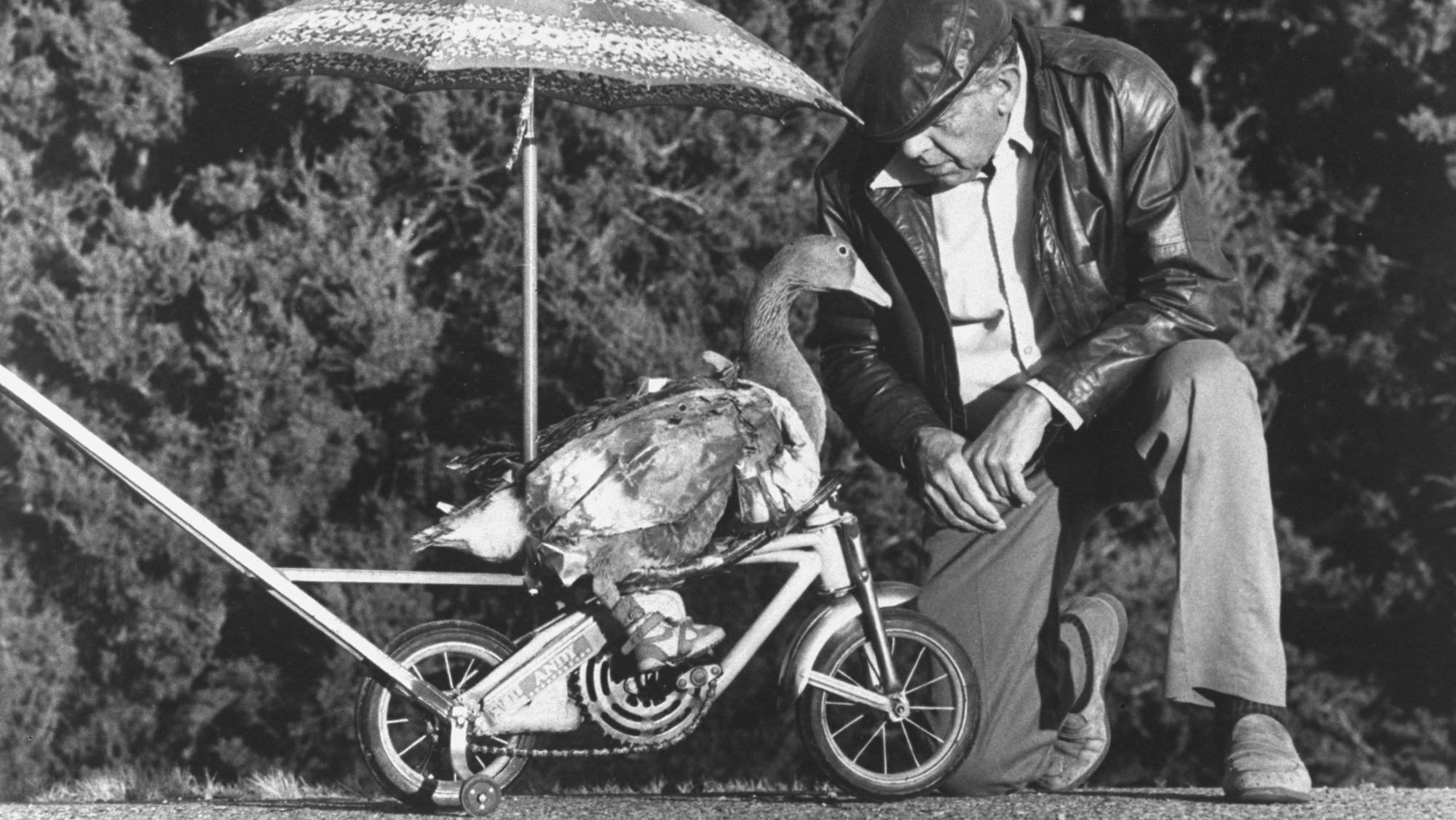
In this week’s episode of The Weirdest Thing I Learned This Week, we unravel the captivating tale of Andy, the beloved footless goose who both captured hearts and sparked a murder mystery (gasp!). Born without feet in 1987 on a Nebraska farm, Andy’s life seemed bleak until he was rescued by Gene Fleming, an inventor who transformed his mobility with a pair of custom shoes.
Andy became a local celebrity, strutting across the community and even appearing on The Tonight Show with Johnny Carson. But the joy of Andy’s life was cut short when, at the tender age of four, he was found murdered. The culprit’s identity, however, is shrouded in endless question and mystery.
Was Andy a victim of a senseless act, or is there more to this story than meets the eye? Tune in to find out!
FACT: The sports bra is shockingly new
By Claire Maldarelli
As a runner and athlete, I’ve always wondered: why hasn’t the sports bra evolved alongside other athletic innovations?
In my fact this week, I explore the history of sports bras, starting with the invention of the jog bra in 1977 by Lisa Lindahl, Hinda Miller, and Polly Palmer. The trio were frustrated by the lack of proper support for women athletes, so they set out to design a product that ended up revolutionizing how women approached sports. But despite significant advancements in athletic gear over the decades, the sports bra has seen surprisingly little development since then.
But it’s not all doom and gloom! Scientists of today are beginning to dig into sports bra technology again. Take, for instance, the Reebok Pure Move bra, which utilizes non-Newtonian fluid technology to adapt to movement. That means it behaves like a solid under stress but relaxes when at rest. Anyone who has had to wear a sports bra knows that sounds pretty enticing.
This week, I uncover the complexities of sports bra design, the need for better support for female athletes, and the quirky science behind how non-Newtonian goo could hold the key to the future of sports bras. Listen to the episode to hear more!
FACT: Sex in space is, well… hard!
By Moiya McTier
Let’s boldly venture into the cosmos to explore a topic that NASA would rather keep under wraps: sex in space. Surprisingly, while astronomers are known for their playful and often cheeky language (think “Milky Way bulge” and “kink instability”), NASA really shies away from studying anything related to sexual activity among astronauts.
Despite the romantic allure of stargazing and the undeniable chemistry that comes from being in close quarters aboard the International Space Station, NASA insists that no human has ever had sex in space. But with nearly 700 people having traveled beyond our atmosphere since the dawn of space travel, one can’t help but wonder if the cosmic conditions are more conducive to romance than they admit.
And even aside from pure romantic motivations, studying reproduction in microgravity is hugely important. If we’re ever to travel deep into space, we’ll need to know how to continue our species out there. But that definitely comes with its own challenges. From the mechanics of physical connection in a weightless environment to the physiological hurdles posed by lower blood pressure, sex in space isn’t as easy as it sounds. Of course, some researchers are working toward a solution. Tune in to hear all about it, in addition to some other facts about non-human species that have reproduced (with varying results) up in space.
FACT: Viking Berserkers might’ve just been microdosing henbane
By Jess Boddy
I’m really big into working out and weightlifting. And often, that includes taking pre-workout beforehand–a concoction of carbs, caffeine, and other motivating molecules. It helps me lift heavier, get stronger, and have an overall more enjoyable time at the gym.
But I wondered… Is there some kind of historical precedent for this? (Of course there was.) Back in the Viking era, fierce warriors called Berserkers would consume mysterious concoctions before heading into combat, purportedly entering a trance-like state of ferocity that made them seemingly invincible.
I explore the modern science behind these ancient practices, including a recent study suggesting that the Berserkers may have used a hallucinogenic plant called henbane, known for its pain-dulling and delirium-inducing effects.
And even aside from the physical benefits, any kind of ritual before engaging in something physically demanding can go a long way when it comes to the mental game. There are the kamikaze pilots who took ceremonial sake shots. Or in fiction, too, consider the iconic “witness me” battle cries of the War Boys in Mad Max: Fury Road. Whatever the ritual, it can give us a serious boost before diving into the fray.
Check out the full episode this week to hear all the grisly, pumped-up details.
