
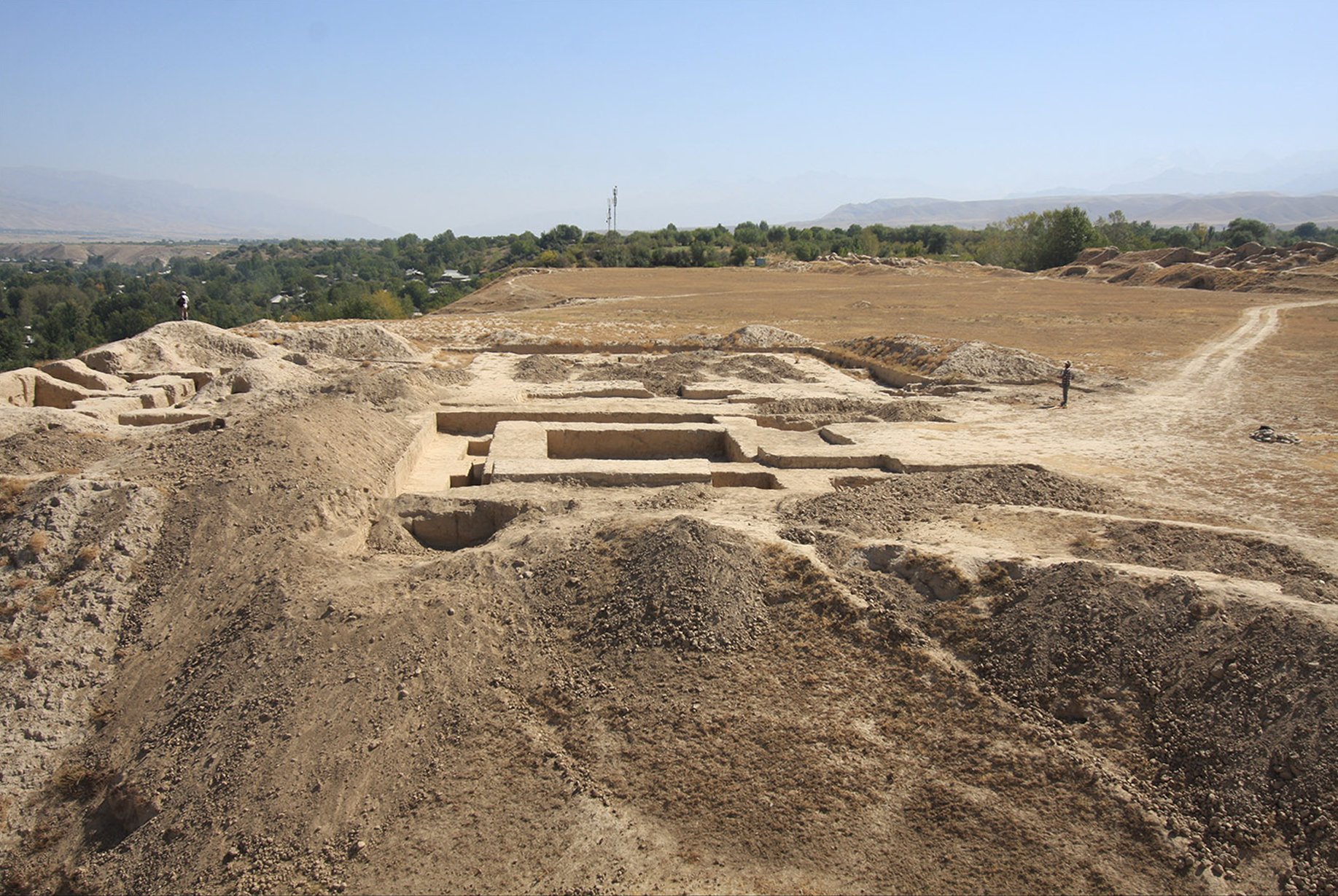
Tucked along the picturesque Zeravshan River in the rocky mountains of northwestern Tajikistan lies the ruins of a forgotten, ancient palace. The monumental royal complex once presided over a bustling city along the Silk Road, not far from modern Tajikistan’s border with Uzbekistan. In its heyday, the palace’s walls were covered with colorful murals and intricate wooden carvings, most of which have been lost to time—until now.
A study recently published in the academic journal Antiquity recreates and analyzes one of palace’s most surprising murals. The mural shows four priests accompanying a young boy to a fire altar and is unlike anything that has been previously discovered. For the archeologists in this new study, the depiction raises far more questions than answers.
Tajikistan’s great, forgotten civilization
For centuries, the palace was an impressive seat of power of Sogdiana, the homeland of an ancient Iranian people known as the Sogdians. One of the earliest mentions of Sogdiana is in the fifth century BCE, when the land was a territory of one of the world’s first empires—the Achaemenid Persian Empire. During the early fourth century BCE, Alexander the Great conquered Sogdiana, absorbing the land into his own massive, but short-lived empire.
Seven hundred years after Alexander, the Sogdians reached their zenith. Capitalizing on their strategic location between Asia and Europe, they became skilled merchants, trading in Indian gemstones, Tibetan musk, and luxurious furs from the Asian steppes during the fourth century CE.
The Sogdian golden age persisted until the eighth century CE, when Islamic forces took control of much of the region. Some Sogdians converted to Islam, while others assimilated into Chinese culture or other civilizations. Within several centuries, the Sogdians had largely lost their distinct cultural identity.
The Royal Palace at Sanjar-Shar
While much of Sogdian culture may be lost to time, some of their structures still stand, including the ruins of an ornate palace hidden among northwestern Tajikistan’s dry, rocky terrain. Known as the Royal Palace at Sanjar-Shar, its remains are about seven miles east of modern-day Panjakent.
Built sometime in the fifth century CE, the palace was a massive complex built to impress. It had numerous, grand reception halls arranged asymmetrically along a central T-shaped corridor, a layout that mirrors other official Sogdian residences. Visitors to the ancient palace would’ve been greeted by a treasure trove of goods from across the ancient world, from ornate Chinese mirrors to gilded belt buckles.
But some 300 years after its construction, the illustrious palace burned to the ground. Peasants moved into the ruins, using the once-noble palace as utilitarian storage space for at least another century.
The perplexing fire mural
In the late 1940s, Soviet archaeologists began excavating the Royal Palace at Sanjar-Shar. In the decades since, numerous excavations have taken place at the site. Archaeologists have found a wealth of goods that once decorated the lavish residence, including numerous fragments of wall murals.
A bright blue lotus flower once adorned the palace’s central T-shaped corridor. Nearby, a hunting scene graced the walls of a smaller square room. The walls of a great rectangular hall displayed mounted cavalry riding alongside demonic figures with “bulging eyes and raised eyebrows,” the study’s lead author, archaeologist Michael Shenkar of the Hebrew University of Jerusalem, writes.
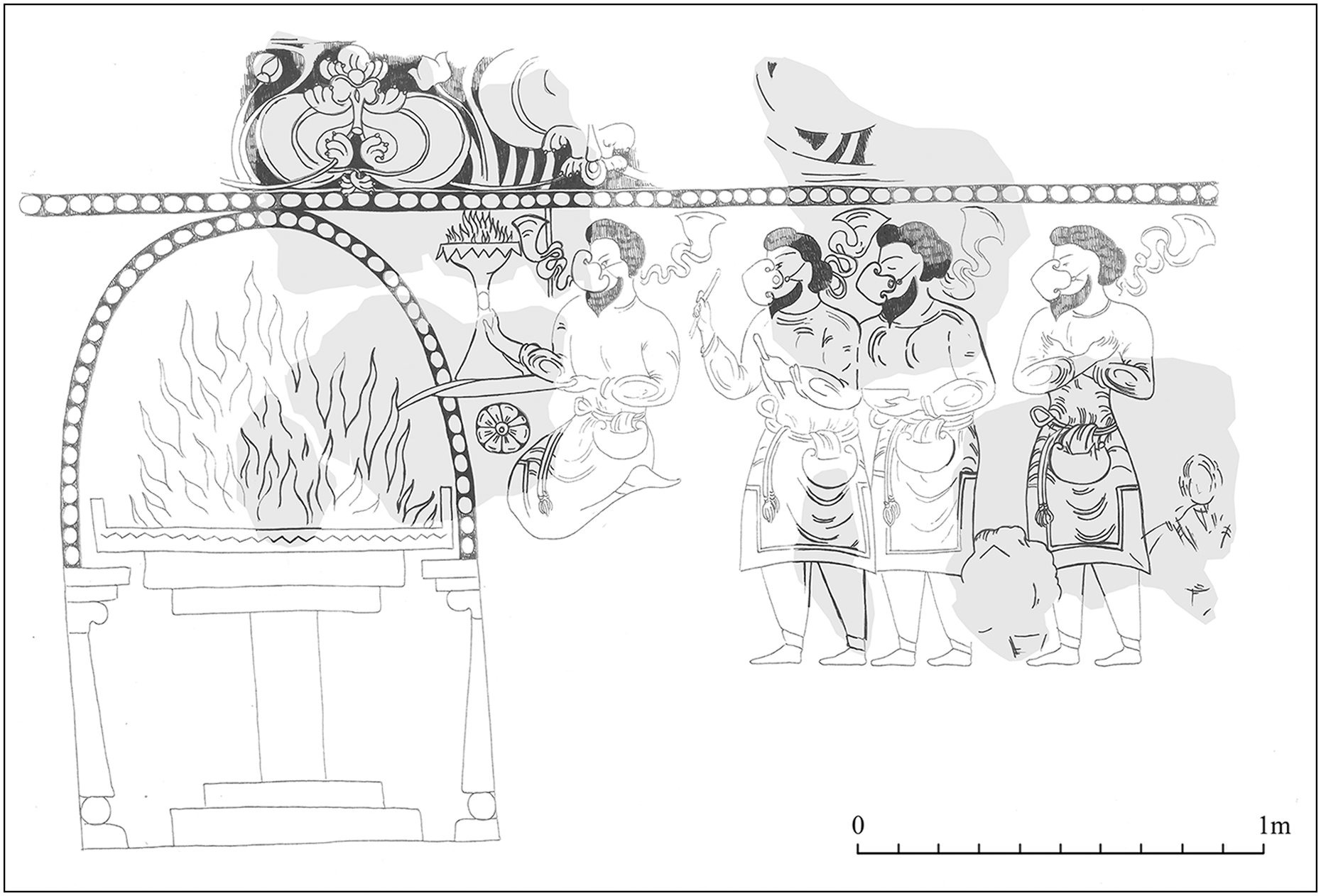
In the same room as the big-eyed demons and horseriders, perhaps the most puzzling mural fragments were discovered in 2022 and 2023. Reconstructed for the first time by Shenkar and his team, the fragments show four priests, and possibly a small child, approaching a stationary fire altar. Depictions like these have only ever been found on ossuaries (chambers for storing human remains), and even then, those paintings usually only show two priests.
The priest at the front of the mural’s procession was “evidently the most significant,” but he’s “also the most poorly preserved,” Shenkar writes. “He was likely depicted kneeling on both knees, raising a small altar towards the larger, stationary one—a common posture in Sogdian art, often showing worshippers offering incense on a portable incense burner.”
However, offerings like these were usually made to painted or sculpted deities, not to fire altars. Shenkar and others are still figuring out what exactly the connection is between the incense offering and fire worship.
Meanwhile, “the second and third figures in the procession likely held objects,” but what exactly they held remains a mystery. The third figure also wears a padām, “a ritual mouth cover, still in use today by Zoroastrian priests,” Shenkar writes. “The second figure may also have worn a padām, while the ribbon extending from the back of his neck is an unusual feature, as such ribbons in Sogdian art typically accompany deities and kings.”
Is the priest some sort of deity or king, then? Perhaps this specific priest held a particularly important position of power? Scholars don’t know. “The fire-worship scene is a rare addition to Sogdian visual culture,” Shenkar writes, offering unparalleled insights into Sogdian society on the eve of their downfall.
Today, scholars can only hope that the Sogdians have left more clues to unravel this mysterious mural and other secrets of the illustrious Royal Palace at Sanjar-Shar.
