
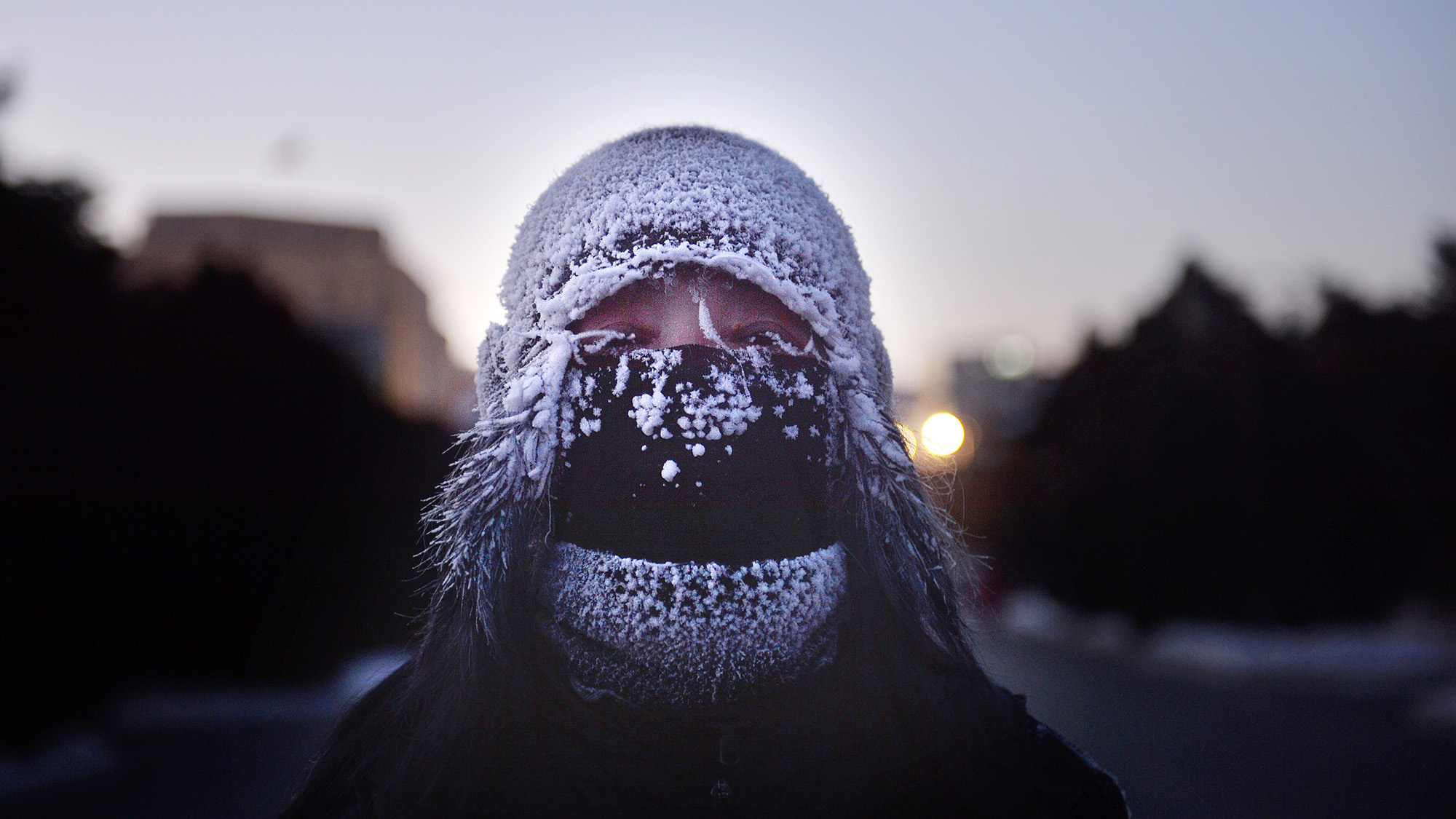
Winter is not for the faint of heart. In Moscow, January temperatures hover in the low teens. In New York City, skyscrapers turn Manhattan into a series of freezing wind tunnels. In Sapporo, Japan, the average snowfall is almost 200 inches each winter.
Even so, humans have developed plenty of clever ways to wait out the cold. But what would happen if instead of bundling up inside with a hot chocolate, you were left in the frigid cold—just how cold can humans get and recover? Well in a new episode of Popular Science’s Ask Us Anything podcast, we explore just that.
Ask Us Anything answers your most outlandish, mind-burning questions—from the everyday things you’ve always wondered to the bizarre things you never thought to ask. So, yes, turbulence is like jello and no, cracking your knuckles won’t cause arthritis. If you have a question, send us a note. Nothing is too silly or simple.
This episode is based on the Popular Science article “The coldest body temperatures humans have survived.”
Subscribe to Ask Us Anything
Listen and follow Ask Us Anything on your favorite podcast platform:
Spotify | Apple Podcasts | YouTube | Or wherever you get your podcasts.
Full Episode Transcript
Sarah Durn: We’ve all been there. You get all bundled up in a long winter coat and scarf, throw on a hat and gloves, and brace yourself to go outside into the frigid winter weather. But then the moment you step outside, the air stings your face because it’s fricking cold.
Immediately your body gets to work. Blood vessels constrict to keep blood around your core.
You start to shiver and your muscles get really tense. Then you finally make it to your destination and blissfully step inside. The air is like a warm bath. And you think, “just three more months of this.”
But what would happen if you had stayed outside? Just how long can the human body survive in the extreme cold?
Welcome to Ask Us Anything from the editors of Popular Science, where we answer your questions about our weird world. From “Why cats lick you,” to “How pilots avoid thunderstorms,” no question is too outlandish or mundane.
I’m Sarah Durn, features editor at PopSci.
AC: And I’m editor-in-chief, Annie Colbert.
SD: Here at Popular Science, we love obsessing over strange, weird questions.
AC: And this week our curiosity has led us to the chilling question: just how cold can humans get and still survive? Sarah, you recently edited a story about the lowest survivable body temps, so how cold can us humans go?
SD: So in some wild cases, people have survived a core temperature as low as 53 degrees Fahrenheit.
AC: Ugh.
SD: I know! That’s 45 degrees colder than our normal body temperature of 98.6.
AC: Ugh. Bur. When we were talking about this episode, I was thinking about the coldest I’ve ever been, and I think it was in Poland in January many years ago.
I had stepped into a slushy puddle at the beginning of this two-hour, outside-only tour in Gdansk, and I should have just stepped into a coffee shop or something to warm up, but I was very, very cold.
SD: Oh, no, that sounds awful. Especially for something you’re like choosing to put yourself through.
AC: Yes.
SD: Yeah. I think for me, I just remember getting so fricking cold skiing growing up.
My dad would always say, “one more run, guys, come on!” And we’d just be so cold and shivering. Especially going up the lift and just getting pummeled with wind and snow.
AC: Yeah. Sometimes dads, they’re pushing you to push through and it’s too cold.
SD: It’s too cold.
AC: So cold. And so these cases we’re gonna talk about where people survived core temps in the fifties are rare, right?
SD: Oh yeah, definitely. Many people have died from hypothermia after their internal body temperature has dropped, even just below 90 degrees.
AC: Oh, wow.
SD: Yeah. And crazier still the person who actually survived a 53 degree body temp was only a toddler.
AC: Oh my God. As the parent of a toddler, I feel terrible for those poor parents. How on earth did this child survive?
SD: I’ll tell you all about it after a short break.
AC: Aw man, cliffhanger.
SD: I know! Sorry.
AC: But before we take that break, we wanna know: what questions are keeping you curious? If there’s something you’ve always wanted to understand better submit your questions by clicking the “Ask Us” link at popsci.com/ask.
Again, that’s popsci.com/ask and click that “Ask Us” link.
SD: We can’t wait to hear your questions!
AC: And with that, we’ll be right back after a short break.
Welcome back. Okay. Before we get into the science of just how cold humans can get, I wanna zoom out for a second because hypothermia might seem like a modern medical term, but humans have been dealing with extreme cold for basically forever.
SD: Yeah, this is not a new problem.
AC: Not at all. Ancient writers describe soldiers freezing sailors perishing, quote “by reason of cold,” armies collapsing during winter campaigns, but there wasn’t a diagnosis.
There wasn’t even a word for hypothermia until the late 1800s.
SD: Yeah. And even then, doctors didn’t always recognize it, right?
AC: Correct. During Antarctic exploration in the early 1900s, think Sir Ernest Shackleton, Robert Falcon Scott, hypothermia wasn’t even mentioned, but descriptions of hypothermia symptoms are there: confusion, poor judgment, people wandering off in storms, what one explorer called “a half thawed brain.”
SD: Huh. Why did it take so long for the condition to be defined?
AC: One big reason is thermometers.
SD: Okay, tell me more.
AC: So thermometers weren’t really used in medicine until the late 1800s, and even then doctors were much more focused on fevers than dangerously low temps.
That starts to change around the 1900s.
SD: So once we could accurately measure body temperature, we started understanding just how low the human body can get.
AC: Precisely. So Sarah, can you tell us what exactly is hypothermia?
SD: Yeah. Hypothermia is a condition that occurs when your body loses heat faster than it can produce it, causing your core body temperature to drop below 95 degrees Fahrenheit.
AC: So just a bit below normal body temperature of 98.6.
SD: Right. Humans are considered homeotherms, which just means we’re built to keep our core body temperature steady, right at that 98.6 degree mark.
AC: So how exactly does hypothermia affect the body?
SD: Yeah, so mild hypothermia can make people confused, clumsy, and (this one surprised me a bit) hungry. Because your body is using so many calories to try and stay warm.
AC: Mm-hmm.
SD: Usually at that point, if you just move inside and start to warm up, you’ll be okay. But if your body temperature continues to drop further, heart rate and breathing slow, and in some severe cases, below an 82 degree body temp, the body starts shutting systems down.
AC: Which makes it all the more unbelievable that anyone survives below that.
SD: Right. And yet there are a few extraordinary cases where people did.
AC: Hmm. All right. Let’s talk first about the adult record holder for surviving low body temperatures.
SD: Yeah, let’s do it. So that would be Anna Bågenholm. In 1999 she was skiing in Norway, fell through the ice, and became trapped in near freezing water for about 90 minutes.
AC: Huh.
SD: I know. By the time rescuers reached her, she was clinically dead. No heartbeat, no breathing.
AC: Oh, that’s terrifying.
SD: Her core body temperature had dropped to about 56 degrees Fahrenheit, the lowest ever survived by an adult outside a hospital.
AC: Ah, so how did she survive that?
SD: Yeah. Well, a few things just lined up perfectly.
She was trapped in an air pocket so she could still breathe as her body cooled. And as her temperature dropped, her brain’s need for oxygen dropped too. Doctors hooked her up to a heart lung machine, and warmed her very slowly over several hours. She spent weeks in intensive care, but made a full recovery.
AC: Oh, I can’t believe that really happened.
SD: I know, me neither.
AC: But then there’s a case that beats even that record.
SD: Yeah, so this toddler.
AC: Oh no.
SD: I know. In 2014, there was a 2-year-old boy in Poland who wandered outside, wearing only a pajama top and socks. He was missing for several hours in temperatures around 19 degrees Fahrenheit.
When rescuers found him, his body temperature was just over 53 degrees Fahrenheit.
AC: That number is still so shocking to me.
SD: Yeah, same. His body was so stiff, they couldn’t even intubate him at first. Like Anna, he was connected to life support and rewarmed very gradually. And after two months in the hospital, he survived with no lasting physical damage.
AC: So intense. So what’s actually happening inside the body at these extreme temperatures? Why doesn’t everything just kind of stop forever?
SD: Yeah. The key thing is that cold slows everything in your body. This includes harmful processes like inflammation and cell death. Also at normal temperatures, the brain needs a constant supply of oxygen.
But as the body cools, that demand drops dramatically. So in very specific situations, especially cold water or rapid cooling, the brain can survive much longer without oxygen than it normally could.
AC: Hmm, fascinating. So do doctors ever use hypothermia on purpose?
SD: Yeah, they do. By the mid 20th century, surgeons realized they could cool patients during heart or brain surgery to protect vital organs.
Today induced hypothermia is sometimes used after cardiac arrest to reduce brain damage.
AC: Ah, so cold went from being the enemy to a medical tool.
SD: Yeah. Though a very carefully controlled one.
AC: Yes. Of course.
SD: Hypothermia is still very bad, very dangerous.
AC: Yes.
SD: Outside of a hospital, most people don’t survive these conditions. The takeaway is not humans are secretly freeze-proof.
AC: Yes. It’s more like under extremely rare circumstances, cold can buy the body a little bit more time.
SD: Exactly.
AC: This has made me feel even colder and even more paranoid about forgetting my mittens at home.
SD: Me too. And all this got me thinking, you know, “what are the coldest places humans choose to live on earth?”
AC: Hmm. Oh man. I might need more than mittens for this.
SD: I think you might. That’s coming up after this quick break.
Welcome back! To wrap up, let’s shift gears a bit and take a look at some of the planet’s coldest places.
AC: Okay, I’m already cold just thinking about this. Hit me.
SD: Yeah. So the coldest, inhabited place on Earth is generally considered Oymyakon in Eastern Siberia. Hopefully I’m saying that right. It’s a village where people live year round and winter temperatures regularly drop below minus 60 degrees fahrenheit.
AC: Nope. No thank you. That’s not for me. I will say I genuinely enjoy winter, but nope, that’s definitely not for me.
SD: Yeah, me neither. When it’s that cold, cars can’t be turned off or they won’t start. Kids still go to school unless it’s colder than about minus 50 degrees Fahrenheit. And people almost entirely rely on meat and fish because nothing grows there in winter.
AC: Oof. I thought taking my kid on the New York City bus to school in single digits was hard, but you know what? Good on them.
SD: I know it’s pretty badass. And then if we’re talking uninhabited places, Antarctica takes the crown, obviously.
AC: Mm-hmm.
SD: The coldest temperature ever recorded on Earth was minus 128 degrees Fahrenheit.
AC: Brr!
SD: I know. That was measured in 1983 at the Vostok Russian research station.
AC: That number doesn’t even feel real, and it’s making my soul feel cold.
SD: I know, mine too. Ugh, at that kind of temperature, exposed skin can freeze in seconds. And the human body cannot survive without serious protection.
AC: Which really puts all these survival stories we talked about today into perspective.
SD: Yeah, totally. Our earth is wonderful, but it can also be terrifying, and humans are surprisingly resilient and innovative when it comes to surviving the planet’s extremes.
AC: That feels like a good note to wrap up on today.
And that’s it for this episode, but don’t worry, we’ve got more fabulous Ask Us Anythings live in our feed right now. Follow or subscribe to Ask Us Anything by Popular Science, wherever you enjoy your podcasts. And if you like our show, leave a rating or review.
SD: We care what you think. Our theme music is from Kenneth Michael Reagan, and our producer is Alan Haburchak.
This week’s episode was based on an article written for Popular Science by RJ Mackenzie.
AC: Thank you team, and thank you to everyone for listening.
SD: And one more time. If you want something you’ve always wondered about, explained on a future episode, go to popsci.com/ask, and click the “Ask Us” link. Until next time, keep the questions coming.
AC: Stay warm out there, everyone.
SD: Yeah. Bundle up.
AC: Woo. Bundle up so you don’t freeze.
