
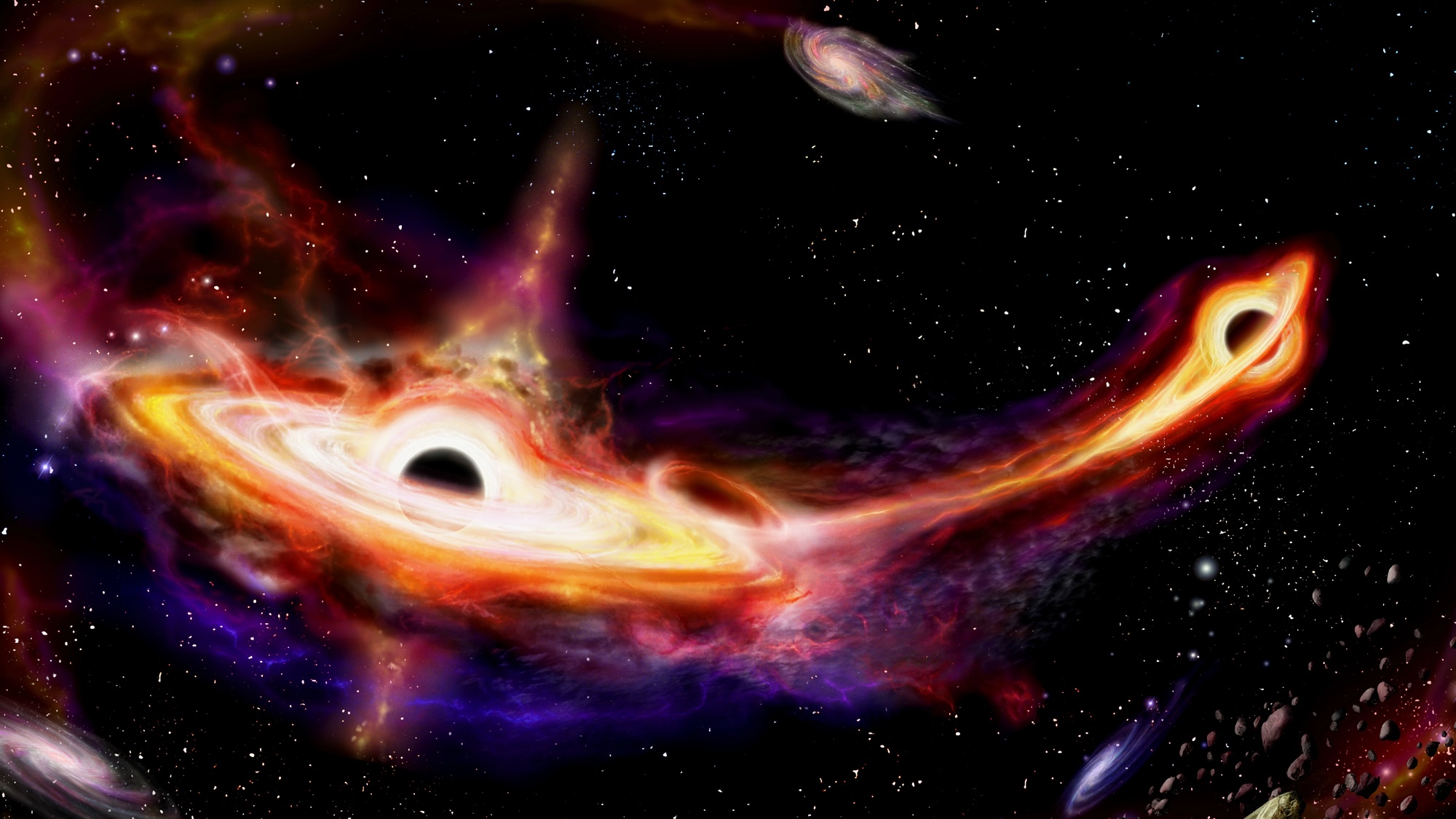
Supermassive black holes literally don’t add up. Astrophysicists know it takes more time than is mathematically possible for one of them to reach its incomprehensible proportions via standard gas accretion. Despite this, they are clearly observable at the center of nearly every large galaxy. So how do they get so big?
The likeliest explanation is that supermassive black holes attain their size when two smaller black holes smack into one another during a galactic collision. For years, this theory has remained simply that—a theory. However, evidence from a team at Germany’s Max Planck Institute for Radio Astronomy now offers the first clear look at a pair of supermassive black holes at the heart of a distant galaxy. As they explain in a study published in the journal Monthly Notices of the Royal Astronomical Society, the duo is racing towards a head-on collision.
Markarian 501 (Mrk 501) is an elliptical galaxy located in the Hercules constellation, and the site of the breakthrough. Researchers recorded a spectrum of radio frequencies during dozens of observations over 23 years. Like many other galaxies, Mrk 501 features a jet of supercharged particles ejected from a black hole at nearly the speed of light. Mrk 501’s jet is particularly bright because it points towards Earth, making it easy to study.
Researchers started noticing something peculiar over the years of observational data. Although oriented in a different direction, it became increasingly clear that there wasn’t one, but two jets emitted from the heart of Mrk 501. In a matter of weeks, astronomers tracked the second jet as it started behind the first one, then proceeded to move counterclockwise around it. In June 2022, the radiation appeared so crooked that it looked almost circular—a situation known as an Einstein ring. The researchers believe the likeliest explanation for this was that the system was briefly, perfectly aligned towards Earth. During that time, gravitational lensing from the first black hole bent the second jet’s light behind it.
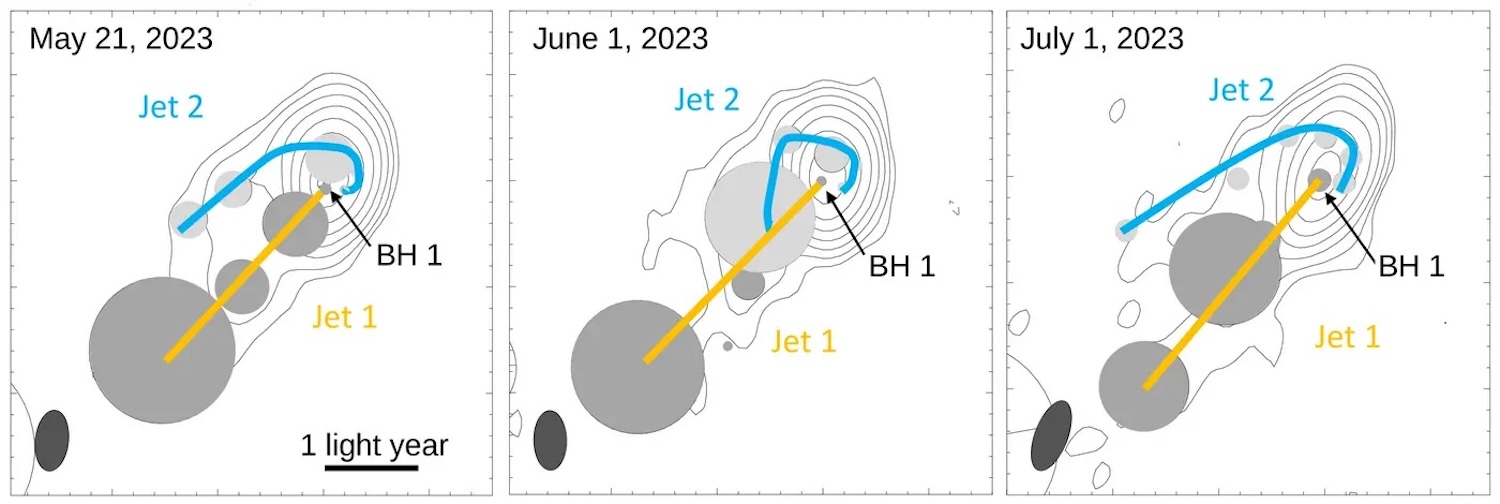
“We searched for it for so long, and then it came as a complete surprise that we could not only see a second jet, but even track its movement,” study coauthor and astronomer Silke Britzen said in a statement.
After multiple repeating brightness cycles, Britzen and colleagues estimated the black holes orbit each other once every 121 days. The distance between them is 250–540 times farther than Earth’s distance to the sun. That may sound like a lengthy separation, but it’s actually incredibly close for cosmic objects possessing masses anywhere between 100 million and 1 billion times that of our sun. They’re already so near one another that it’s possible they merge a century from now.
Unfortunately, no one will likely ever witness the actual grand finale. At more than 440 million light-years away from Earth, the two black holes are inseparable even when seen through astronomy’s most advanced tools. This will only become more difficult to see as they move closer to one another. That said, the dual jet emissions remain the strongest evidence so far that supermassive black holes grow by combining forces. If true, the pair should eventually start emitting extremely low-frequency gravitational waves that are detectable—providing even more evidence of the astounding meetup.
