
Here’s a fun (and creepy) fact: The Earth is home to approximately 20 quadrillion ants. To put zeroes on it, that’s around 20,000,000,000,000,000 of the six-legged insects living all around us. How did such diminutive creatures attain their prominent—and ecologically vital–role on the planet?
According to one team of entomologists, the answer may be an evolutionary preference for quantity of quality. Their findings are explored in a study published today in the journal Science Advances, and may help explain genetic complexities in much bigger animals.
“Ants are everywhere,” University of Cambridge zoologist and study co-author Arthur Matte explained in a statement. “Yet the fundamental biological strategies which enabled their massive colonies and extraordinary diversification remain unclear.”
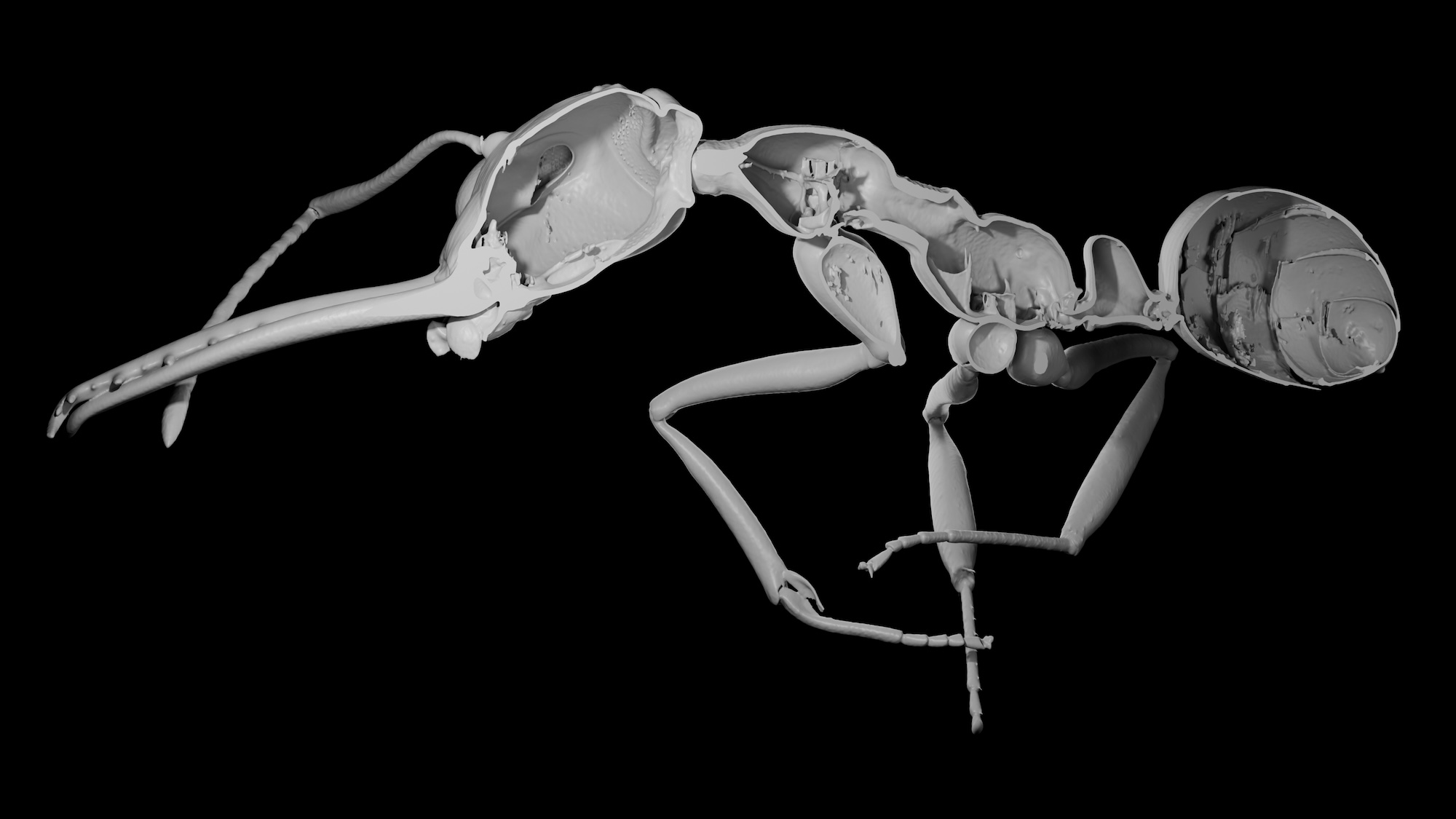
To investigate, Matte and his collaborators focused on each insect’s cuticle. For humans, a cuticle usually refers to the thick, protective layer of skin near fingernails and toenails. Ants grow a cuticle layer over their entire exoskeleton. Aside from guarding them against predators, disease, and drying out, an ant’s cuticle acts as structural support for their muscles.
However, these benefits aren’t free. Cuticles require a lot of nutrients to maintain, particularly rarer elements like nitrogen and multiple minerals. The thicker the cuticle, the more food an ant needs. Scale that up, and it can possibly cap a colony’s total population. This underlying principle also extends far beyond bugs.
“There’s this question in biology of what happens to individuals as societies they are in get more complex,” added study co-author and University of Maryland entomologist Evan Economo. “For example, the individuals may themselves become simpler because tasks that a solitary organism would need to complete can be handled by a collective.”
Knowing this, Matte, Economo, and their team hypothesized there may be a correlation between ant colony sizes and their cuticle makeup. To test this, they parsed a dataset of 3D X-ray scans for over 500 ant species, paying close attention to the ratios between cuticle and body volumes. The researchers ultimately identified that the ants’ body mass-to-cuticle composition ranged as widely as 6 to 35 percent. From there, they funneled this information into various evolutionary models and discovered that ant species with less cuticles usually lived in larger colonies.
“Ants reduce per-worker investment in one of the most nutritionally expensive tissues for the good of the collective,” said Matte. “They’re shifting from self-investment toward a distributed workforce, resulting in more complex societies.”
Matte likened the trade-off to the evolution of multicellular life. While cooperative units are technically simpler than a single cell, they add up to a much more complex, single organism.
The authors also noted that less cuticle support may be associated with higher diversification—a facet biologists frequently use to measure an organism’s evolutionary success. Although they don’t have a concrete explanation, the team believes that it may have to do with granting ants the ability to venture into new habitats with fewer nutrients.
“Requiring less nitrogen could make them more versatile and able to conquer new environments,” explained Matte.
This further suggests that what’s good for the colony isn’t necessarily good for the individual ant. It also may have initiated an evolutionary feedback loop over countless generations. Despite each ant’s increased vulnerabilities, their overall numbers produced larger colonies with robust disease control and nest defense traits. But the latest findings don’t only relate to ants—they can be seen throughout history and in everyday life.
“The tradeoff between quantity and quality is all around. It’s in the food you eat, the books you read, the offspring you want to raise,” said Matte.
