
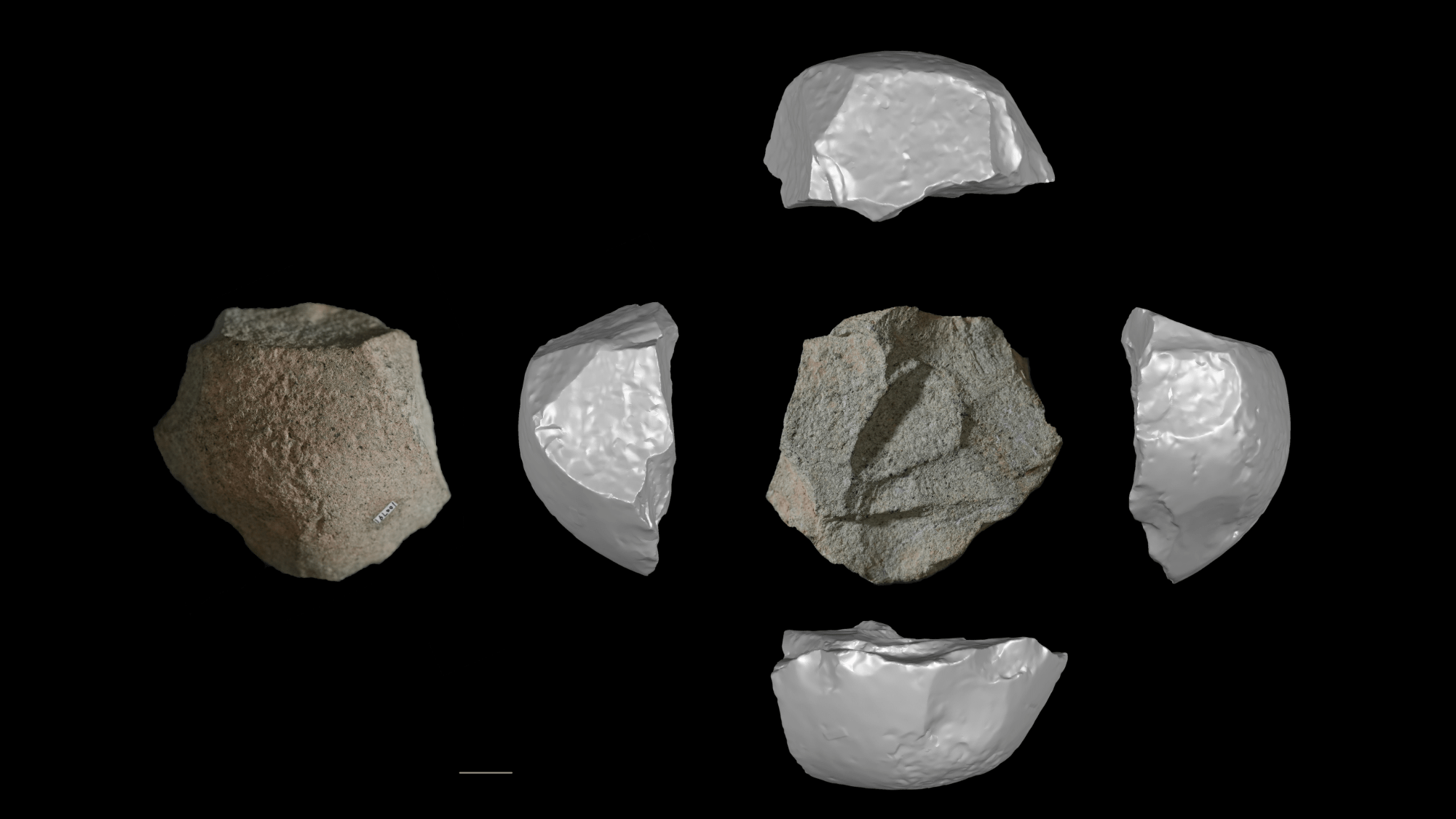
A remarkable collection of ancient stone tools proves that human creativity can thrive in challenging times. The complexity of the stone tools found amidst the bones of butchered animals in central China demonstrate an elevated level of intelligence and creativity. Early humans forged the tools during an ice age 146,000 years ago, not during the relative ease of a warm period. According to a study published today in the Journal of Human Evolution, this challenges the idea that the early humans could not innovate.
“People often imagine creativity as something that flourishes in good times,” Yuchao Zhao, a study co-author and the assistant curator of East Asian archaeology at the Field Museum in Chicago, said in a statement. “Finding out that these stone tools were made during a harsh ice age tells a different story. Hard times can force us to adapt.”
A distant human cousin
The stone tools were found at the Lingjing archaeological site in central China. An early human species called Homo juluensis, a cousin of our own species, occupied the area. While they went extinct about 50,000 years ago, Homo juluensis had a very large brain size and traits seen in both eastern Asian archaic humans and Neanderthals in Europe.
Until recently, archaeologists believed that ancient humans in East Asia during the late Middle Pleistocene (300,000-120,000 years ago) did not make many significant technological advances, compared to the early humans living in Europe and Africa. However, the Lingjing stone tools tell a different story.
The disc-shaped stone cores at Lingjing were part of a detailed, carefully organized tool-making process. Homo juluensis built them by striking small stones against larger stone cores. Some of the cores were wired evenly on both sides. Other cores were more carefully built. One side was primarily a surface to strike from. The other side was shaped to produce sharp flakes.
According to the team, these asymmetrical cores are especially important. They indicate that prehistoric humans were not just knocking off pieces of a stone at random. Instead, they were managing the core as a three-dimensional object, where surfaces have different roles, while keeping the right angles for producing useful flakes.
Related Stories
“This was not casual flake production, but a technology that required planning, precision, and a deep understanding of stone properties and fracture mechanics,” said Zhao. “The underlying logic of this system—and the cognitive abilities it reflects—shows important similarities to Middle Paleolithic technologies often associated with Neanderthals in Europe and with human ancestors in Africa, suggesting that advanced technological thinking was not limited to western Eurasia.”
The stone artifacts left behind by the Homo juluensis’ living at Lingjing suggest that they were capable of complex thought and creativity. However, this story further complicates a shift in the timeline of how long ago these tools were made.
Aging bones
Homo juluensis at Lingjing would butcher animals like deer, with their bones found alongside the stone tools. A rib from a deer-like animal found at Lingjing contained several glittering calcite crystals—an important particle for dating objects. Calcite crystals have trace amounts of uranium, which degrades into another element called thorium over time. Scientists can then tell the age of the crystal by measuring the ratio of uranium to thorium present inside of a calcite crystal.
“The calcite crystals inside the bone acted like a natural clock, allowing us to refine the age of the site,” says Zhao.
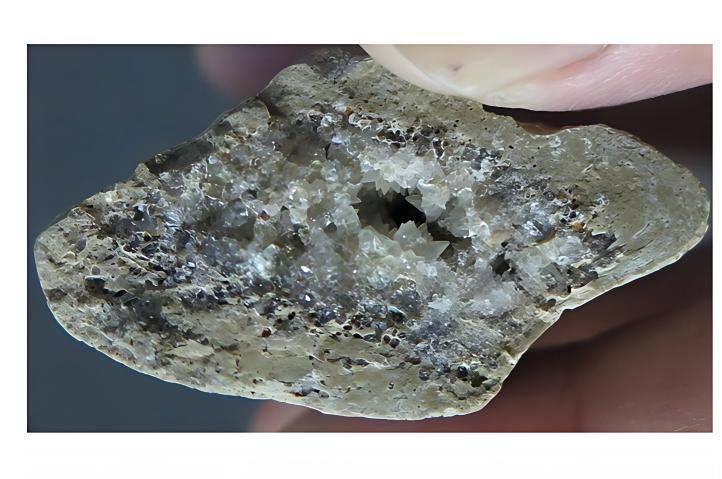
Based on this new analysis, the team believes that these tools date back about 20,000 years older than scientists once believed. While 20,000 years doesn’t sound like a huge amount of time in the grand scheme of things, it’s an important difference. They were likely made during a harsh and cold ice age instead of a warm period. With this new timeline, these tools were likely adaptations for surviving hard times.
“Altogether, this research reveals a much richer story of innovation, intelligence, and human evolution in East Asia,” says Zhao.
