
It may always be beneath our feet, but moss has intertwined with human history for thousands of years. Indigenous cultures often harvested the plants for bedding material and structural insulation. Europe’s oldest natural mummy, Ötzi the Iceman, died with moss packed into his boots for warmth. Meanwhile, scotch whisky wouldn’t even exist without the decaying power of peat—a terrifying thought, if there ever was one.
More recently, botanists have begun to stress one of the plant’s most underutilized uses: its ability to solve crimes. Take the case laid out in a study published today in the journal Forensic Sciences Research. According to botanists at the Field Museum in Chicago, moss helped close a 17-year-old grave robbing case that rocked the town of Alsip, Illinois.
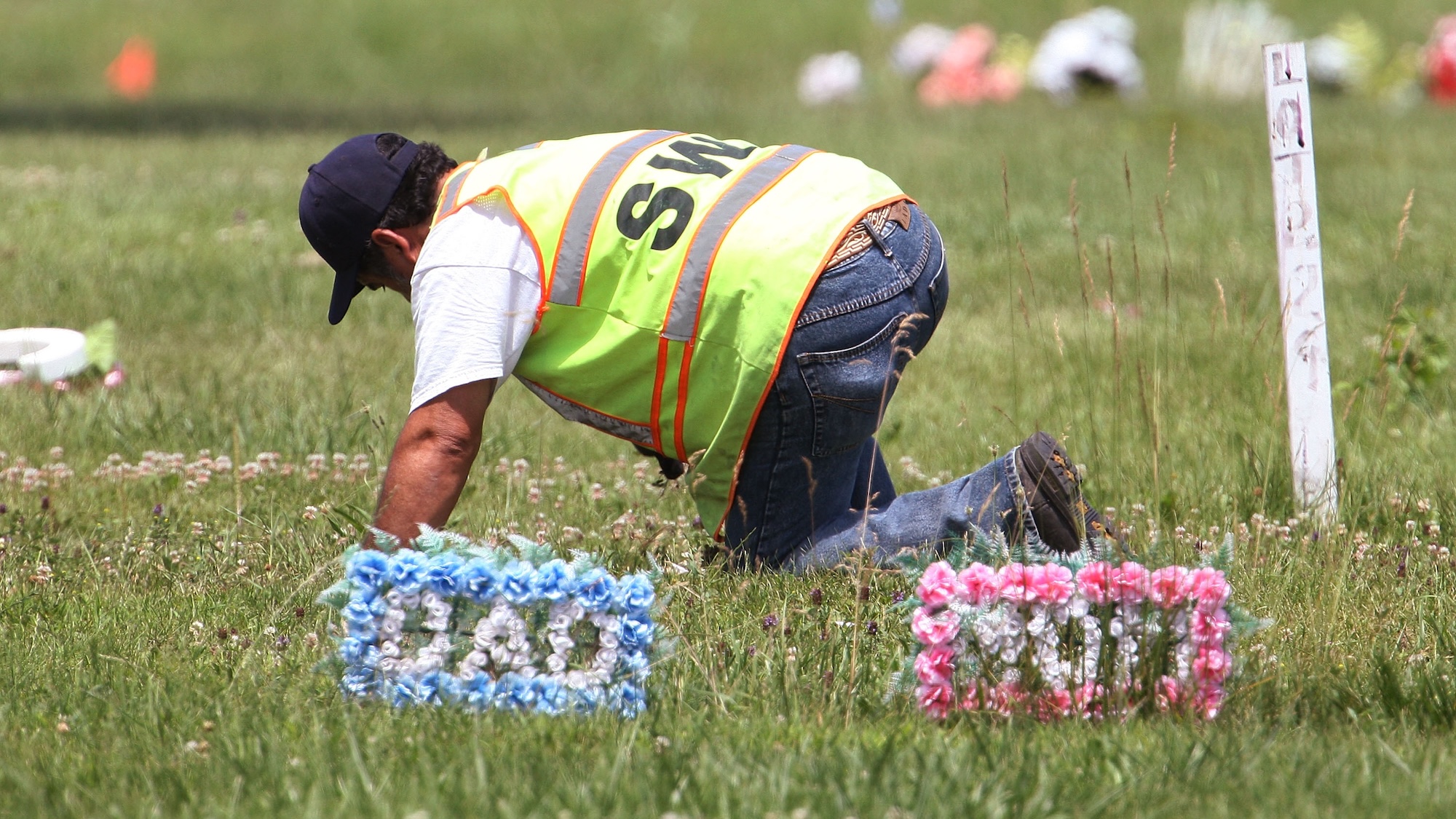
In 2009, employees Burr Oak Cemetery employees were accused of digging up old graves, emptying their remains in various locations around the grounds, then reselling the burial plots to newly grieving families. National attention quickly followed news of the crime. Burr Oak, a historic Black cemetery, includes the gravesites of civil rights figure Emmett Till, blues musician Willie Dixon, and First Lady Michelle Obama’s father, Fraser Robinson. During the subsequent investigation, FBI agents reached out to Matt von Konrat, the Field Museum’s head of botany collections, for help.
“The investigators wanted to know what kind of moss it was, and how long it had been buried in the soil,” von Konrat explained in a statement.
The moss in question was found about eight inches below the topsoil near some of the cemetery’s reburied human remains. Specifically, the FBI needed to learn the exact moss species, its age, and where it grew in the cemetery. It was easy enough to pinpoint the species as Fissidens taxifolius, or common pocket moss. The rest of the information required a field trip to Burr Oak Cemetery.
“We did a survey of the different kinds of mosses growing near the crime scene, and that species of moss was not growing there,” said von Konrat. “When I surveyed the rest of the cemetery, we found a huge colony of that species of moss growing in the same area where the investigator suspected the bones had been dug up from.”

The sample’s age was also extremely important. Defendants claimed that other workers likely committed the crimes before they started working at the cemetery. Since the moss was found next to the disturbed remains, it stood to reason that its age would help clarify the overall timeline. Luckily for investigators, the plant has some appropriately spooky attributes.
“Moss is a little bit freaky,” von Konrat said. “Mosses have an interesting physiology, where even if they’re dry and dead and preserved, they can still have an active metabolism, a few cells that are still active.”
Similar to the radiocarbon dating of fossils, the level of metabolic deterioration in moss can reveal to botanists when the plant was harvested or moved. To analyze this, von Konrat’s team compared the amount of chlorophyll in the sample with various museum specimens collected across a range of ages. They then concluded the cemetery evidence was only a year or two old—and was definitely reburied during the accused employees’ tenure at the cemetery. With the help of that tiny clipping of moss, the defendants were eventually convicted of desecrating human remains in 2015.
This isn’t the first time von Konrat has praised the crimefighting capabilities of moss. Last year, his team published a review of 150 years’ worth of cases around the world in which moss helped bring culprits to justice.
“Mosses are often overlooked, and we hope that our research will help raise awareness that there are other plant groups out there, apart from flowering plants, and that these serve a very important role in society and around us,” said von Konrat.
