
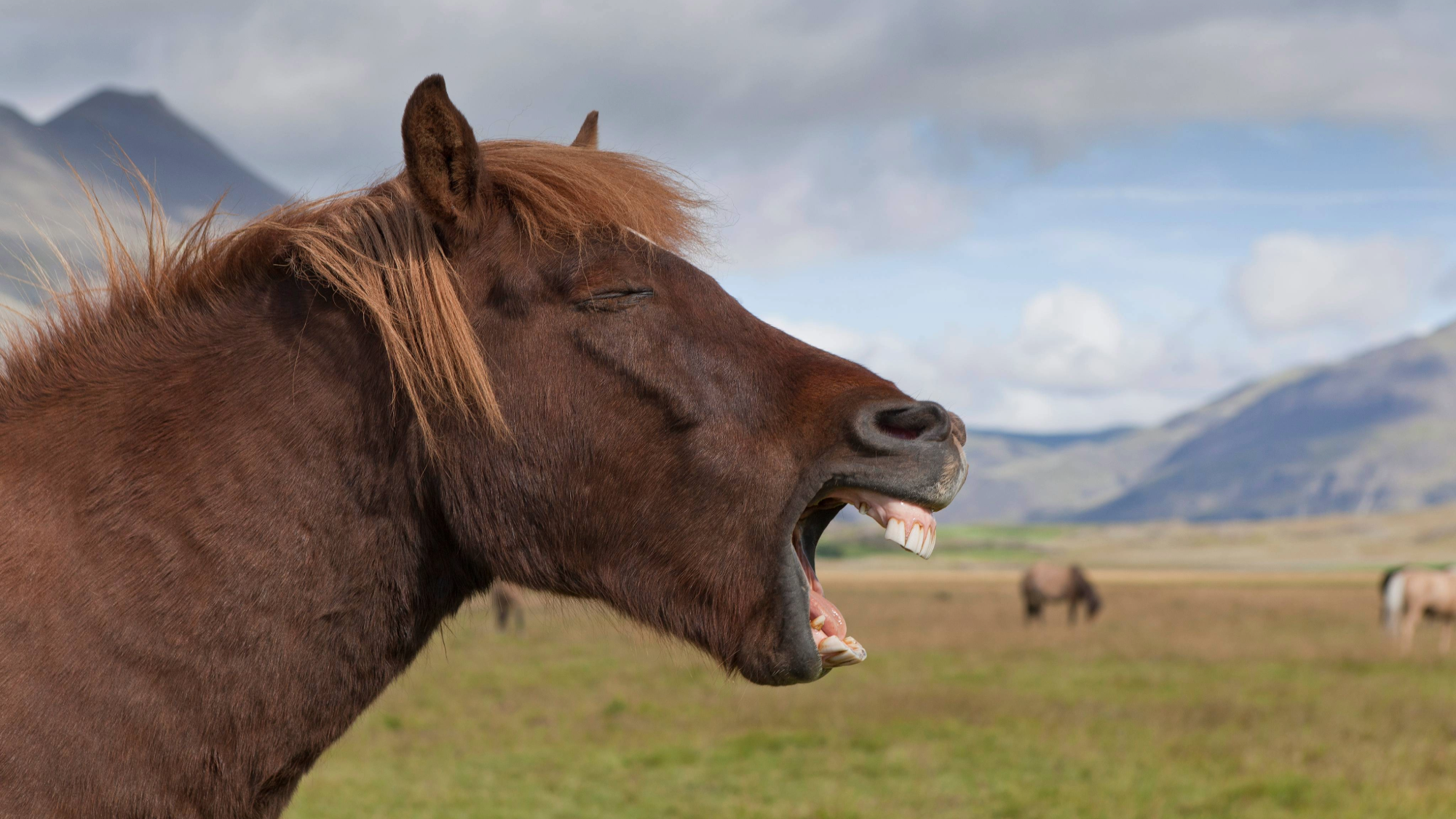
A horse’s whinny is an iconic sound, arguably on par with a cow’s moo and a sheep’s baa and a donkey’s hee-haw. Most people can immediately recognize a horse’s signature sound, so it might come as a surprise to learn that researchers have no idea how the animals actually produce some of the whinny sounds. That is, until now.
“Although humans have been co-existing – and co-evolving – with horses for 4000 years, we still understand their communication imperfectly,” Elodie Floriane Mandel-Briefer, a biologist at Copenhagen University interested in vocal communication and cognition in birds and mammals, tells Popular Science. “The whinny in particular is strange: it has a low-frequency component that fits the large body size of horses, but a very high-frequency component as well that is way too high for such a large animal.”
About 10 years ago, Mandel-Briefer and colleagues discovered the existence of the two pitches, which overlap to create a vocal phenomenon called biphonation. The low-frequency component is produced when air from the lungs causes vibrations of the vocal folds. This is also how humans, along with the majority of mammals, make sounds.
However, normal vocal fold vibrations can’t explain the high-frequency part of whinnies, given how big horses are. So how are these animals making such high noises? Mandel-Briefer and co-authors investigated this biomechanical puzzle in an interdisciplinary study recently published in the journal Current Biology. They ultimately discovered that a laryngeal whistle is behind the whinnies’ high-frequency sound. Part of their work involved two of the authors blowing air through horse larynges secured from a horse meat supplier.
“Initially they only got the low component, but with some playing around they were able to obtain the high frequency component as well. That showed that both components are produced by the larynx itself (not, as in human whistling, with the lips),” Mandel-Briefer explains. “To prove that the high component is a laryngeal whistle, they then blew two different gases through: air and helium. Because it has different physical properties, helium—compared to air—shifts whistle frequencies up, while frequencies emitted by tissue vibration (like the low component) do not change.”
The frequency change confirmed that a laryngeal whistle explains the mechanical production of the high-frequency whinny component. More broadly, the team found that horses create biphonation by simultaneous vocal fold vibration and laryngeal whistling. As far as they know, horses are the only animals that use these two mechanics at the same time. The team proposes that their biphonation probably evolved to communicate multiple messages to each other at once.
In a 2015 study, Mandel-Briefer and colleagues also demonstrated that frequency and emotion are connected. The high-frequency whinny component indicates that a horse’s emotion is pleasant or unpleasant. The low-frequency components represent the feeling’s intensity. Horses could also use two components to convey messages across varying stretches of space. The high component is louder and can travel farther.
While Przewalski’s horses, which are close relatives of domesticated horses, also create whinnies with biphonation, more distant relatives such as zebras and donkeys don’t seem to have the high frequency part. Horses might possess distinctive vocal adaptations enabling them to create a more plentiful and intricate call spectrum than fellow mammals.
The paper “highlights the remarkable adaptive flexibility of the mammalian laryngeal vocal production system,” Mandel-Briefer concludes. “Understanding the communication system of any species is of fundamental scientific interest to help us understand their cognition, emotions and welfare, and this helps us understand horses better.”
