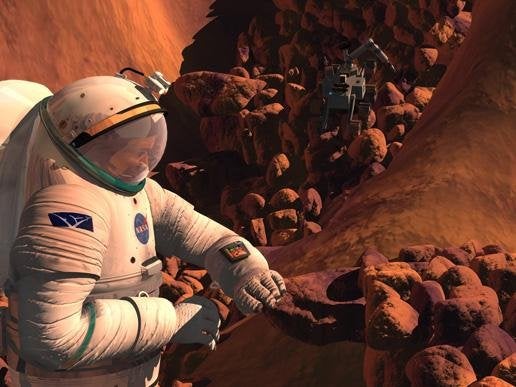
Here’s some optimistic news: 71 percent of Americans are confident humans will get to Mars in 20 years, according to a new poll. Here’s some disappointing news: Americans think NASA gets way more of the federal budget than it really does.
A nonprofit advocacy group called Explore Mars teamed up with a PR firm to gauge public opinion about Mars exploration. Americans are confident we’ll get there eventually, and once they were told there are currently two operational NASA rovers on the planet, 67 percent of people agreed the U.S. should send both humans and robots there.
Interestingly, the poll found that on average, people think NASA spending accounts for 2.4 percent of the federal budget. It’s really more like 0.5 percent. When people were told the real number, they overwhelmingly agreed, strongly or just "agreed," that it’s worthwhile to increase NASA’s budget to a nice, whole 1 percent to finance this expected trip.
People think the biggest barrier to getting to Mars is affordability--73 percent said that--while 67 percent think politics are a major hurdle. Technological capability and motivation aren’t seen as major obstacles.Why should we go there? The top three reasons are to understand Mars better, to search for life, and to maintain U.S. leadership, according to respondents. “This is a wakeup call to our leaders that Americans are still explorers,” said Chris Carberry, Executive Director of Explore Mars, in a statement.
The poll questioned 1,101 people between Feb. 4 and Feb. 6. It will be a few weeks until we can see the full polling data, which will explain how the answers break down across demographics. It will also be interesting to see how these questions were phrased. But still, it’s good to know people think we can do it. Now to pay for it....
Five amazing, clean technologies that will set us free, in this month's energy-focused issue. Also: how to build a better bomb detector, the robotic toys that are raising your children, a human catapult, the world's smallest arcade, and much more.


Online Content Director: Suzanne LaBarre | Email
Senior Editor: Paul Adams | Email
Associate Editor: Dan Nosowitz | Email
Assistant Editor: Colin Lecher | Email
Assistant Editor: Rose Pastore | Email
Contributing Writers:
Rebecca Boyle | Email
Kelsey D. Atherton | Email
Francie Diep | Email
Shaunacy Ferro | Email
I'm suprised the major reasons didn't include colonization.
It may not be NASA funding it, with the private sector starting to cast their gaze to space, I'd say redbull has a better chance to get us to Mars than NASA does at this rate. Oh and not to make fun of NASA, I love the work NASA does its just a shame that budget for NASA is something like 1 of 1% of the national budget. If we took like 5% out of the defense budget NASA could afford a manned mission to Mars in that time frame.
By the way I'm not specifically saying Redbull will have a space program just an example.
" I think therefore I am"
United States total military budget: 711.0 billion dollars in 2011.
NASA total Budget: 18.4 billion (or not even 2.6 percent of US military).
Now imagine if the military and NASA budgets were combined and split 50/50.
The US military would get 364 Billion, and STILL have more to spend than (the next four biggest spenders) China, Russia, UK, and France COMBINED. Yes, the US would still be top dog.
NASA would then also get 364 Billion, about 20 TIMES more than it gets now.
Imagine the possibilities!
In addition, more of the total amount would be spent in the USA (rather than overseas bases), resulting in a net boost to the US economy. More US civic pride (bases on Mars) and less international resentment towards the US (fewer overseas bases).
www.en.wikipedia.org/wiki/List_of_countries_by_military_expenditures
Few things:
I worked for NASA this past summer, and one of the primary guys in charge of planning the next NASA launch gave a small group of us an in-depth plan.
Going to MARS by 2030. To orbit it, and control rovers in real-time for scientific inquiry. And to not to land. Over the next 20 years, we are going to make the great accomplishment of reducing the time-lag to control the rovers by 16 whole minutes!
In 1950 we weren't in space. 1960 we weren't really in space. 10 years later we made it to the moon. 20 years later, we sent robots to explore our solar system and land on our closest planetary neighbor. 40 years after that, we're lowering the time-lag on said robots. Noticing a pattern here?
I personally do not think NASA will go back to space. As great as it was in the past, it is terribly underfunded, and volatile due to how politicized it has become. Anyone who says NASA has a plan for 10 years out is selling you something; because they tend to scrap half of what they are doing every 4 or 8. It's just how it goes.
Constellation was canceled, and nothing new will replace it. It will be attempted, run over-time and over-budget, and be cut. Especially now that politicians and the public themselves can point to companies like SpaceX and say "they are doing it more successfully at 1/3 the cost! Just hire them!". NASA is just too bogged down with bureaucracy (ie inefficiency).
Elon Musk will go to Mars by 2030. A Private guy who looked up at a dot in the sky and said: "Hmm, I'd like to visit there." And he's about half way there. He is going to do it. A bunch of private citizens are going to another planet through nothing but their own hard work and initiative.
In America, (for those foreigners who love to post "'Merica") private, individual people can decide to do the impossible, group up with other dreamers, and do it. And if you don't believe me, compare the number of Swedish Patents to American Patents. Or look for where your new medical advances come from. Or your new home gadgets.
With Elon Musk goes the idea of America. Which is all America really is. And so America will make it to Mars by 2030.
But NASA will not. At best they will hitch a ride.
@brian144
+1
---
(Type 0.72) = We are still just cleaver monkeys!
The whole world expects a human mission to Mars in 20 years.
They just don't necessarily expect NASA to lead it.
I thought that was obvious.
HEYO!
to mars or bust!
Yo, vt007, we are more than cleaver monkeys. We were created by God. And we were made to be superior to other creatures of the earth.
"we were made to be superior to other creatures of the earth."
and also slaves to our alien overlords.
From start to finish, the Apollo program only took about 8 years to put a man on the lunar surface and bring him back safely. But it has been almost 40 years since NASA has sent an astronaut beyond low earth orbit. Are we supposed to believe that this will change in the next 20 years?
If anyone would like an AWESOME fictional read about a stranded astronaut on mars, read The martian, by Andy Weir. Its like $1 on amazon and a great story. Especially if you're in to any science & engineering stuff.
Sadly, unless NASA decides that there is good reason to send people to mars to research something a robotic system cant, then i think we'll all be waiting a long time.
Agreed, NASA won't be going to Mars, but American corporate and private exploitation will be.
NASA has done great things, but their role is in getting us out there in a relatively safe manner. Deciding what airlocks everyone can connect to, for example. Mandatory minimal requirements, and something to the effect of humans offworld must be rendered assistance, like we do for people on foot in winter in Alaska. Maritime Law needs to be amended to include space as well as other world conduct.