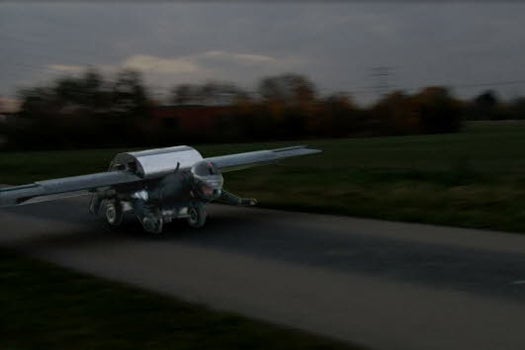
But, uh, how do you land?

Jetpacks For Everyone
Jetpacks For Everyone Courtesy Skyflash

It's 2013, so we've all been wondering: Where's my jetpack? The future won't have truly arrived until we can strap into a backpack and fly ourselves around town. And while that's not exactly here, it's getting a whole lot closer.

Fritz Unger's Skyflash is a homemade jetpack designed to eventually reach a maximum height of 25,000 feet. Unger and his friend have been working on the project since 2007, but have started running piloted tests on the engines and the wing mechanism in the last few months.

Unlike many other jet wings, Skyflash is designed to take off from the ground, rather than being dropped from a helicopter or plane (perhaps because the name Skyfall has already been taken).

Inspired by the wings of a condor, the largest flying bird in the western hemisphere, what the Skyflash creators call "the ultimate flying backpack" has a wingspan of about 11 feet and is powered by two turbo jets. The team's Facebook page ambitiously says it will be capable of speeds of 200 miles per hour, but for now Giz Mag is reporting that it has a cruising speed of 78 miles per hour at heights of up to 11,800 feet.

"I wanted to fly free as a bird. I wanted to get rid of the air frame and everything you typically need," Unger told the Discovery Channel.

For the first road test with a pilot, Unger tried his prototype with just one of the engines, getting up to 30 miles per hour on the ground.

Later they tested it with both engines and no wings, dubbing it the "World's Craziest Snow Blower."

The project has gone through three prototype wings. Right now the model is made of plywood, but the next step will involve fiberglass construction and even more powerful engines. Without a pilot, it currently weighs 25 kilograms, a little more than 50 pounds. It's controlled by a throttle and an 8-inch display strapped to the pilot's wrist, which connects to a computer within the central wing body.

Giz Mag explains more:

Climbing and steering are achieved by the pilot shifting his body weight. The heat-proof boots worn aren't just a precaution, but a design feature because the jets’ thrust angle is controlled by dipping the boots into the exhaust like the control vanes on a V2 rocket. To turn, the pilot stretches out an arm and climbing is done by bending the knees.
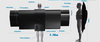
Condor-Inspired Wings
Condor-Inspired Wings:  Courtesy Skyflash

The Skyflash team is planning a full test flight sometime in the middle of this year, which hopefully means they'll actually get up into the air. Before you get too excited, though -- they may not have figured out a way to land it yet. They say a safe landing is achieved "the same way you took off." In case of an emergency, the wings have a quick release option and the body contains a parachute, but it's unclear what a non-emergency landing would look like. Since the test videos largely involve the pilot laying on his stomach on the ground, a parachute seems like a preferable landing method right now.

[Giz Mag]

7 Comments

I would hate to see the guy have an accidental face plant!

I want one!

All we have here is a guy rolling around ont he ground soon to be setting his shoes on fire. You need a bit more than a helmet and a bobsled costume to get into the air. No offense, but we had a similiar sotry that ended up be bogus last year with the dutchman video with flapping wings. I'd post the link, but your the spam-blocker doesn't allow that.n-flaps-his-arms-and-flies

Popsci can you please do a little more fact-checking and report on science opposed some poor deranged kid who wants to fly.

Goto Youtube and Search For fusionman flying or Jetman and see a man who knows what it take to strap a wing to his back and really fly. I pitty this fool if he ever gets off the ground. He needs to call jetman and get some tips..

in order to thank everyone, characteristic, novel style, varieties, low price and good quality, and the low sale price. Thank everyone

http://al.ly/AvJ

http://al.ly/AvJ

http://al.ly/AvJ

http://al.ly/AvJ

│\_╭╭╭╭╭_/│  
 │         │\|/  
 │ ●     ● │—☆—  
 │○ ╰┬┬┬╯ ○│/|\  
 │   ╰—╯   /  
 ╰—┬○————┬○╯  
  ╭│     │╮  
  ╰┴—————┴╯ sdfgewgwe

@Trikus: If they can design this pack to the specs they provide here (honestly, that's the biggest hurdle), I see no reason this wouldn't work. They are talking about a minimum speed of ~80mph, and the equivalent of a 50-100 lb airframe. A single-prop plane weighs a heck of a lot more than that, and can easily take off at those speeds. All you really need is a wing capable of producing some decent lift. The talk of 25,000 feet and 200 mph sounds a bit optimistic to me, but it's certainly got the capacity to fly. Landing isn't that hard, assuming they don't want to get fancy- just strap on a parachute that can open with the pack still attached. Admittedly, I don't see a traditional airplane landing going over well. Potential wardrobe fires are an issue to contend with, as well as exposure, but I think those can be overcome based on existing technology.
____________________________________
Nisi credideritis, non intelligetis.

To be honest I'm inspired by his determination... but I think that that particular design would be air worthy. I doubt highly that it was tested in a wind tunnel. It looks like it would be susceptible to destabilization because of the lack of a large wing area and no rear stabilizer.


June 2013: American Energy Independence

Five amazing, clean technologies that will set us free, in this month's energy-focused issue. Also: how to build a better bomb detector, the robotic toys that are raising your children, a human catapult, the world's smallest arcade, and much more.


Online Content Director: Suzanne LaBarre | Email
Senior Editor: Paul Adams | Email
Associate Editor: Dan Nosowitz | Email
Assistant Editor: Colin Lecher | Email
Assistant Editor: Rose Pastore | Email

Contributing Writers:

Kelsey D. Atherton | Email
Francie Diep | Email
Shaunacy Ferro | Email

circ-top-header.gif
circ-cover.gif
bmxmag-ps