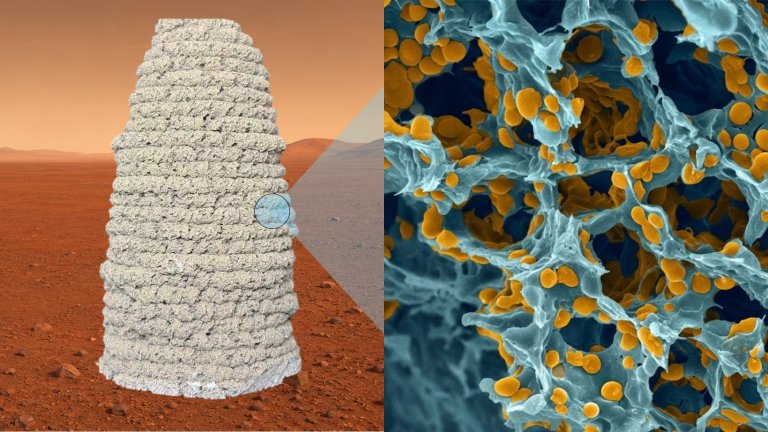
Aeroponics for Space Habitats Autonomous aeroponic plant production could provide future Mars astronauts with fresh food and oxygen. Daniel Zukowski/University of Colorado

Future astronauts en route to Mars or deep-space destinations will need specially designed living quarters and renewable sources of food — so this year’s X-Hab Challenge includes a remotely operated, robotically controlled space garden. Students at the University of Colorado and Colorado State University are developing a workable prototype “bioregenerative food system,” which they’ll deliver to NASA next summer.

NASA’s yearly X-Hab competition invites university teams to design deep space habitats and concepts that could someday be used by real astronauts. The designs often focus on space-worthy structural scaffolds, detailing vertical or horizontal building layouts that could survive the harsh environment on Mars or the moon. This year’s contest includes a robotic garden, too.

The completed project will be able to grow, harvest and compost a variety of plants which astronauts can cultivate for food. The plants would also purify water and provide oxygen. It will give isolated, lonely space travelers something to do, as well as something to take care of — the responsibility can be a psychological boost, according to the CU students. Choosing which tasks to automate and which to do manually, like picking the fruit, are part of the project, according to aerospace engineering sciences graduate student Christine Fanchiang, who is co-leading the Colorado team’s effort.

The team already has a working aeroponic prototype, which they plan to build upon with their $40,000 X-Hab grant during the next year. The system will eventually be able to plant seeds, monitor plant growth, harvest the plants and even process crop waste, recycling nutrients back into the system.

This year’s five teams, announced in late May, also include California State Polytechnic University and Oklahoma State University, whose teams will work on vertical and horizontal habitat layout designs; Texas A&M University, which will work on a wireless “Smart Plug” for DC power supply; and the University of Alabama-Huntsville, whose team is designing a microgravity storage system.

[University of Colorado]

2 Comments

Perhaps create a 1 mile large ball in space with an office space to house what is necessary for the astronauts. Let the ball rotate so the sun can shine on solar reflectors gaining energy and yes heat from blacken areas on the ball. There have to be fans circulating a breeze. Parts of this ball can also allow the correct amount of solar radiation inside the ball to grow plants too. It will have to closing and opening calibration timed device. Now fill the ball with gases, veggies, algae and anything else to get this outer space green house growing. If we can create a stable green house, making a stable oxygenated atmosphere, this is just a step towards living in outer space.

my roomate's aunt makes $83/hr on the laptop. She has been without work for 8 months but last month her pay was $8682 just working on the laptop for a few hours. Read more on this site...NuttyRich.com


June 2013: American Energy Independence

Five amazing, clean technologies that will set us free, in this month's energy-focused issue. Also: how to build a better bomb detector, the robotic toys that are raising your children, a human catapult, the world's smallest arcade, and much more.


Online Content Director: Suzanne LaBarre | Email
Senior Editor: Paul Adams | Email
Associate Editor: Dan Nosowitz | Email
Assistant Editor: Colin Lecher | Email
Assistant Editor: Rose Pastore | Email

Contributing Writers:

Kelsey D. Atherton | Email
Francie Diep | Email
Shaunacy Ferro | Email

circ-top-header.gif
circ-cover.gif