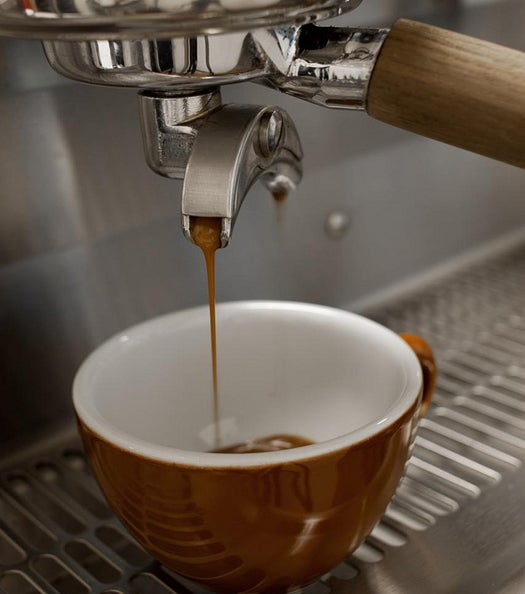
Espresso is both widely drunk and widely misunderstood, and even though we're avid drinkers of the stuff here at PopSci, when asked precisely what the term means, we couldn't come up with a satisfying answer. That's because it turns out to be much easier to talk about what it is not than what it actually is. Surprisingly, there is no real definition of espresso--there are certainly elements that the experts agree on, but there are no codified guidelines, no explicit recipes. "The reality is there's no master bible," said Matt Lounsbury of Portland, OR's Stumptown Coffee Roasters.
Here's what everyone agrees on: an espresso is a concentrated, often thick coffee beverage with a layer of dense foam whose ingredients are exclusively coffee and water, created with a machine that forces hot water through a basket of tightly packed, finely-ground coffee for a limited amount of time at very high pressure. "Espresso" is also the blanket term for the process that creates this beverage.
Espresso first gained a toehold in the U.S. among immigrant Italian communities in cities, but it didn't really take off with the rest of the country until the so-called "second wave" of coffee--basically, Starbucks. It's since become something somewhere between an obsession and an art form with the "third wave" of coffee, led by smaller, hipper roasters like Chicago's Intelligentsia, Portland's Stumptown, Oakland's Blue Bottle and New York's Gimme!.
Here's what espresso is not: it is not a type of bean. Kyle Glanville of Chicago-based coffee roaster/retailer Intelligentsia notes that "people are very confused about what espresso is, especially thanks to the proliferation of espresso products--chocolate-covered espresso beans, things like that. But coffee is coffee." Espresso can be made with any type of bean; the reason that we often think of espresso as requiring a dark roast is that the specific flavor profile of the espresso that first caught on in the United States was from southern Italy, where they prefer a very dark roast. That's been used by marketers ever since, with specific dark roasts labeled as "espresso beans." But espresso can and is made with any level of roast and any kind of bean, and in fact the traditional very dark roast is not especially popular among the leading American coffee roasters and baristas.
Here's another thing espresso is not: it is not the same as strong coffee. Coffee made with devices like the moka pot or the newer AeroPress produce coffee much stronger than coffee made with methods more popular in the U.S. like drip, pourover, or French press, and do have some element of pressure involved. The moka pot is sometimes even called a "stovetop espresso maker." Not so, says Lounsbury. "The moka pot and AeroPress get closer to an espresso profile," he says, "but it's still not the same. The mechanical aspect is what makes [espresso] unique."
Glanville is a little harsher. "Moka pot is not espresso. Moka pot is moka pot. Doesn't even resemble espresso. It's slightly more concentrated [than drip coffee] but not espresso in the way that we know it." He also noted that a moka pot is not capable of creating crema--the trademark thick, tan foam that floats on the top of a shot of espresso and is the result of very highly pressurized water forcing through the coffee.
The broad strokes of what makes espresso are mostly agreed upon, at least by the leading American roasters, but the specifics, especially of temperature, pressure, choice of bean, and time, are up to the barista and, in the case of Stumptown, the roaster--coffee shops and restaurants have to spend time with Stumptown to learn how to create a beverage to the roaster's standards before Stumptown will agree to become a supplier. But Matt told me that in Stumptown's view, here's what espresso is:
Those are just Stumptown's particular guidelines, though--roasters like Stumptown are necessarily vague about what is and is not espresso, because there's no actual definition, but are emphatically precise about what makes good espresso. I asked Matt if home espresso makers--the kind that cost a few hundred bucks and can be found at your local Target--produce actual espresso. "It's a controversial subject, I'll put it that way," he said.
It's hard to nail down what is and is not espresso when there's no definition, but everyone I spoke to agreed that pretty much every home espresso maker that costs less than $1,000 is incapable of producing enough pressure, power, and consistency of temperature to produce a shot anywhere near the level of tastiness that a proper commercial machine can make, though some were more disdainful of home machines than others. Kyle at Intelligentsia doesn't even have an espresso maker at home, calling home espresso a task that "very few people can really undertake. It definitely requires dedication and patience and a lot of money."
Kyle's colleague Geoff Watts mostly echoed Stumptown's definition, but noted that espresso is also drunk differently than drip or press coffee. "It's an extremely intense way to experience coffee, and is unlike drip in that you're consuming it over a short period of time in a small volume," he said. It's stronger than coffee by volume, but a shot of espresso has much less caffeine than a small (8 oz.) cup of coffee.
Oh, and one last thing: "expresso" is not a word and its use will cause any self-respecting barista to attempt to throttle you with their suspenders. Beware! They are stronger than they look.
Five amazing, clean technologies that will set us free, in this month's energy-focused issue. Also: how to build a better bomb detector, the robotic toys that are raising your children, a human catapult, the world's smallest arcade, and much more.


Online Content Director: Suzanne LaBarre | Email
Senior Editor: Paul Adams | Email
Associate Editor: Dan Nosowitz | Email
Assistant Editor: Colin Lecher | Email
Assistant Editor: Rose Pastore | Email
Contributing Writers:
Rebecca Boyle | Email
Kelsey D. Atherton | Email
Francie Diep | Email
Shaunacy Ferro | Email
Coffee is Popular and I do enjoy the stuff. Now for precisely defining what is Espresso? Well, I found the definition easily enough online "...Espresso is a concentrated beverage brewed by forcing a small amount of nearly boiling water under pressure through finely ground coffee beans. Espresso often has a thicker consistency than coffee brewed by other methods, a higher concentration of suspended and dissolved solids, and cream (foam). As a result of the pressurized brewing process the flavors and chemicals in a typical cup of coffee are very concentrated. Espresso is the base for other drinks, such as a latte, cappuccino, macchiato, mocha, or americano...." en.wikipedia.org/wiki/Espresso
Now is asking what is espresso a science question? It as science as asking the question, what is pie from a food perspective.
Personally, I read a popular subject article and towards it being scientific, I am left wanting?
Has the intelligence of the readership of PopSci sunk so low that the term "espresso" needs be defined, especially when it's an issue for linguists, as opposed to scientists?
cakesthethird,
You write rather well and seem like a smart guy. Enlighten me sir, what scientific knowledge did you gain from this article?
Lighten up, all of you.
I have for YEARS wanted to see in print, what was published here.
Being a fan of the glorious brown beverage, I have hated having to explain to the a "barista" that I would like an espresso with a roast other than pure carbon pellets.
The key point being made is, espresso is a misunderstood, and by defining what it is, or is not, the author wins my respect!
(my user name Luvjava is also my license plate, and has been that as far back as the early 90's)
Mr. Luvjava,
I notice your profile is as old as my previous comment. I am glad to be an inspiration for you to comment. Now that you have a profile, I hope you comment more on PoPSCi. I like coffee and espresso very much too. Though, I do not have a license plate dedicated to it.
I have heard it often said in writing, it is best to write what you know. I am guess, the writer today was not very inspired in science, but must really enjoy espresso and went with that. It is a popular subject. I wish you well and take care!
my roomate's aunt makes $83/hr on the laptop. She has been without work for 8 months but last month her pay was $8682 just working on the laptop for a few hours. Read more on this site...NuttyRich.com
Another "lie" is the "second wave" or :third wave" business you speak of.
Trish Skeie coined the term not to describe purveyors of coffee but rather the enjoyment, or the consumers, of coffee. Purveyors have coopted it as a self-marketing term ever since.
If anyone wants to infer something scientific from this article, then infer that espresso is chemically different from drip brew coffee.
As a barista for years, and a big fan of Popsci, i can tell you that coffee is pretty interesting.
if you want more info on the science, i would suggest the articles & links section at jimseven
Great article. Especially like the "expresso" reference.
@ArabianCoffees... I agree about the 'expresso' reference - it's nice to see it in writing.
Unfortunately, the only people who would be intrigued enough to read or comment on this article apparently already know better.
ArabianCoffees and Luvjava profiles were created just to comment on this article. How long have you guys been working for Dan Nosowitz. Perhaps one or both of you are Dan, lol.
Great article. Especially like the "expresso" reference.
Great article. I like the sun.
Great article. I like green grass.
Great article. I like children.
Great article. I like puppies.
Great article. I like rainbows and butterflies,....
Great article. I like the writer, big hug, squish!
lol.
Some of you guys need to lighten up. PopSci is in a "Food Tech" themed week, and this is a short article written about an often misunderstood food item whose name is derived from the mechanical process used to make it. If you are going to publish several articles EVERY DAY, then you have to change it up some and keep people interested. Espresso is not a naturally occuring substance. You can consider it science since a scientific process had to have been used to develop the method of creating espresso.
Robot,
Not an iota, though the subject (coffee) is ripe for explaining novel scientific concepts in a popular context. Take the decaffeination process -- while there are several methods, one of the more interesting is using supercritical CO2 at extremely high pressures to "dissolve" the caffeine without affecting the aromatic oils that lend coffee its distinct flavors.
The process to get a good espresso here in Italy is indeed a mix of scientific investigations (coffee machines manufacturers) and personal experience: a good “barista” should adjust some parameters (i.e. the grinder, the quantity of grains per shot etc.) depending on the weather (humidity, especially) and other parameters. In the street where i live, there is a bar every 70 meters, so if you are not able to make a perfect espresso, you will be out in few days.
The need to define what is Espresso is a consequence of a semantic error of non-Italian people: using that word for many kind of brewed stuff. Here in Italy, everyday, everywhere, you just ask to any barista “un caffé” (a coffee, please), and you will get an espresso, that's all, you know what you will get, the barista know what you expect. There are many recipes for a chocolate brownie, anyway i guess no one in U.S. try to define the ontological essence of a chocolate brownie ...
24-27 grams? thats one hell of an overdose, someone correct me if im wrong but the "standard" is 7g per 1oz shot, although i overdose myself i usually use 15g depending on the beans of course, i have even considered an upgrade to an 18 gram basket but i dont really see much need for more than that.
cakesthethird,
I like your icon sir. ;)
I am actually amazed that I'm being accused of being a shill for the author, or actually the author, because I chose to support the views in this article.
Robot,
Maybe you can zoom in or my avatar, note the date on the plate, it's 1998. Or do I have to have to sign a legal document proclaiming that I “Luv Java” and be ridiculed because I didn’t spell LOVE correctly.
Ever think that a person that love's Java would have a have an online persona that had something to do with coffee, or that a story about coffee would cause me to create a profile here and comment on the story.
The tone of this thread is what the world is coming to. Lack of civility.
Your actions are those of a child or troll, where you feel that you have no responsibility to act within the norms of society. Calling someone a liar that you never met. Would you walk up person in a dinner party and shout “liar” because they state an opinion.
You have no social value
If you somehow feel that you have "WON", you are mistaken.
You have only proven that you lack socal skills, and should have been spanked more as a child.
I am pretty sure that in posting this comment, I have violated the standards of the web site, I will risk loosing access, by posting this comment.
Luvjava,
BIG BIG HUG! I have no intentions or desire to insult you. I enjoy coffee too.
Take care and have a cup of joe! ;)
my roomate's aunt makes $83/hr on the laptop. She has been without work for 8 months but last month her pay was $8682 just working on the laptop for a few hours. Read more on this site...NuttyRich.com
With the many hundreds of different chemicals in coffee, it has kept more than a few scientists busy for years. That being said! I don't agree with the coffee shops saying that home devices for Expresso don't make it real. They would say that! Because if everyone knew how cheap & easy it is to make expresso at home,they would lose a lot of business.
Right you are, thor101370. I've been pulling great shots with my PID'ed Silvia for years now, at a cost of about 20% of what they charge at my local coffee joint.
I've drunk coffee around the world. The worst has usually been in America, even though it costs the most there! It doesn't matter how expensive your machine is -- you have to roast the beans right -- and American baristas invariably over roastthe beans, which means most of the finer aromas and lighter aromatic oils have already been burned off.
Moka forces water up from below, espresso forces it down from above. This does change the taste -- perhaps some of the real scientists who are reading could explain why.
You can get super strong coffee even by using simple gravity, which is what a traditional Indian drip filter pot uses -- the filter is just a double chambered cylinder with small holes at the bottom of the chamber on top!