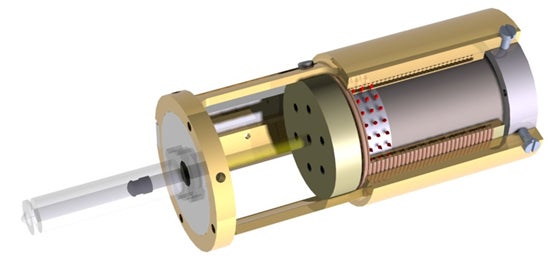
Whether you’re at the doctor’s office or taking medicine at home, future injections could be a lot less painful with this new gadget developed at MIT. Instead of a sterile metal point penetrating your skin, it fires a jet of medicine through your skin at the speed of sound.
It’s similar to a normal syringe, except instead of a needle plunger, it uses a Lorentz force actuator, made from a magnet surrounded by a conductive coil. When a current is turned on, the magnetic field interacts with the current to produce a force. That force kicks a piston, which ejects a drug that has been embedded inside the capsule. The speed of the ejection and the depth it will reach can be controlled by altering the current.
To penetrate the skin, the ejection happens at ultra high speeds, almost equivalent to the speed of sound through air. The drug flows through an opening that’s about as wide as a mosquito proboscis, according to MIT News.Researchers led by Ian Hunter and Catherine Hogan tested a prototype device with two different velocities: One can breach the skin and reach deep into tissue, and another can deliver drugs more slowly, so they can be absorbed by the skin. Different people would need different piston velocities — “If I’m breaching a baby’s skin to deliver vaccine, I won’t need as much pressure as I would need to breach my skin,” Hogan said.
That’s key for this device, because other existing types of jet injectors are limited by their design. They may use a spring-loaded injector, which can only work at one velocity, for instance.
While the supersonic variable-speed delivery is new, it’s hardly the first device to seek elimination of the hated hypodermic needle. Several other alternatives exist, like super-thin microneedles, as wide as a human hair, and a microneedle patch, which deliver drugs with no pain and simply dissolve on the skin. But again, those would require a drug-specific design.
For the average trypanophobe, the prospect of sticking oneself with a needle is anathema, so a more universal system like this could improve patient compliance with the doctor’s orders. Plus, the researchers also point out, it could prevent needle-stick injuries by health care workers and others. The Centers for Disease Control and Prevention says hospital workers accidentally prick themselves 385,000 times per year. Not so with a jet injector.
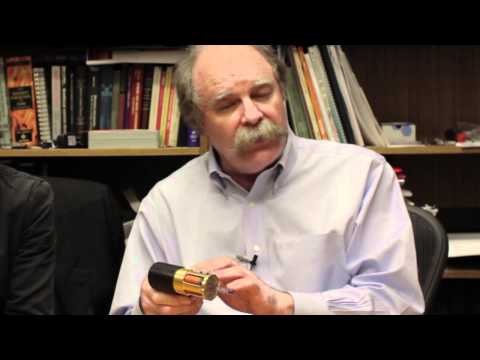
Watch Hogan and Hunter explain further in the video.
[MIT News]
Five amazing, clean technologies that will set us free, in this month's energy-focused issue. Also: how to build a better bomb detector, the robotic toys that are raising your children, a human catapult, the world's smallest arcade, and much more.


Online Content Director: Suzanne LaBarre | Email
Senior Editor: Paul Adams | Email
Associate Editor: Dan Nosowitz | Email
Assistant Editor: Colin Lecher | Email
Assistant Editor: Rose Pastore | Email
Contributing Writers:
Rebecca Boyle | Email
Kelsey D. Atherton | Email
Francie Diep | Email
Shaunacy Ferro | Email
So... when do I get to see this in the doc's office? This is a highly useful tool
Hyposprays here we come! This just reaffirms what I've said for years. Gene Roddenberry was from the future!
1978, I was at Old Dominion University when the flu shots came around for students... no needle, just a jet injector gun that had a bottle of the fluid upside down on top of the gun.
OMG next to the "tricorder", the "hypospray" is the second Star Trek device I most want in the real world!
Lol, I really hope this is painless, because the thought of anything going through my skin at the speed of sound sounds awfully painful. I mean at the "high velocity" setting, does it just rip (used loosely since the scale is so small) through skin cells or does it just get forced through the pores?
I had a needle less injection in 1969. I think against TB or Cholera, the spot on my upper thigh was sore and pussy for months, I might have been allergic to the serum. The device looked like a glorified version of an airless Wagner spray gun. So what else is new?
Could we use it to inject some common sense into Obama?
The main concept of this is from the 1960's. The only new thing is that it uses a magnet, rather than air power. This seems unlikely to be a particularly important change.
www.wikipedia.org/wiki/Jet_injector
Sounds to me like the device that Bones always used in Star Trek to spray vaccines through the skin.
I don't know about this. in my opinion, the air injectors were always more painful than needles (which didn't hurt at all, if you ask me) and this only seems like another one of those.
--------------------------------------------------------------------------
why learn from your own mistakes, when you could learn from the mistakes of others?
“The most incomprehensible thing about the universe is that it is comprehensible” -Albert Ein
So how do they stick this in a vein to draw the blood? It`s not in the video. To only inject something the microinjector needles seem to be much less painful. That's the main thing for me. I want to feel as little as possible since i really hate those needles.
You cannot draw blood with this tech Greenmatrix, it can only be used for IM (intramuscular injections). Pneumatic IM guns have been used for a while in some places (including the military) The advantage to this may very well be greater portability because of the size of the unit. I have pricked myself twice bouncing around in the back of my speeding ambulance(scary)as a Paramedic and tell you I would welcome this in some instances.
This isn't really new and just like the air injection version from the '60's and 70's, this is probably too painful to ever catch on.
You guys are seriously comparing this version to one from the 60s? You people are morons if you think they are going to be same. They've tested it on people, so I think they would know whether or not it hurts.
Then again, you morons can sit in your little world of stupidity and just assume nothing ever changes and current tech is the same an tech from 50 years ago.
The older injectors are nothing like this one they actually were more painful than a standard shot. The reason they were used was because they were quick the military really likes them. They could also do damage to your skin and muscles if you moved while being injected the air pressure and speed could tear things like your skin. They are fast the operator dosent have to worry about sharps or disposing all the used needles so they have some good points. This new one is nothing like those you shouldnt get the pain from the air hitting you so hard and forcing the liquid in. This one is much different the old ones had one power setting all or nothing this one can be dialed in for different skin thickness, toughness, and how deep to inject the medicine. This new one uses a much smaller hole to push the medicine through so it disturbes less area on your skin and doesn't agrivate your nerves as much which reduces pain.
Contoria: People have been killed with something in the same neighborhood there was a Russian dissident I cant remember where exactley I think it was in London this guy was a reporter and talked very unkindly about the U.S.S.R. one day while waiting at a train station or something like that someone walked up to him touched his calf with the tip of an umbrella and injected what looks like a hollowed out bb with holes in it full of ricin the guy felt a little sting but went on his way 3-4 days later he was dead. Simular incidents have happen some using umbrellas some using other things one guy was injected with uranium so this type of system has been used to kill. Humans can be incredibly creative in ways to kill other humans from quick and silent to painful and drawnout.
I dont look busy because I did it right the first time
Benboy00 this is a huge change if it works the way they say it does the adjustibility of the power is a massive change and leap forward and being able to inject at different depths instead of just one.
African Rover for you to be sore and leak puss for that long of time I would agree with you that you had an allergic reaction or your injection site became infected like if they didn't get your skin clean the injection could have pushed some bacteria or something else under your skin. If you say that doesn't sound likely or possible I know someone who got MRSA internally by it being on her skin and the nurse didn't get the skin cleaned properly. They put a central line a type of IV in her and the MRSA followed it and it went septic in her almost killed her she will never live outside of a nursing facility for the rest of her life if you can call it living. So stuff like that is possible I think what this thing needs is a high power ultraviolet light it works really well at killing nasty little things like germs and viruses and the like.
I dont look busy because I did it right the first time
I wonder if a variation on this could be used as a tattoo machine?
--==]] visit my blog at zentastic.com [[==--
we could make Stimpacks like from the Fallout Series but no needle:D
Finally!!
Now I no longer have to cower in fear of my next injection!
--------------------------------------------
I like nonsense, it wakes up the brain cells.
Hate to burst everyone's bubbles, but it will still hurt (unfortunately).
The Naval Hospital I go to for vaccinations uses something like this already, and although you don't have to deal with the sting of a needle, you will still be sore from the medicine.
I have seen such kind of injection only in movies.Now i read about the new technology that excists today.May be it should have a key to switch between child and adult.Bady and children skins are delicate than adult skin.Hope to see this injection in hospitals near my home.
And why would we call such a device a "gadget"?
anklw8s Yes the medicine is still going to sting its entering your body and displacing things. This particular system isn't out yet I don't know what type you've had used on you at the Naval Hospital. It could have been similar to this but a lot of the military ones use a burst of air and the air hurts also. Even with the med hurting at least you don't have the pain of the needle on top of it. Im thinking about all the needles that get thrown away every day currently it could hurt the companies that make needles but they will still be needed in IV's and to draw blood. But just the number of needles used for injections daily cutting out that amount would make a huge difference and help cut down on accidental sticks to a doctor or nurse. I wonder if this could also be modified in the future to be used for diabetics where they dial in how much med they need and it can inject it. You know how much trouble that would save diabetics not having to carry needles with them all the time. Its future capabilities could be very impressive.
What about cross infection? I work at a hospital and we are always concerned about this. Anything that has touched a patient either gets cleaned or discarded.
For now I think I'll prefer the old-fashioned disposable plastic syringe/needle with the post-use needle guards.
Brian Fraser, Scottsdale, Arizona
Hmm, I have a hypospray, it is a medi-jector EZ by Derata. I have had it since 1990 (when I found out that I have become a diabetic). Unfortunately they don't sell it any more. I had bought the newer model from them too, but the plastic tip exploded on me during an injection, not cool! But the original EZ is still working fine (metal tip), amazing it didn't sell well. So this is not new news at all, mine even has adjustable pressure and it is about the size of the hypospray in Star Trek (the EZ actually was in an episode of the next generation). An alien had injected Riker with it (so it was an "alien" version of the hypospray.
Also, does anyone know where I can find the insulin bottle adapters for the EZ?