Each time NASA gets a new budget from Congress, a recurring debate takes a spin through a media cycle or two. At its simplest this conflict of opinion is a split between people who think Americans give NASA too much money and those who think it’s not enough. There are the more nuanced arguments too, those that hinge on specific line items and whether or not a specific program or ambition is worth it (or not worth it). But all the noise can largely be distilled into a question that looms ever larger in the current age of austerity: is what we’re getting out of NASA worth what we’re putting in? Is space science a good investment?
When the most recent NASA budget was handed down in February, the media frothed even a bit more than usual. The budget had been cut pretty modestly given the current political climate, but the cut more or less targeted a specific division of NASA: planetary sciences, the division that puts rovers on Mars, orbiters around objects like Saturn and the moon, and visits other bodies around our solar system like the asteroid Vesta and Kuiper Belt objects.
Click to launch the photo gallery
The budget slashing had an immediately tangible impact, as NASA pulled out of two planned Mars missions (leaving the European Space Agency holding the bag). And the debate, of course, was on. Figures like Neil deGrasse Tyson–arguably the most visible and coherent defender of NASA and space science–was quoted widely espousing the view that NASA is persistently underfunded and that a NASA with means and a mission will not only inspire a generation to pursue big things, but will spawn whole new economies and technologies, creating jobs and prosperity along the way.
Then there’s the other side. The Atlantic’s Megan McArdle put it succinctly in a story titled “Neil deGrasse Tyson is wrong about NASA.” NASA “has been a laughable mess for years now,” she wrote. If it’s economic benefits we’re after, the growing commercial space sector is where we should look for growth, not to a government agency that lacks a clear path forward (NASA lovers, don’t get riled toward The Atlantic; it gave Tyson a forum as well).
Both sides of the argument have their merits, and the point of this piece is not to declare one side of the argument more valid than the other. But it’s worth noting that Tyson, if he is wrong, isn’t completely wrong. The policy experts can argue budgets and administration and the politics of NASA. We’re simply arguing that Tyson is correct when he says investments in space science pay dividends here on Earth. They have done so famously in the past, and they continue to do so as you read this sentence.
When we pay (and sometimes we pay handsomely) for things like the James Webb Space Telescope, for a new Mars rover, or to extend the life of the ISS, we are paying for the capabilities that those specific pieces of technology provide–we’re paying for the object itself. But the technologies and know-how that fall out of those things–better optometry tools borne from the world’s most sophisticated space telescope or a Salmonella vaccine enabled by microgravity research on the ISS, for instance–create benefits that we never would have otherwise experienced.
Times are lean, and we still have to pick and choose what space ambitions are worthwhile to pursue. But it is narrow-minded to think that our space science dollars are simply being spewed out into the vast blackness beyond the sky. Many of those dollars come right back down to Earth in the form of new knowledge and technologies that enrich life right here on the surface. Click through to the gallery above for a rundown of a few of our favorite ongoing space investments that are paying technological dividends on Earth at this very moment.
_Note: The Atlantic article cited above displays two different bylines on The Atlantic’s site: Megan McArdle and Katherine Mangu-Ward. We’re not sure why. The point is, one of them wrote the piece.
Better Eyesight from the James Webb Space Telescope
When the James Webb Space Telescope launches into space in 2018, it will be on its way to helping humans see further into the ancient universe than ever before. But it is already helping humans to see better through a slew of improvements in measurement technologies that are vastly improving the optometrist’s toolkit. The same sensing technology–called “wavefront imaging”–used to image and refine the telescope’s 18 primary mirrors is enabling ophthalmologists to measure aberrations in the human eye with unprecedented accuracy. Those measurements are in turn improving the diagnosis and research of ocular ailments, making laser eye surgeries more effective, and influencing the design of new contact lenses. For the hundreds of millions of Americans wearing corrective lenses (and the many millions more born with eyes), the JWST is providing better optical health, which we’ll need when the biggest and baddest space telescope the universe has ever known begins beaming back beautiful imagery of the deep cosmos later this decade.
Curiosity’s X-Ray Diffraction Instrument: Catching Counterfeits in Vietnam
The Mars Science Lab mission and its Curiosity rover, currently en route to the red planet, was the impetus for several cutting edge technology advances as NASA researchers sought to pack as much hardware as possible onto the lightest possible spacecraft. As a result, innovators like David Blake at NASA Ames Research Center had to leverage years of work–in his case, more than two decades of accumulated labor–to shrink an X-ray diffraction device normally the size of a refrigerator to something the size of a briefcase. Curiosity got its lightweight, compact X-ray instrument, but the world got the Terra, the world’s first portable X-ray diffraction device sold commercially by a spinout company called INXITU (now owned by Olympus). The Terra has enabled researchers in a variety of disciplines to haul X-ray diffraction into the field with them, allowing them to use the technology in a variety of ways that simply weren’t possible before. Mining and mineral exploration companies can use it to check the chemical composition of materials on the spot. The Getty Museum has reportedly used a unit to inspect and evaluate artistic artifacts. It has security applications as a bomb detector. The U.S. Food and Drug Interdiction is reportedly considering using portable X-ray diffraction for drug interdiction, and Blake’s own hobby involves working in the developing world–specifically in Vietnam–to help authorities identify counterfeit pharmaceuticals, a threat that is costly to both public health and pharmaceutical companies. It turns out when big technology is made small enough to travel, it can really go places.
Developing Vaccines From 240 Miles Up
Ongoing experiments with Salmonella bacteria aboard the International Space Station have yielded huge insights into the virulence of the pathogen and provided researchers with key clues to thwarting that virulence via the development of a human Salmonella vaccine. Two Arizona State University teams are now carrying that research forward via a genetically altered strain of Salmonella carrying a protective antigen against Streptococcus pneumonia, the bug that causes meningitis, pneumonia, and bacteremia, in an effort to find an effective vaccine for pneumonia and related pathogens. Testing in the microgravity environment is critical. Experiments aboard the ISS have found that bacteria can grow more virulent in weightless environments–environments that are very much like the one found inside the human intestines. The Recombinant Attenuated Salmonella Vaccine, or RASV, investigation has allowed the researchers to see just how far they can push the anti-pneumococcal effectiveness of their doctored strain of Salmonella, and thus how high they might potentially push a protective immune response in humans. The ongoing work on RASV has already yielded a promising oral vaccine candidate that is in clinical trials down here on Earth.
In Fact, the Entire ISS is One Pretty Amazing Experimental Theater
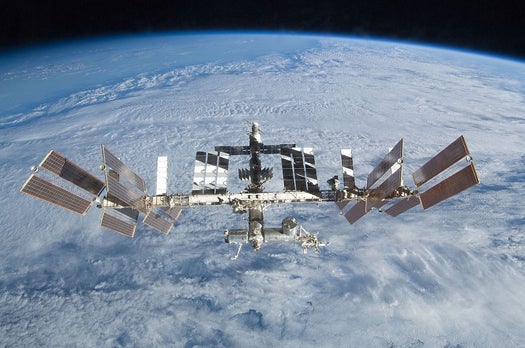
The International Space Station is expensive. A lot of the science that takes place there seems pretty mundane, and some of it is. But like the Large Hadron Collider or KM3Net, the ISS is a one-of-a-kind laboratory that can do science that can’t be done anywhere else. And the best thing about the ISS? It’s already built. Upkeep is expensive, but the scientific impact of shutting it down would likely be far more detrimental than the economic impact of keeping it aloft for a few more years. How so? The amount of scientific experimentation ongoing aboard the ISS at any given time is fairly huge. Some of that is pure space science, but plenty of it packs Earth-bound benefits. The FLEX and FLAME combustion experiments are studying the way fire behaves in microgravity, offering a better understanding of how man’s most important primitive tool and informing the development of flame suppressants and new ways of utilizing liquid fuels here on the home planet. Similarly, the ACME (Advanced Combustion via Microgravity Experiment) is studying the way things actually combust in microgravity, exploring future Earth potentials like using electric fields to manipulate combustion to get maximum efficiency from our fuels and scrub pollutants from the byproducts. Then there’s the MISSE (Materials on the International Space Station Experiment) projects, which have for years been testing materials in the harsh conditions on the outside of the station, leading to better materials science back here on the surface–particularly the kinds of materials that go back up to space aboard the satellites that enable the communications and geolocation services we so enjoy down here. And then there are the various experiments in plant biology, biotechnology, robotics, medicine, human physiology, and so on. The ISS’s value to science and technology back on Earth has been–and still is–significant.
Even the Space Shuttles are Still Doing Earth Science
NASA may have put its reusable orbiters out to pasture, but data collected by the Space Shuttle Radar Topography Mission is still paying dividends and boosting solar power efficiency along the West Coast. Researchers at the Jacobs School of Engineering at UC San Diego are using data collected from that mission to create complex topographical maps that take into account the shadows cast on Earth’s surface by elevation features like hills and valleys. From these maps, anyone from power utilities to residential rooftop solar installers can develop much better projections about the output of any solar project–projections that can make or break a solar project financially. In the solar business shadows are the enemy, and a poorly placed array can experience energy production dips that can cost it double-digit percentage drops in output. That means longer return on investment and less energy for the grid. With the shuttle data in hand, the UCSD team can provide much more detailed analysis of how geographical features will affect a given piece of terrain over the course of a trip around the sun. Better projections mean more confidence for utilities and solar customers, which should help make solar energy more efficient, minimize waste, and perhaps accelerate the rollout of solar technology in places where it can do the most good.
Better Data Beaming Through Space–And on Earth
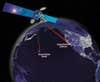
When NASA’s planetary sciences division does send another robotic mission to Mars–and NASA administrators are currently scrambling to find some loose cash in other budgets to reboot its Mars exploration program–it wants to supercharge communications between the home planet and its robotic rovers. Right now it takes about 90 minutes to transmit high-resolution images from Mars back to Earth via radio waves, and the space agency feels that it is bumping up against the ceiling of what radio communications can do. So the agency is putting together a new optical system that could boost data transmission speeds by 10 to 100 times across space–and pioneer a new through-the-air optical data transmission system that could be a game changer for the high data-load aircraft of the future. The Laser Communications Relay Demonstration project will place an experimental payload in orbit aboard a commercial communications satellite and use lasers, detectors, a tracking system, two different modems, and other hardware to test laser communications between Earth and low Earth orbit. LCRD will address the challenges of operating an optical communications scheme amid atmospheric conditions that can interfere with laser beam integrity and–if all goes to plan–demonstrate a fully functioning laser communication system over the next several years. Back on Earth, the ability to use line-of-sight optical systems to beam large amounts of data from the sky to the ground (or from the ground to a satellite and back to a different place on the ground) is tantalizing, especially as sophisticated unmanned military surveillance systems proliferate. The ability to quickly dump data from the sky to the ground is integral for intelligence analysts striving to quickly deliver relevant information to soldiers operating on the ground. And, of course, there are civilian applications as well. As global data demands swell, any system that can move large volumes of data quickly through the air optically could make a huge impact in places where fiber optic cable isn’t feasible or economically viable.