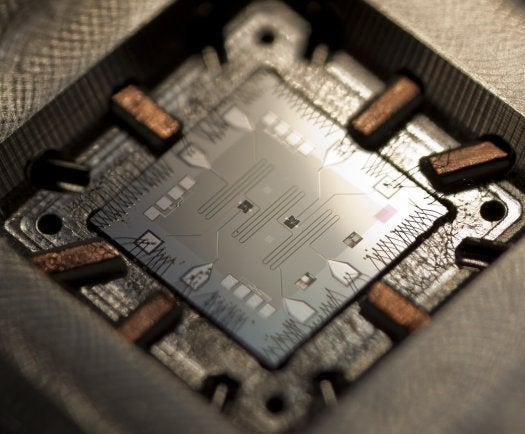
Researchers on two continents are reporting two big breakthroughs in quantum computing today — a quantum system built on the familiar von Neumann processor-memory architecture, and a working digital quantum simulator built on a quantum-computer platform. Although these developments are still constrained to the lab, they’re yet another sign that a quantum leap in computing may be just around the corner.
In the first study, researchers at the University of California-Santa Barbara say they’ve built the first working quantum computer chip based on the von Neumann system. Named for the engineer who designed the concept, the von Neumann architecture combines processors and memory, and it’s the basis for every computer out there. (With one notable recent exception.)
This quantum CPU (quCPU?) is a big breakthrough, because quantum computers by definition are difficult to design. They’re based on the concept of superposition — that a quantum bit, or qubit, can exist in two different states at once. Put another way, it can be a 0 or a 1 at the same time, and it can therefore perform calculations more quickly than a system based on 0 or 1. But it’s hard to keep the qubits in a state in which this is possible, and interfering with them — i.e., reading their data — can destroy their superposition capabilities. So, a system that integrates random access memory into the qubits is a big step toward a working computer.Researchers at UCSB super-chilled their quCPU to near absolute zero and performed a few calculations. Quantum information traveled back and forth among storage and processing elements, and the system performed pretty well — not perfectly, but it’s a start. They also found that the quantum memory can retain information for much longer periods than the qubits, which is also a good sign.
Next, the team is trying to increase the number of quantum devices integrated on a single chip, and they’re studying different metallic materials to make this easier, according to Physics World.
In another quantum paper, researchers in Austria report building the first working quantum simulator — kind of like a quantum computer, but different in scope. It can be used to model the behavior of quantum systems, which can potentially help improve quantum computers.
It would be useful for many reasons to model the behavior of quantum systems, but this is impossible with a traditional computer, as Richard Feynman figured out in 1982. It would take exponential time, with the system working more and more slowly as the calculations increased in number. For a general description of a quantum spin system with 300 particles, a computer would need more memory than exists in the world — even if all of the observable matter in the universe was processed into memory, as the Austrian researchers put it last year. But a quantum simulator, which can complete so many more calculations, would not experience this slowdown. To make one of these, you would have to very carefully control the setup of the simulator, and this is what the Austrians have done.
The team used six laser-cooled calcium atoms as qubits, and used laser pulses to initiate calculations. They found the system could simulate several types of interacting spin systems, according to Science magazine, which published both papers today. The simulator can be reprogrammed to simulate any type of quantum system, the researchers say.
Given breakthroughs like these, quantum computers may be closer than ever.
138 years of Popular Science at your fingertips.
Each issue has been completely reimagined for your iPad. See our amazing new vision for magazines that goes far beyond the printed page
Stay up to date on the latest news of the future of science and technology from your iPhone or Android phone with full articles, images and offline viewing
Featuring every article from the magazine and website, plus links from around the Web. Also see our PopSci DIY feed
A 10,000-rpm, no-pulse heart is completely revolutionizing how we think about transplants. Plus: rapid-response virus hunters, a shocking cure for migraines, the world's youngest person to have achieved nuclear fusion (in his parents' garage!), and much more.
So I wonder how far off sales of a functioning QuCPU will be?
ROFL, computers have come a long way since then eh? From punched out IBM cards and 'obese' code to quantum mechanics with a molecule being in 2 states at once, representing both 1's and 0's. Well, its not marketable to the general public yet, but I'm sure time heals everything. :)
A year ago I would have said keep dreaming, it's like the fusion of the computer world but based on a whole slew of advances in this field in the past 2 years I'd have to say within ten to fifteen years, at least for government/corporate/university use. Wouldn't count on a quantum iPhone for at least a few decades though.
they need to somehow outperform current computer architectures. current microprocessrs serve us well in many cases. if it ain't broken don't fix it.
@highermorals Just because something works doesn't mean we shouldn't try to find something better.
Silicone has reached it's limit as a CPU medium,(electron tunneling anyone?) that is why they are packing more cores into the CPU in lieu of significant increases in clock speeds. A new medium,(diamond?)or a CPU that works far more efficiently that current architecture will be needed sooner rather than later.
Yes, John von Neumann was a rather talented "engineer", wasn't he, Ms Boyle?
http://en.wikipedia.org/wiki/John_von_Neumann
i am a bit confused, didn't an article on here announce D-Wave's Quantum Computer last may http://www.popsci.com/technology/article/2011-05/lockheed-martin-buying-one-d-waves-brand-new-quantum-computers do they exist or not?
I think this new quantum processor is a significant development. If you look at D-Wave's pseudo-quantum computer, which does not rely of superposition of the qubits, and is special-purpose as it only solves a particular class of problems, this new processor has superposition and limited (I believe) general-purpose capability (quantum logic gates). But the major development is that it does not use photons and the accompanying tons of equipment for entanglement.
My classic computer knowledge might be on its way to being obsolete!
thanks ChipGuy, obsolete is inevitable
I just cant imagine how fast the quCPU is。 how waste if I use my quantum computer for daily stuff。Do you mind if use your iPad just as a photo frame?I'm thinking that do I really need a powerful phone with petabytes memory space。
@qinliang, Some of you ideas come across to me often as I consider a new computer or CPU for purchase. No matter how fast my computer, I still only type 30 wpm. lol.
But, I guess in other things that seem useful; like booting up quickly, expressing a variety of multimedia, games and other task that take much processing power, a fast CPU is always helpful.. ;)
I think this is the right steps towards that Jetson/Star trek world we all crave so badly. If we can get videos and Hd tv from whether somthing was either 1 or 0, so imagine whats next Holodecks & Minorit Report type interfaces galactic mapping oh yeah & all the other little things we take for granted.. I can't wait.
These are cool and all, but we're never going to see any practical use for this technology until scientists manage to figure out a way to make it work without cooling things to near absolute zero. I suspect that the day when that becomes possible is still a long way off, unfortunately. :\ Well, we can always work on perfecting neurosynaptic chips in the meantime and then build a quantum version of them later on. That would be the ultimate goal, after all - a quantum neurosynaptic processor - so we may as well get the easier half of it right first.
I am a bit of a gamer from time to time and this makes me think that when this tech is eventually perfected and put into production, aftermarket video cards may be obsolete for a while! That would be pretty nice -imo-
@BubbaGump --
If you can frame your comment only in terms of what you encounter as a home pc user, particularly if you think that your typing speed has anything to do with the matter, then you are entirely in the dark, painfully ignorant and have no idea at all what your machine can be used for.
Just a hint, Bubba: there are those of us whose interest in the potential computational power of quantum systems for things of much greater import than your ability to watch a porn movie in HD -- which, by the way, should be more a function of the quality of your GPU than your CPU unless you are using an archaic graphics rendering application.
Quantum computing will bring in a new era of programming. Like punch cards were made obsolete so will be programming with modern day compilers and interfaces. Good bye windows and visual studio. Bubba in this new era you wont need to type. QuCPU's will make AI and voice recognition take a quantum leap.
This will probably be very expensive when first produced, but I can't wait!! The next generation of computing, Processing at the speed of light!!!! Imagine the possible applications of quantum computers!!! =D
@QIII, Sir, I wrote 2 paragraphs. I was speaking to the person about me and relating to the fact of life, and I meant this in a funny and light way, " no matter how fast computers become, I still only find myself typing 30wpm ".
Then in my second paragraph hints towards how a faster computer would be useful.
Perhaps you heard of Microsoft Windows and the introduction of GUI? For the general public at large, it has been the graphic interface that helps make the home experience to computers so available and useful. GUI and GRAPHICS is probably the single one thing that made all home computers popular and available. I guess for you and maybe you are of a younger age it seems common place and so you overlook the obvious. We humans relate mostly to graphics in this world. It is even said that most communication is not so much with words but how we express them physically. Now consider how helpful graphics are then. It takes vision and perception to enjoy visual clues. Take care.
@BubbaGump --
I have been a computer professional since the early 70s.
And, again, your post in response to mine indicates a very limited understanding of what computers are useful for. You came right back to the personal computer.
By the way, Bubba, even on your PC your GPU is useful for much, much more than HD porn flicks.
Research the term GPGPU.
@Mathprof - Splitting hairs, I know, but if you read the link you provided.... Neumann held a degree in chemical 'engineering', as well as consulting for an electrical 'engineering' school.
i love this. a step closer to the Singularity.
_________________
The people of the world only divide into two kinds, One sort with brains who hold no religion, The other with religion and no brain.
- Abu-al-Ala al-Marri
The stories of human-computer hybrids have always been fodder for sci-fi. Now, two brand new advancements in science have introduced the possibility of biological computers much closer than they have been before. Two new developments bring biological computing closer than ever. These developments and others have been making the possibility of biologically compatible computers more likely. Medical science is especially interested in the possibility, as programmable, biologically neutral computers would be able to improve diagnostics. Medical science is not the only use for these developments, but it is sure to be one of the first uses. Truly usable, commercial biological computers are likely to be years, if not decades away. These developments, however, are two major steps toward the reality.