Industry can't keep up with massive helium demand
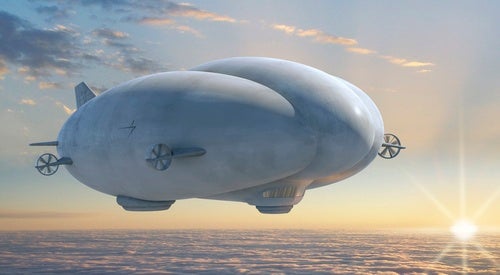
LEMV: Not Your Father's Blimp Lockheed Martin

The second golden age of the airship has run head-on into a logistical snag, Danger Room reports this morning. The military is so eager to get more airships in the air in places like Afghanistan that industry cannot keep up with its demand for helium gas and helium gas containers.

We’ve reported previously that helium supplies are running short (can we go ahead and coin the term “peak helium?”), but that was at a more macro, global scale. The military’s problem is more specific: it needs to get more reconnaissance aerostats in the sky over Afghanistan, and it can’t find dealers that can fill its tall orders for helium.

Airships like Northrop Grumman’s Long Endurance Multi-Intelligence Vehicle (LEMV) need a hell of a lot of helium--roughly 800,000 cubic feet per--quantities that commercial dealers can’t seem to reliably meet. In fact, DR reports, when the Pentagon’s Defense Logistics Agency recently put out a request for helium to meet the DoD’s airship needs, no one called back. They had to break down their bulk order into smaller pieces.

That’s not to say we’re completely out of helium, but right now demand seems to be outstripping supply. Helium gas isn’t just good for party favors. Helium has the lowest boiling point of any known readily available gas, so it’s an in-demand gaseous cooling source for things like superconducting magnets in MRI scanners or particle colliders. It’s used in everything from fiber optics to quantum computers.

And, of course, in airships, which brings us back to the problem at hand. The military continues to fuel up more blimps--they can carry way more reconnaissance gear than, say, Predator and Reaper drones, and they can stay aloft for days rather than hours. But there’s really no great way to get at helium in large quantities cheaply and easily. Which means those colorful party balloons may become a lot more expensive at some point in the next decade.

[Danger Room]

45 Comments

I really like to see a Blimp made into the shape of a giant PINK PIG. Just to see PIGS fly.

And much more fun, yes, I love to see this fly in Afghanistan, lol, snort.

The use of He in party balloons and military blimps should be outlawed as a frivolous use of a critical scientific resource.

Hydrogen is an even better lifting gas despite the Hindenburg disaster. Yes, it burns but so does jet fuel. The risks of hydrogen can be managed without too much difficulty.

Best of all, the hydrogen supply is unlimited.

There is no compelling reason not to use hydrogen, as the lifting gas in unmanned airships. There will never be a shortage of hydrogen.

Hydrogen got a bad rap after the Hindenberg -- even though the spectacular flames were caused by the rocket fuel they used to coat the outside surface, and not by the hydrogen lifting gas (which burns invisibly).

Isn't there a power cell process that has a single byproduct of helium?

Or am I thinking of pure fusion?

It's ridiculous to use helium in airships. It's EXTREMELY expensive. In 2011 I think it cost $75.75/ thousand cubic feet, making it cost about $60600 to fill a single blimp. But helium tends to leak, so they have to be refilled frequently. By contrast, hydrogen or lift gases containing hydrogen can be ten times cheaper, and are plentiful.

It also has far inferior lift capabilities compared to hydrogen, since it's four times heavier. Hydrogen very definitely can be used safely. It's flammable, but so is gasoline and jet fuel. We don't ban those in aviation.

@bildan:

GMTA! You beat me by less than 3 minutes. I was still composing, while you posted. Obviously, I completely agree with you.

I am not sure how high this blimp fly’s, but this blimp seems like an easy target to shoot out of the sky; an expensive target to lose too. In this case if its filled with hydrogen or helium, it doesn't matter.

I imagine our drones are a little harder to shoot down.

I think that the rise of airships once more is an amazing feat, but I do not think in this economy it was the best move.. Even if they were filled with hydrogen, is there that much of an advantage over what we already have other than the ability to hold one position in the air better than a helicopter?

The USDD has two options: Switch to hydrogen and take the risks, or have a more integral role in convincing Congress to give NASA the money it needs to mine astro-resources from the moon and the sun (which are ripe with helium).

@tundrasea

I believe the concept is dual (manned/unmanned) operations.

@mp

Something the size of a Jumbo Jet or a blimp is a very difficult target to hit at 36,000 feet, which is practicle for recon & surveillance missions in an area devoid of land defensive counter-air assets capable of reaching such altitudes.

That's why drones can zip around Afghanistan uncontested. Otherwise there'd be supersonic fighters and high altitude precision bombers flying offensive counter-air missions overhead to destroy such assets, and drones ops would be pushed to higher altitudes to avoid enemy fire.

As far as hitting an aerostat goes small weapons fire would tike some time to bring it down, and then you can fix the holes with relative ease (compared to new parts for a chopper) As far as larger munitions, the damage would generally be limited to a single hole the size of the projectile, as there is no heat or mass signature significant enough to trigger them.
Compare the cost of one fill up with helium to 5 days of helicopter flight (remember to include the imbedded costs of maintenance, the flight crew, the required down time AND the fuel) Here is where the cost savings are found. Did I mention the repair costs? Airships use what are essentially high quality bicycle patches.(application technique is usually proprietary)

@phoenix, the problem with mining asteroids is that its considered common ground, we aren't allowed to set up military installations in or above low orbit. it's kinda like how if two soveriegn states are warring and there's a third state who doesn't want a part of it, they'll say, "no military on our lands" and enforce it. it's just that "space" is technically owned by everyone, so everyone sat down and agreed not to put a military installation out there. and since the only entity close to the ability to make a moon mining expedition would be the united states armed forces it would technically be considered a military outpost.

that's not to say that some private sector couldn't go out there and monopolize the helium market!

to mars or bust!

@ Phoenix...Mining the moon is unlikely to make helium any cheaper, so I think that we should go with Hydrogen, which as many people have mentioned has gotten an unnecessarily bad rap. You can always encase the containers in a neutral element if you are afraid of reactions, and since most of the prototypes I have heard about were unmanned, I am not sure if it really matters that much anyways.

I thought they have been storing a huge amount it West Texas for some 50 years. Where is that now, did it leak out?

Seems they could mix helium and hydrogen to make a gas mix that is lighter.

@ghost

Exactly the point on that. Private industry benefits public industry as well. A mining company could easily sell its prospects for government use (which includes military). In the legislative process anyone could have lobbyists pushing an agenda of public interest including the military, and it doesn't have to be a military issue. That would be the loophole around international law surrounding the usage of space. It's how the Americas were utilized during Europes colonial period.

Space may belong to everyone, but in that sense it doesn't belong to anyone. Space pretty much belongs to the nations with the capabilities to put assets into space. This explains the existence of comm sats and GPS for military use. Space may not be weaponized in that sense but it is used for war (of course we could talk ICBM as space based weapons launched from the surface).

Sure enough when another great economic power begins to increase space activity that conflicts with U.S. space dominance (say China), it will be a cause of friction that will lead to the debunking of established international law the moment one entity breaks the rules.

@Nikita

I agree.

Guess it's an excuse for NASA to plan trips to Jupiter which is loaded with Helium.

Hydrogen would definitely be a better lifting gas but it is only half as light as Helium not four times as aarontco said. Lets make bigger airships, the bigger they are the more efficient they get because the volume is cubed and the surface area is only squared!

It's too bad hydrogen is so explosive. It is much more cost effective, with around twice the lifing power and a fraction of the cost of helium. I wonder if there is a way to make hydrogen more practical to use as a lifting gas?

I am very confident that it is possible to design a double envelope (outer envelope helium, inner envelope hydrogen) that would be very, very difficult to light on fire, even firing RPG's and incendiary bullets at it at point blank range. The outer envelope of helium would simply smother everything.

@woolsocks: The outer envelope doesn't have to be helium. It could even be nitrogen, which is technically 3% lighter than air. Mixing nitrogen and hydrogen would produce ammonia, which is also sometimes used as a lift gas.

We do indeed have problems finding quality helium. It is very difficult to manufacture and there have been issues with the quality of the helium in the past as well. Air "mysteriously" found its way into the cylinders in the past.

Some of your theories are correct. Hydrogen can be used safely if done properly. The issue up until now has been lagging policy. The science doesn't matter if clients won't use it. But I suspect that the DoD is already writing emails internally looking at this as an option. We shall see. We can easily modify operations to support hydrogen filled airships given about 6 months. There are some permits involved with this process as well.

Brady Soule
Director of Marketing
Helios Airships
heliosairships.com

@bob5312

Hydrogen is not explosive.

Hydrogen in a stoichiometric system with a compatible oxidizer is explosive.

If you you make a balloon from high temperature membrane, fill it with hydrogen, poke a hole in it and light the escaping gasses on fire you will see you will see a small flame like a pilot light and that is all. The flame will not go inside the balloon and there will be no explosion. The balloon will just slowly deflate at about the same rate weather nor not the flame is lit.

You can run a normal blimp off hydrogen but it is unsafe because the membrane may become unstable and the hole could expand from the heat of the fire. Tests may show this is not the case but you should at least have the tests done before using hydrogen.

It may be the case that self healing membranes could be developed that would light the escaping hydrogen intentionally. Heat sensitive fibers in a hexagonal pattern would then tighten around the shrinking or closing it.

This is another problem caused by government intervention in the market and the inevitable mismanagement that goes with it. The US government set up the natural helium reserve and began to sell it down in the nineties. The price is artificially low which leads to missallocation of resources that we are seeing. If the resource had been left to the market from the start and the strategic reserve not established the price would have been set by the market and would have reflected its scarcity. Perhaps it would have been too expensive for party balloons. Government mismanagement of the economy it's the same old story we seem time and again and seem doomed to repeat.

And history repeats itself. This same problem plagued the Germans back when everyone was building lighter-than-air vehicles. Thats why the Hindenburg and all it's sisters used hydrogen instead of helium. And it's why party balloons outside the West are usually filled with hydrogen as well. The biggest issue with supply, however, is natural gas. How is that market going, how many NG wells are being tapped and harvested now, and per year? The only other way I know of to gather He is through fractional distillation of atmosphere, and that takes a lot of power.

Do any of you believe that hydrogen has twice the lifting power of helium as commented above?

In reality, the difference in lifting power between the two gasses is almost insignificant.

I'll leave it as an exercise for the reader to figure out why.

The Goodrich/Goodyear good something blimp routinely gets hits from small arms flying over LA. The resulting holes are not significant in terms of leaking gas.

Here is a excerpt I pulled from "physics.stackexchange.com"

air (fluid): 1.2 kg/(m^3)

helium (contents): 0.0899 kg/(m^3)

hydrogen (contents): 0.1786 kg/(m^3)

Helium has an atomic mass of about four times that of hydrogen. But it does not form a diatomic molecule like hydrgen (H2) does. So it's density is only twice that of hydrogen, rather than four times.

So, at STP, the CONTENTS of a hydrogen filled ballon will give a net bouyant force of about:

(9.8)(1.2kg - 0.0899kg)/(m^3) = 10.0N/(m^3) ---> about 2.44 lb./(m^3)

The CONTENTS of a helium filled ballon will give a net bouyant force of:

(9.8)(1.2kg - 0.1786kg)/(m^3) = 10.0N/(m^3) ---> about 2.25 lb./(m^3)

The hydrogen filled ballon gives about 9% more net bouyant force.

Remember that temperature and pressure both dramatically affect actual bouyant force.

@ Lucky

Fantastic point. Its the bouyancy force that matters... not the weight of the gas. Even though the helium is twice as heavy as hydrogen (I think the guy above that said 4 times heavier forgot hydrogen is generally found as a diatomic molecule), the equation for bouyancy doesnt use the mass term as a multiplier, its done as a difference between densities (between the lift gas and air), so really the difference is very small.

Wikipedia has a good explenation of this:
http://en.wikipedia.org/wiki/Lifting_gas#Hydrogen_versus_helium

Beat me to it... In any event, though it may not be much more powerful than helium, the availability of hydrogen definitely is a big plus. That alone would be enough to warrant my interest in this program.

Unless of course I invested a lot of money in a special skin for the airship that turned out to be about as flameretardant as a pile of dried leaves (its fall... its whats on my mind)....

The other factor to concider is the cost of materials. Hydrogen is harder to contain that Helium. Even the fabrics I've used for helium had to be rigorously inspected and repaired before they could be used. and the porosity was an issue even then. I haven't looked in a while, but last time I checked there was still a big trade off between the porosity and the duribility of the materials( let alone UV resistance). Double hull would help, but it increases the required volume of lifting gas for a given payload. (by a lot)

Another aspect of using H2 for lift is that you could replenish any leakage by using an evaporator unit or capturing water during a rain storm. Then using solar cells to provide electricity break the molecule into component gasses, You could inject the Hydrogen back into the balloon.
This practice could extend the duration of missions.

@ Pheonix, Ghost. Helium costs around $5 a litre right now. Show me the company willing to go to the moon for that price. If there was gold the moon, it still wouldn't be economically viable to mine it.

@ hydrogen proponents. I agree hydrogen got a bad rap with the whole: "oh the humanity" event but the reasons still hold true today.

One RPG when the blimp is descending to be refueled and the project would be scrapped.

I was going to write a correction, or at least a clarification of my initial comments noting that the fact that hydrogen is four times lighter than helium does not translate into four times better lifting force. Hydrogen also tends to be highly corrosive compared to helium, and both of them readily leak through just about any balloon membrane, since they are so small. However, hydrogen is substantially cheaper and super-abundant compared to helium, especially if you don't need the 100% pure stuff. Coal gas, for example has long been used in balloons. One can also use hydrogen compounds like ammonia which are harder to combust.

Note that the military probably does need to worry about combustibility, since, even back in WWI German airships were brought down by incendiary bullets. However, most of these current drones are being flown too high and with too much air superiority support to have to worry about the enemy engaging them easily.

For civilian applications, however, hydrogen or hydrogen containing compounds like methane would be perfectly viable. Methane is a big enough molecule so that it doesn't leak much, compared to hydrogen or helium. Also note that a normal bullet would not have an incendiary effect even on hydrogen, and the average person is unlikely to have explosive phosphorus bullets.

One thing people haven't mentioned is that one can also have heated gas balloons. Even blackening the upper canopy can produce a solar effect that can boost lift while the sun is shining.

Additionally, the advent of flexible solar panels means that the solar arrays could be built right into the outer cloth of the balloon, providing both energy and heat

One thing people don't seem to realize is that these things are actually quite hard to shoot down. Normal munitions and often rockets would usually just go clean through the membranes and not do much unless it struck a vital component which would be a very hard shot. Also simply do to the amount of gas used, the holes created by most weapons would not be substantial enough to cause any immediate threats.

As for hydrogen, it's no more dangerous than having planes carry fuel. The Hindenburg indecent is pretty much the only reason we don't use it, even though it's pretty much been proven that it happened because of flammable coatings and the fuel igniting.

POP!

Yacob521, Maybe I'm missing something here, but why would an RPG not penetrate the membrane, explode and ignite the Hydrogen?

Just use hydrogen. And give me one of those blimps...
-Spouting a fountain of nonsense since 1995-

Perhaps there is some way to mix Hydrogen with smaller amounts of some suppressant,with qualities like HALON.

One thing is for sure ... regardless of the expense of filling LTA's and "topping them off" ... The ongoing operational cost is FAR less than conventional aircraft and the loiter-endurance is unmatched.

CERTAINLY, when it comes to unmanned aerostats which employ limited sensor and electronics packages (i.e. cheaper and smaller aerostats), pure hydrogen, alone, should meet all requirements (just be sure to store it in secure locales).

Harveyd wrote: "why would an RPG not penetrate the membrane, explode and ignite the Hydrogen?"

To begin with, it is unlikely that an RPG could reach 36,000 feet. Secondly its fuse probably would not be sensitive enough to be set off by penetrating a thin membrane like rubber or mylar. Thirdly there would be little or no oxiders if you only have hydrogen or helium around. The British used exploding phosphorus bullets, but I think the main idea was to catch many parts of the envelope on fire, puncturing it in many places and using the fire to draw the air in and ignite the hydrogen.

However the idea of using missiles against blimps is not new. The used a airplane-fired Le Prieur rocket against blimps as early as 1916.

The problem with hydrogen is not its use in a LAV but generating and/or storing it on the ground in a secure fashion. One motor round in the wrong place at the wrong time or a suicide bomber could ruin a lot of peoples day. There is already a problem storing fuels and explosives but hydrogen is much more prone to leakage. You could use water and electricity to generate it but the amount of both needed is more of a logistic burden than one would think. If you store or create it in a country as far from the battle field as you could get and filling up LAV's there or even using them to transport the H2 to the battle field you have a propulsion fuel expense to consider. The real problem has been a thing called the EPA and Ken Salazar who have crippled fossil fuel development in the US.

@aarontco. The airship cannot remain at 37K feet. It needs to return to earth every few days. As I mentioned in my previous posts. When its descending, being refueled or returning to its altitude it's a sitting duck. It is also, at this point, directly over friendly REMFs.

To think modern enemy combatants would not be able to take out this device is crazy. If the sensitivity of the RGP primer was too heavy, it would be modified, though I doubt that would be a concern. The membrane needs to be of a heavy material to withstand the forces required to hold the gas. The oxygen will be provided by the big gaping whole created by the recent explosion of the RPG detonating.

Do you believe the first war machine ever built that is impenetrable to enemy attacks is this one? A hydrogen blimp?

I think this blimp should be shaped into a giant pink pig. As the terrorist poke their heads out of the caves in Afghanistan to shoot at the great pink pig in the sky, our guys on the ground can take them out or our drones too. It could be one great prairie dog shoot. YEE HA!

I would like to add, while hydrogen only has about 8-10% higher buoyancy than helium, "In a practical dirigible design the difference is significant making a 50% difference in the fuel carrying capacity of the dirigible and hence increasing its range significantly."
http://www.time.com/time/magazine/article/0,9171,786149-2,00.html
@harveyd: If the RPG fuse is too sensitive it will explode in midair due to aerodynamic forces. Anything can be shot down while landing. If the blimp were filled with helium, an incendiary round hitting it could still be used to ignite the canopy. Fireproof materials tend to be pretty heavy. Therefore the goal is not to make these devices invulnerable to attack. The goal is for them to avoid attack with air superiority support.

I work on aerostats in Afghanistan. They are cheap, easy to maintain, reliable, and stay in the air for days/weeks on end. They have also saved countless lives as we watch for the bad guys who might ambush our troops or plant IED's.

You can't shoot an aerostat down with an AK-47 or RPG. They are too high up for small arms. They are susceptible while on the ground but a few dozen bullet holes is a minor inconvenience as we can patch it up and then launch it.

The reason the military LOVES aerostats is because they stay in the air for a very long time. If we have to bring them down more often to refill with hydrogen for example the people responsible for maintaining the aerostats will become a bigger target.

Helium is expensive but it's easy. It doesn't diffuse as easily as hydrogen and stays in the air longer. Staying aloft longer directly corresponds to more lives saved. There's a saying in the military: "You're either efficient or effective". The military may spend more money on helium but if even one life is saved it's worth it. Plus, there is a large cost associated with a servicemembers death due to government life insurance, body prep, and funeral expenses. Death is expensive.

If hydrogen can be as efficient as helium then everyone in the community would love to transition due to heliums logistical difficulties.

just needs more time to gather then helium and then move forward, trying to move a huge project ahead of schedule is daring and stupid if you don't have all the needed parts.

Talk about the cost of helium if you want to, but check out the cost of jet fuel for the most efficient aircraft in the world to stay on station for 24 hours. Even helium is still cheap.

Hi Folks,
Lots of of silly comments here by people who no idea what they are talking about. Firstly the Helium shortage caused by the main production facility in Wyoming being closed for longer than expected for essential maintenance is now over. That problem did effect Helium supplies for civil use, whilst the military problem was only lack of big containers and Linde came to the rescue. Both the LEMV (HAV 304) and Blue Devil blimp are now fully inflated and both have very low natural leak rates, so use a minimal amount of Helium once built.
Forget about Hydrogen as the FAA / EASA will never certify its use as a lifting gas for commercial civil airships. They might allow private use by non commercial balloons or even un manned military RPV's overseas if pushed, but the authorities and insurance companies are totally against the idea of a Hindenburg or R101 mk2.
If you buy expensive UHP Helium always check it is the real 99.9% pure gas as one or two small suppliers have repainted and labelled much cheaper welding gas bottles (About 97% pure) in the past. If you design and build airships plan on an operating purity of 96.5% and use cheaper welding gas not UHP Helium. You could even use balloon grade in combination with a high efficiency purification rig for a big airship or hybrid.
For more info see my Gasbags comedy site Helium page:
3w dot airship dot me or for more about hybrids try:
3w dot hybridairship dot net
Regards JB (Airship & Blimp Consultant)


June 2013: American Energy Independence

Five amazing, clean technologies that will set us free, in this month's energy-focused issue. Also: how to build a better bomb detector, the robotic toys that are raising your children, a human catapult, the world's smallest arcade, and much more.


Online Content Director: Suzanne LaBarre | Email
Senior Editor: Paul Adams | Email
Associate Editor: Dan Nosowitz | Email
Assistant Editor: Colin Lecher | Email
Assistant Editor: Rose Pastore | Email

Contributing Writers:
Rebecca Boyle | Email
Kelsey D. Atherton | Email
Francie Diep | Email
Shaunacy Ferro | Email

circ-top-header.gif
circ-cover.gif