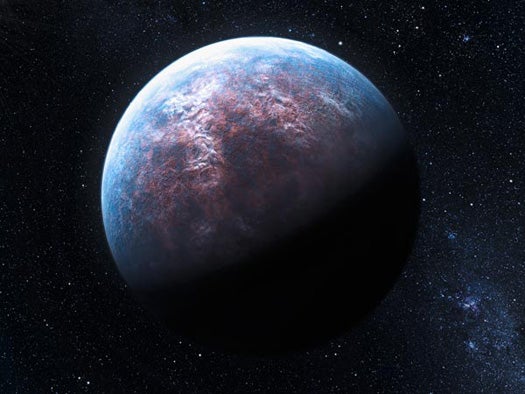
Scientists have tracked down another goldilocks planet 31 light-years from Earth, and according to astronomers it has some strong points in its favor when it comes to the possibility of harboring the ingredients for life. HD85512b orbits an orange dwarf in the constellation Vela, and it’s just the right distance from the sun--and just the right mass--to rank among the most Earth-like planets ever discovered.
And by “among,” we mean really one of just two (or three, depending on how you feel about Gliese 581g). Of the hundreds of exoplanets astronomers have recently discovered orbiting distant stars, only one--Gliese 581d--has been of the proper mass and distance from its star to be considered a strong candidate for habitability. Nearby Gliese 581g was once thought to be even more Earth-like than 581d, until some scientists asserted that 581g doesn’t even exist--a point that is still under debate.
HD85512b was discovered by the ESO’s High Accuracy Radial velocity Planet Searcher, or HARPS, in Chile (it’s the same instrument that found Gliese 581d. The data show that HD85512b is roughly three-and-a-half times the mass of Earth and rings its planet on the inner fringe of the so-called “goldilocks zone” that is not to distant and not too close to harbor liquid water. It’s size is also indicative of an Earth-like atmosphere of oxygen and nitrogen rather than the hydrogen and helium that dominate the atmospheres of larger worlds.That alone makes it a potential candidate for life, but HD85512b has a couple of other characteristics working for it. For one, its orbit is almost perfectly circular and stable, so any climate on the planet wouldn’t swing wildly as it orbits. The planetary system is older than our own--a full one billion years older--so clearly it’s had enough time for life to potentially have developed there. in the same vein, its star is also more mature than our sun so it is less prone to violent solar activity that could destabilize the planet’s atmosphere.
Of course, there’s no way to tell if it actually has an atmosphere with modern instruments, and atmosphere is a critical ingredient here. Since HD85512b is orbiting on the inner portion of the goldilocks zone, it is more akin to Venus than to Earth in the amount of solar energy it’s taking on. But scientists speculate that cloud cover of fifty percent or more could offset that proximity enough to allow life to thrive--albeit a kind of life more suited to a balmy, hot environment (relative to Earth’s).
On average, Earth boasts 60 percent cloud cover so the idea of HD85512b having 50 percent isn’t so far-fetched. In fact, it’s probably more likely than the idea of humans building a light-speed spacecraft and then making the 31-year journey to go in for a closer look at the weather. But it’s fun to think about.
Five amazing, clean technologies that will set us free, in this month's energy-focused issue. Also: how to build a better bomb detector, the robotic toys that are raising your children, a human catapult, the world's smallest arcade, and much more.


Online Content Director: Suzanne LaBarre | Email
Senior Editor: Paul Adams | Email
Associate Editor: Dan Nosowitz | Email
Assistant Editor: Colin Lecher | Email
Assistant Editor: Rose Pastore | Email
Contributing Writers:
Rebecca Boyle | Email
Kelsey D. Atherton | Email
Francie Diep | Email
Shaunacy Ferro | Email
I have read that our earth having a moon and its exact proximity\orbit is one of the main reasons life develop on earth. It would be nice if they find a similar type moon situation with this new type of goldilocks planet.
Maybe the Moon helped, but I doubt a single moon set up is required for life to form. There are probably a myriad of other ways. 31 light years huh? Man that is so depressing to think that even going the speed of light it would still take 31 years to get there. Does anyone know off hand what the current speed limit for man made objects is, in other words, how fast could a ship go before breaking up and human tolerance? Galactic distances are going to be the largest hurdle to becoming a space faring species, well, besides our own stupidity that is.
bring on warp prives and slipstream!!! wonder if there is good fishing in the seas there? ahhh the possiblities
I am not sure as to our limits; however, I can tell you that Voyager 1 is currently the fastest moving space craft which we have created and it is only moving at an approximately 38,500 mph (more than 62,000 km/h).
One of the big problems (at this moment) is the immense amounts of energy required to push ships to interstellar speeds. For example, if one were to push a Titanic-sized spacecraft to a (non-relativistic) speed of .1c, it would take the equivalent of about half the world's energy production in a year (or about 1/10th of the US nuclear arsenal); even at that speed it would take about 300-400 years to reach the 31 ly of that wonderful nearby planet (giving time for accel / deaccell). Space, here we come!
I think we've been looking at space travel in far-too much of a Newtonian way. Classic physics can't solve the problems of the future. We've just begun to scratch the surface of quantum mechanics and when we master those concepts we'll discover alternative modes of "trave" that will get us to Gliese or this planet much more quickly than current forms. I for one can see a form of teleportation/data transmission that could get us there almost instantly. If we could figure out exactly how Quantum Entanglement works, we might be able to get there in seconds. On TED you will find a video of a young man who made the first macroscopic quantum object. And there is no known rule that says what happens on the quantum level can't happen on macroscopically, and he pretty much proved it.
What if we could use quantum entanglement on a region of space? We could entangle a region of space enclosing a ship, with another region near some planet in a far-flung solar system. Then through so--as yet unknown process--swap those two regions, so that the volume of extrasolar material appears here in our system, and that ship has replaced it.
I'll coin this term right now! QUANTUM DISPLACEMENT
The speed/range of this system would be limited to the range of the technology that makes it possible. In theory, one day we'd be able to traverse the entire galaxy in seconds but that might require building a network of "anchors" that will swap entangled regions with each other, moving a vessel along. One downfall is it may only be possible to move a set number of vehicles at any given time (like a gigantic shell game).
I think scientists should RIGHT NOW figure out if its possible to use quantum entanglement on a region of space, and if its possible to force those regions to swithc places altogether or simply exchange their energy content(its hard to imagine, but I'm sure if you told someone from Ancient Rome that Venus and Mars are just planets that we've studied at length, and in fact, not gods they'd be shocked and surprised, probably in denial).
@lawsonrw
*cough*need to set up a reciver base at destination*cough
*cough*would have to travel to plant to do this*cough
*cough*quatum entagalment as of now only affects light*cough*
____________________________________________________________
*growls*If you troll or flare I WILL MAUL YOU!*growls*
I *STILL* dont understand why earth bound and space bound telescopes are able to clearly make out an entire galaxy 81 billion light years away from earth, can clearly see one of the arms in the spiral, and yet cannot capture a pic of a planet only 31 light years from earth
@macmansa
glad you offered challenges to the idea. What if there's things about the universe we don't yet know? What if each star has a specific signature? What if we could direct our machine to place a vehicle x distance from that signature? That might be far fetched. Perhaps, the best way would be to use a really powerful laser to "capture" that region, in which case it'd take 31 years to build this "highway." But every subsequent trip would be nearly instant.
That kinda takes care of the first two contentions.
Lastly, scientists have entangled more than photons. Everything from quarks and gluons up to hydrogen molecules and more can be entangled. According to "phsyics" a macroscopic object can't be in two places at once (as opposed to a quantum object existing as a wave and thus, in more than one location at any given time). But if you check out that TED video, you will see a piece of metal in two places at once. ;)
It seems the secret to getting macroscopic objects to behave as quantum objects is to make them absent of any form of radiation (heat, radio, light, etc.) So the obvious answer is to build a meta-material that can "cloak" a large vehicle from these forms of radiation!
http://www.nature.com/nature/links/010927/010927-2.html
Ok so NASA found another explanet. Really big news but were in the wide range universe is it located?? Up down straight across from earth? And what galaxy is it in cause every known galaxy has a name. And how does a
moon create life on earth??
@scubasdteve87
the reason we cannot look at a planet "only" 31 light years away while still being able to see a galaxy billlions of light years away is that not only is a planet's radiance dwarfed by the star it orbits but also a galaxy is billions of light years across compared to a few thousand kilometer diameter planet. Hope this clears things up
Lawsonrw I think current entanglement is limited to changing site B into site A. I am not sure if they swap information. So you would just be creating a copy of site A. You would also have to make the trip to site B the conventional way to build your second entanglement machine. Hopefully the machine can copy the electric signals going through your brain so you are still YOU when ya get there.
I'm think they are up to dozens of atoms at a time now.
Scubasteve I dont think we are detecting visible light. It's not just printing out a pic of a galaxy 81 light years away, its numbers then recreated by artists
@bob5312...you are correct, except for the size of galaxies, the Milkyway is 100,000 light years across, you are off by a few zeros, cheers
Would something at light speed either have 0 mass or infinite mass? So impossible right?
Meta-materials are looking like they will be the key to overcoming most of the challenges.
scubasdsteve8, good question. Firstly, the furthest galaxy detected to date is about 13 billion light years away and not 81. Second, galaxies (spirals) like our Milky Way are 100,000 to 200,000 light years in diameter. All exoplanets are in our galaxy and we could call it our "neighborhood". Galaxies shine visible light from billions of stars (some with diameters greater than the orbit of Jupiter) while a small planet reflects light from a relatively small star.
So galaxies can be see in different spectrums also while planets are detected by means of gravitational effects upon the star they orbit or by light differentials when the planet transverses the star. Not that both deltas are very very small and requires very accurate instruments.
You can see many nearby galaxies with a simple refractor and some with binoculars.
@bob5312 -- you asked several questions. I'm going to tackle some of them.
"Ok so NASA found another explanet. Really big news but were in the wide range universe is it located?? Up down straight across from earth?"
The planet, HD85512b, orbits the star Gliese 370, which is just 31 light years away. In the scales of "light speed", it's pretty close. It's in the Vela constellation, which is in the southern sky. In other words, if you live in the northern hemisphere, it's going to be pretty hard to see.
"And what galaxy is it in cause every known galaxy has a name."
Well, the star is only 31 light years away. The Milky Way galaxy, which is the galaxy we are in, has a radius of 50,000 light years. 50,000 > 31 ... It's pretty simple man, the star Gliese 370 and the planet HD85512b are in the Milky Way galaxy, just like us.
As for this article; I'm sure this is just the first of many potential planets we're going to find. I say "potential" because we don't truly know what it is we're detecting until we can directly see it. Anyways, there's nothing unique about our Sun, so it stands to reason that there are planets around every star we see. That said, science requires proof and the gathering of proof takes time, so these steps are very necessary. Discoveries such as this one are helping to lay the foundation of evidence that will change science from requiring proof other stars have planets, to science assuming other stars have planets.
Just the idea of these places and their distances from us is amazing. It blows my mind every time. The thought of standing on the moon and looking back at earth brings tears to my eyes. Imagining these galactic destinations is just amazing. On the other hand it might be like going on a trip. When you get there it feels pretty much the same as where you were :)
We Humans have to stop thinking in terms of our own personal existences. We have a problem with only thinking in terms of our life expentancies. Which means we only tend to foresee what will inherantly effect our own life spans. So we sit and hope that someone discovers faster then light technologies instead of approaching our futures with a more practical solution.
Given what we know and our current scientific capabilities we can and should start colonizing other terestrial bodies I.E. our moon, other planets moons etc. Mine asteroids and other terestrial bodies to create ships for longer distance travels within the universe. Create ships that are capable of sustaining life indefinately so we can send scores of people across the galaxy while having dual missions. Keep the ship on course for its destination, Reproduce to replace every ship member and train all offspring to take the place of every crew member as necessary as they grow old and pass away. This would allow for 100's of years worth of traveling through space. The ships would have to have the technology on board as well to mine asteroids and explore other terestrial bodies to maintain upkeep of the ship so it could be repaired as needed.
This could be done but would take a massive ship with the ability to simulate home world comforts to keep the species from developing psychological disorders through generations of being away from the home world. However this all starts with one step. That step is starting to move people off this world and on to colonies planted on terestrial bodies within our own solar system.
@ kehvan
So our milky way galaxy is 50,000 lightuears large. Don't you think NASA would have discoverd everything about our own galaxy with all the probes there sending into space, everyday there sending something new up there. It says that the planet was made 2 billion years before our solar system was created do shouldn't that section of the milky way show any evidence as to how our galaxy was created?
@lawsonrw I like the way your mind works. I also frequent TED and have been to one of there "Gatherings"
genome8 this was not NASA "Ok so NASA found another explanet". It was dicovered by ESO. ESO is the European Southern Observatory. Their HARPS instrument has been making many great discoveries lately. And this article should have mentioned Stephane Udry the Swiss Astronomer who led the discovery including more members of the University of Geneva. It`s made a bit confusing because the article on national geographic somehow insinuates that Lisa Kaltenegger led the discovery while she led a self made follow on `evaluation` study to the planet`s Habitability and not the planets discovery itself. Her follow on study was submitted on 17 August. As she states herself she follows on the just published data by ESO/Geneva, stephane Udry`s team that discovered the planet in the Goldilocks zone.
@scubasdsteve87 It helps to think of it like this. Your eyes are receivers of a signal, and the greater the distance from your eye to the signal of interest, the lower the signal to noise ratio is. The same goes for any analog sensor that is meant to be interpreted by the human eye. The greater the distance, the lower the signal to noise ratio.
Have you ever needed to turn the volume up on your TV because you had trouble hearing it? Well pretend that your TV is the planet HD85512b and you are 1 mile away from it. The sound waves travel just like light, but the farther away the receiver is, the more degraded and distorted the sound will be.
Here is the really cool part. When we look into space with an Earth telescope and see galaxies and star formations, that information is all right here on earth. In fact, information from the entire universe is being beamed to us and it is no farther away than your eye is to your eye lashes.
Now come on, that is pretty cool right? Information about the entire cosmos is literally sitting here on the surface of our planet 24/7.
@genome8 During our short existence as a species we have not witnessed the defacto birth of a single galaxy in the universe. The truth is, not even Stephen Hawking could tell you how one is created.
I personally believe this is because gravity doesn't really work the way we think it does. We believe that every particle has an attractive force, and the aggregate sum of a group of dense particles amplifies the attractive force of the whole.
I think this is where the confusion stems from. We kind of accept gravity as a law of physics, but we don't know how or why it even exists. We just kind of put together a strong case for it based off of observation.
If gravity is the way we understand it and it actually did exist, how is it that the part of the asteroid belt that is farthest away from Jupiter and eclipsed by the Sun, maintains its steady circular orbit even with the gravitational interference from the Sun being closer to those asteroids than Jupiter? It would seem to me like the Sun's gravity would cause those asteroids to move inwards towards the inner solar system.
Instead we see asteroids being pushed away from Jupiter as it makes its procession around the Sun.
given that all of these planets we discovered dwelling in the so called "goldilox" zone are relatively close to earth on a grand scale, it is not unreasonable to believe these "goldilox" planets will start popping all over as our tech for seeing them increases.Very exciting for thinking of future colonization of other habitable worlds, I have always been a dreamer when it comes to the infinite possibilities the universe holds. The gradual discovery of extra-solar planets reminds me of early astronomy, at first all man knew of was the sun, the stars, and the moon, then little by little we started to discover more and more planets orbiting our sun until we have discovered all of them and all of their moons. One day man will locate the perfect habitable extra-solar planet and we will go there, one-way (warp-drive/wormholes) or the other (a really long road trip)! That is if we last that long...
Perhaps we can point a few satilite dish directly their way and broadcast a few " HELLO, HOW IS YOU DAY? " Messages.
Since obvisously we can not be there in our own life times, maybe we will experience the joy of somebody communicating back to us and learn something new.
0101011101101111011101010110110001
1001000010000001111001011011110111
0101001000000110110001101001011010
1101100101001000000111010001101111
0010000001100010011001010010000001
1001100111001001101001011001010110
1110011001000111001100100000011000
0101101110011001000010000001110011
0110100001100001011100100110010100
1000000110000100100000011000110110
1111011011010110110101110101011011
1001101001011000110110000101110100
0110100101101111011011100011111100
1000000100100001100001011101100110
0101001000000110000100100000011001
1101101111011011110110010000100000
0110010001100001011110010010000001
1000010110111001100100001000000111
0011011011010110100101101100011001
0100100001
No, lets not be friends. *muffled in the background* Charge the planet destroyer.
01101001011101000010000001101001011100110010000001110111011000010111100100100000011101000110111101101111001000000110010101100001011100110111100100100000011101000110111100100000011000110110111101101110011101100110010101110010011101000010000001110100011001010111100001110100001000000111010001101111001000000110001001101001011011100110000101110010011110010010111000101110001011100110000101101110011001000010000001110110011010010110001101100101001000000111011001100101011100100111001101100001
@kook916,
You need to copy and past you binary into
notepad and hit the enter key often
to creat a block. Once finish you can
copy and past what you have in notepad
to here. It works much better that way.
Have a wonderful day!
"Does anyone know off hand what the current speed limit for man made objects is, in other words, how fast could a ship go before breaking up and human tolerance? "
None of those things matter. The problem with higher speeds is how can you get enough energy for the acceleration. That is why they are looking at Ion propulsion. The energy for the rocket is provided by the sun, no need to carry the fuel for energy on board.
This is good! The number of potential habitables and the potential number of habitables (Kepler's unconfirmed) increases rapidly.
@ BubbaGump:
The requirement of a Moon that stabilizes the Earth rotation axis and thus inhibits some climate swings is part of the Rare Earth hypothesis. But that was mainly constructed as a bayesian model to shore up wrongheaded religious ideas of human uniqueness.
It is likely that an absence of a moon analog makes some climate swings less. But Earth has still climate swings and life survives. It may also be that climate swings are beneficial for evolution, many propose that a "snowball Earth" climate promoted the rise of complex multicellulars.
@ lawsonrw:
Relativity makes faster-than-light travel impossible; it has all sorts of impossible implications if it could happen. As some physicist said, roughly, 'if it happens the universe implodes'. It hasn't imploded, so it can't happen. =D
@ tatters:
The light has traveled ~ 13 Ga (age of universe), but the universe expands so the remotest galaxies in the observable universe are ~ 45 Ga away. http://en.wikipedia.org/wiki/Observable_universe .
0100100101110100001000000110100
1011100110010000001100101011000
0101110011011110010010000001100
1100110111101110010001000000111
1001011011110111010100101100001
0000001100010011101010111010000
1000000111100101101111011101010
0100000011000100110010100100000
0111001101110101011100100111000
0011100100110100101110011011001
0101100100001000000110100001101
1110111011100100000011011010110
0001011011100111100100100000011
1000001100101011011110111000001
1011000110010100100000011101110
1101001011011000110110000100000
0110111001101111011101000010000
0011001100110100101100111011101
0101110010011001010010000001110
1000110100001101001011100110010
0000011011110111010101110100001
0111000100000000011010000101001
0110010110111101110101001000000
1100001011100100110010100100000
0110000100100000011100110110110
1011000010111001001110100011110
0100100001
@Torbjörn Larsson_OM, I agree with you in a sense. The earth with or without a moon would of still had life. I believe life will always find a way to survive and exist all throughout the universe.
0111010001101000011000010110111001101011011100110010000001101001001000000110011101110101011001010111001101110011
@ Kehvan:
"I say "potential" because we don't truly know what it is we're detecting until we can directly see it."
Habitability in the sense of radiation balance can be verified, in the same sense that exoplanets themselves can be by several different observations. Conversely, we don't see things "directly" (as is) but by some form of observation, more or less direct.
I love how we put almost a religious faith in the thing most likely to change = science. The science of today is so far from the "science" of the 1500s. Imagine what they'll be saying 500 years from now. They'll probably have quotations marks around our understanding of science, specifically that related to speed and relativity. And special relativity actually allows for some FTL but physics in general is based on LINEAR relationships. What if you could go from one place to another without ever existing in the space between (a common quantum characteristic). What if we could do that with a ship and not just a single atom? Just because we haven't done it doesn't mean it can't be done. And BTW, quantum entanglement frequently exceeds the universal speed limit by several orders of magnitude, exchanging information (spin states) hundreds of times faster than light, but the universe hasn't imploded yet.
@Golgunoth
The fastest man made objects were Helios A & B reaching max speeds of approximately 157,000 mph. Also the fastest launched man made object is New Horizons with an escape velocity of approximately 36,000 mph (faster than Voyager 1's escape velocity speeds).
@genome8
This solar system 31 lighyears away is 1 billion years older. Not two.
@jmadriga12
Hubble and Spitzer are the only two space telescopes I know of that can actually see and photograph images (they also do infrared which is why you can see nebulas in certain photos taken by the telescopes).
@tatters
The first extragalatic extrasolar planet potential was discovered in 1996 in a Twin Quasar Gravitational lensing system. Not too long ago, a second potential was discovered around a star in our neighboring galaxy Andromeda, and Popsci did an article of the first confirmed exoplanet in our galaxy of extragalactic origin in a star cluster which is the remains of a smaller galaxy that long ago melded with our own galaxy.
@ashtmoff
I totally agree with you.
@david_forbus
Ionic propulsion is the primary term for what is more generally called (these days) electric propulsion. The scale for what you're talking about does require nuclear reaction to produce the amount of energy necessary to yield the necessary velocity for interplanetary travel. Interstellar travel at relatively shorter time intervals would require more energy than our civilization is capable of producing, or technology that operates on a new set of physical laws.
@Torbjorn Larsson_OM
Relativity is a theory only mildly proven by (relatively speaking) a handful of scientific experiments. It still has yet to gain the credibility for us to even define it as law, and even our own laws can still be brought into question based on our limited experience.
To say the universe will implode if the impossible is possible is akin to a more primitive human saying that if men could fly Ragnarok will bring forth the end of days on Midgar.
When it comes to laws and rules (even in science) they are no different than the rules and laws that govern man made societies; some can be bent, others can be broken.
Besides if you believe in extra-terrestrial visitation, let's say intelligent beings flew to this planet in spacecraft from another world. They wouldn't have come from any planet in this solar system.
Based on vehicle size from UFO reports (if you believe that sorta thing), the vehicles would have to have come from a far off (yet cosmically nearby) star system with technology that defies our laws of physics.
When there's a will there's a way.
@lawsonrw
Exactly my point.
To comment on the article now, I think it is highly likely the more detailed of a picture we begin to see of our own region of [interstellar] space, and the entire galaxy as a whole, the more we will begin to realize that our "neighborhood" and our "city" (galactically speaking)is more populated than we think with planetary star systems, potential life harboring planets, and subsequently extrasolar life; sentient and non-sentient.
I just wanted to say that with all the scientific progress we're making the Technological Singularity really is drawing near. Have you read my book. The Singularity is Near: When Humans Transcend Biology?
Ray out!
@RayKurzweil, I wish I could be a invisible Japanese mouse in Rays house and just listen to all your stories.... ;)
Ray, did you read in PoPSci about company that invented the invisible Japanese mouse? Their results were just published in PoPSci. The public got so excited about the invisible mouse, everyone wanted one. So then the business started growing thousands of invisible mice and selling them all across the world. Eventually the company went bankrupt, because so many customers complain when they open the box, there was nothing in it.
What does this have to do with a goldilocks planet? I don’t know….. lol.
@everyone
please stop being mean to BubbaGump. he is a very influential person.
this is very exciting news. i wish we travel there soon. might take a while to get there.
_________________
The people of the world only divide into two kinds, One sort with brains who hold no religion, The other with religion and no brain.
- Abu-al-Ala al-Marri
I am a bug. The one to appreciate is my puppy! She give love universal and with wonder! Be like her!
@jediMindset. where ever a person come from, we are as human suppose to help along the way. Why do you insult someone who believe in religion as having no brain. This is an attack of a sort. You could just choose to pull out our hand and save a drowning man, why do you shout first to the man he is an idiot, what good does this serve you or the man. Sir, save the man! Respectively, I ask you, I do not know why you put this in each comment you post. Help me learn you learn the lesson you profess.
@RayKurzweil I agree with your ideas and I wish you well in your pursuit.
I've been thinking about this for many years now. Theoretically, for you to successfully transfer your conscienceness into a new digital and virtualized body, it must be done with extreme care to bypass the evolutionary circuitry that ensures the survival of our species.
I can guarantee you that your subconsience mind would go as far as bringing you to the edge of death itself before allowing you to abandon it.
Cloning the complete image of your biological brain will only create a clone of your intelligence. To everyone else your clone would be the immortal Ray Kurzweil. You'd leave a legacy, but you wouldn't defeat death.
Here is an approach which will work, but it will take time. The theory goes that you would grow your digital brain during your biological life from a fresh untrained neural network. The digital brain would slowly and strategically disable certain parts of your brain's components and become the system of record over time.
The digital brain would be able to proxy the biological brain's neural network and slowly become your new subconscience as your conscience mind completely relies on your new digital subconscience to serve up your biological memories.
Your biological brain's components would slowly be turned off and replaced by the new digital and virtualized brain components. The digital subconscience will basically become the Google of your biological brain.
Using this approach one would be completely oblivious that the process was taking place. If the biological subconscience found out this was happening it would immediately trigger the Amygdala and fear would alert the conscience mind that death was imminent and evolutionary survival mode would kick in.
This would cause a flight of fight reaction and the body would reject the digital brain 99 times out of 100.
Best wishes Ray. Either way you're good to go. The singularity has already happened and your biological brain is now being slowly shut off as your new digital one recreates your entire life experience from your biological memories. The light at the end of the tunnel actually is heaven, your digital singularity.
@SolomonSinclair, Do you collet monies on this ideology? What an absolute fraud you are! I hope people ask you intelligent question, prior to put monies in your hand or those you represent. Can you dance and sing too. I am sure you are a wonderful salesman! Oh my gosh, you sing a song! I like fiction and I will enjoy the further froth you bring! You such a joy! You are a complete pleasure of fantasy! You just lack any supporting FACT!
YOUR A JOY! TRANK YOU!
Now, all we need to do is transmit a patterned message via light, and then wait 62 years for a potential response. Who's with me?
Good first we find a planet with a breathable atmosphere and life on it so we don’t half to store years of food for the journey. Next we look at our limitations, to reach a tenth or a half the speed of light, by using Saturns magnetic field as propultion. This will put 2 grams at a time within a sixty year journey. So, our entry vehicle will half to be made of parts that assemble from segments this small. Next, we send what will survive the journey the smallest mammal a shrew or engineered mouse that has been frozen fully or in cloned segments. This has the starter womb to give birth to larger mice to an engineered mouse, to give birth to a small pig, then, to larger pigs, to one engineered to give birth to chimpanzees. From chimps to a small tribe of girls that learn sign language from their chimp mothers to learn language from each other, robots and media. I call this process emryolution and the girls Embryonauts. This could all be done with a smaller budget and is happening now faster than going to Mars.
@BubbaGump
lol. thats my sig. i put it there so that people see my views on the matter. no disrespect intended towards you. lol.
_________________
The people of the world only divide into two kinds, One sort with brains who hold no religion, The other with religion and no brain.
- Abu-al-Ala al-Marri
@AstroBoy
no problem. hes a good guy. i dont understand why people dislike such a good person.
_________________
The people of the world only divide into two kinds, One sort with brains who hold no religion, The other with religion and no brain.
- Abu-al-Ala al-Marri
Mr. JediMindset, well I am traveling and off to Brazil for a stay. I will return. I do travel a lot in my job. I feel very lucky to have such an interesting job. I get to play with gadgets and toys and electronic thingies. I get to do lots of physical stuff as well. I go to places that are unusual too. You have been so nice to me and I really appreciate your comments. Take care, God Bless and I wish all good things happen your way! Bye.