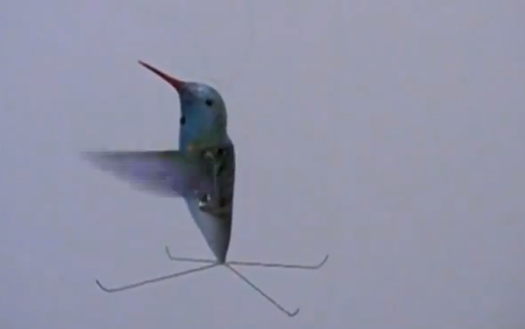
Of all the DARPA projects we follow here at PopSci--and regular readers know that we follow a lot of them--perhaps none has been quite so fascinating as the Nano Air Vehicle (NAV) program, a.k.a. the robotic hummingbird, which culminated earlier this year in a working prototype. So you can imagine our delight when DARPA released this short video chronicling the bird’s journey from drawing board to early prototype to crash test dummy to eventual functioning, camera-equipped nano air vehicle that fits in the palm of a hand.
DARPA began pursuing the project in 2005 and commissioned Aerovironment to begin work on prototype technologies in 2006. Since then, as you’ll see in the video, it hasn’t always been smooth hovering. Early versions were difficult to handle and crashes were not infrequent. But the final product is nothing short of impressive: a tiny, robotic bird capable of two-wing hovering, fast forward flight, and maneuvers like rolls and flips all while carrying all of its own power sources, a small computer, and a tiny camera that beams a feed back to the operator.
Not bad for six years of intense work and more than 300 wing designs. See it come together in fast forward in the video below.
[DARPA]
Five amazing, clean technologies that will set us free, in this month's energy-focused issue. Also: how to build a better bomb detector, the robotic toys that are raising your children, a human catapult, the world's smallest arcade, and much more.


Online Content Director: Suzanne LaBarre | Email
Senior Editor: Paul Adams | Email
Associate Editor: Dan Nosowitz | Email
Assistant Editor: Colin Lecher | Email
Assistant Editor: Rose Pastore | Email
Contributing Writers:
Rebecca Boyle | Email
Kelsey D. Atherton | Email
Francie Diep | Email
Shaunacy Ferro | Email
Great tech here... If they can work on the noise it puts out it could be perfect for recon work, spying, and local law enforcement. Possibilities are endless, i'm waiting for my NS5.
One step closer to the age of easy political assassination :( Put a GPS, a camera and explosives on that thing, and we have a very cheap way to kill people. Great job, DARPA...
Im thinking the explosives might be to heavy for the little guy maybe adapt the nose into a needle to administer a fluid of choice for your future assassinations...
So I just got done reading The Keepers WWIiI and it talks all about this type of biomimicry, particularly where the exact structure and movement of an extremely agile animal is imitated by a robot or vehicle. I used to think biomimicry was just something relegated to more fantasy oriented fiction and science fiction. I didn't think there was a point. The book helped me see that it wasn't. So now I'm doing some research on my own and seeing how true it is. The book talks about small hummingbird and/or insect-like robotic drones that are used for surveillance and take downs, such as administering tranquilizers through minute syringes. More amazing, was the sky infantry, the soldiers of the sky, who ride about in kolibri chariots that have hummingbird biomechanical wings. The chariots are controlled by direct mind to tech interphase, which is also coming along well in our present. This allows the charioteer to freely use their hands to wield about guns or even powerfully built swords. The possibilities are endless, yet the author, Rick Friar, captures quite a bit within his imagination. I just can't believe how real it all is