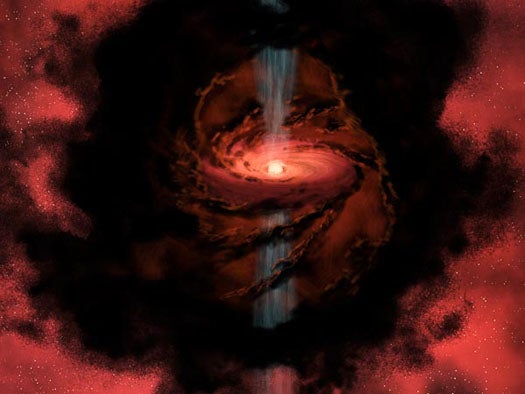
Researchers looking for signs of life elsewhere in the universe often start by looking for one key ingredient necessary to complex life as we know it: water. And just 750 light-years away, they’ve found quite a bit of it spewing from the poles of a young, sunlike star that is blasting jets of H2O into interstellar space at 124,000 miles per hour.
This discovery is interesting on a number of levels. For one, it indicates that throughout the universe young protostars could be distributing vast quantities of water, potentially seeding life elsewhere. But it also sheds some light on the formation of our own sun, and the role water may have played in its formation and in the formation of our own planet.
The star was discovered by ESA’s Herschel Space Observatory, whose eyes were able to pierce the dense cloud of gas and dust that is feeding the star’s formation. There, Herschel saw light signature indicative of hydrogen and oxygen, and in following those traces found that these atoms are forming water on and around the star. But as the molecules move through the star and are injected into the massive jets of gas spewing from the poles, the heat and pressure vaporize the water into jets of gas.Only when the gas jets are far enough away from the star do they rapidly cool and turn back into liquid. At this point, the water droplets are essentially bullets of water moving something like 80 times faster than the average round fired from a rifle. And there’s a lot of them. The amount of water ejecting from the star is equal to the amount that flows through the Amazon every second, researchers say.
Astronomers think this water-spewing stage is short, but that it is also something every protostar goes through. If so, that means water could be scattered all over the universe. And that’s an interesting thought indeed.
The incredible innovations, like drone swarms and perpetual flight, bringing aviation into the world of tomorrow. Plus: today's greatest sci-fi writers predict the future, the science behind the summer's biggest blockbusters, a Doctor Who-themed DIY 'bot, the organs you can do without, and much more.


Online Content Director: Suzanne LaBarre | Email
Senior Editor: Paul Adams | Email
Associate Editor: Dan Nosowitz | Email
Assistant Editor: Colin Lecher | Email
Assistant Editor: Rose Pastore | Email
Contributing Writers:
Kelsey D. Atherton | Email
Francie Diep | Email
Shaunacy Ferro | Email
this is phenomenal. Wow
So it wasnt just comets that brought water to planet earth. It was your friendly neighborhood star the sun!
very cool
The Intergalactic Car Wash, or should I say Planet Wash?
"We use High powered Jets of Oceans of water to blast those pesky, stuck on life forms completely away! Leaving you with a planet clean and ready for your population!"
Sounds like something straight out of the Hitchhikers Guide.
No wonder why Ford always needed a towel!
No, quite hot actually.
This is amazing. Enormous steam jets shooting out of a star. Wow.
-Spouting a fountain of nonsense since 1995-
Am I the only one that realized that water is more basic than rock. Come on people. This planet didn't start as a giant rock that accumulated water. It started a a giant water ball that accumulated rock...like the gas planets further out. I figured this out when they said they had discoverd water much further down in the earth than was thought possible. Our planet is saturated to the core with it. Stars are hydrogen. The most abundant element because it is the most basic. To get water you only need to add an O. Early on I thought that the planet started as rock and hydrogen, and the abundant volcanos stirred up enough lightening to turn hydrogen into water. Then, I realized if we had gas planets, why can't we have water planets. A water planet would collect rock which would build a core until it gained enough mass to heat itself. Core melts. Creates magnetic field. Water vaporizes. Creates atmosphere. Incredibly simple.
can you imagine the permit process they had to go thew to get that fountain built.
@dahiteman
If our planet was made entirely of water and rock was added over time, then the planet would not exist.
Without the solid core of the earth surrounded by the molten iron, the earth would not generate a magnetic field strong enough to hold an atmosphere on the earth, let alone water. The sun would blast everything off of the planet like what happened with mars.
@GTO, didn't he cover that by saying the rock collected and formed a core?
@Zabazoom Don't think for a second that there wont be interplanetary zoning laws.
The earth would have a core by the time the atmosphere was created. The core would promote the atmosphere. If a gas planet can exist, why can't a water planet? This question is not for GTO. Someone with actual knowledge about why this could not be.
I think typically you see gas planets existing further from the sun, and rocky planets closer to the sun...
Which makes me think that gasses might be swept out by solar energy if they are close enough.
If this were true, it could be a reason for why a water planet could not have existed at the distance from the sun where the earth exists...
I'd imagine before there could be a water planet, there would have to be a cloud of water that slowly condensed into a ball.
If close enough to the sun, this "space fog" could be dispersed before it has a chance to form into a water planet.
I don't have any evidence... just a possible explanation for why it "couldn't" be.
Interesting concept though...
@dahiteman
interesting...i never thought about it that way. makes sense. but it still needs a solid/rocky core in order to keep it intact. we only perceive things in 3 states(solid,gas,and liquid) what if there were other states that we couldn't see?
@Jedimindset
actually there are FOUR states of mater solid,liquid,gas, and PLASMA just correcting
we already have "water" planets they're called neptune and uranus the ice giant.
@B.V.
there's a problem with this idea and that is we've found countless gas giants closer there their stars then any planet in this system. many beleive our own gas giants form close to the star then get thrown out to where they are now.
Think of earth as one giant comet, mostly composed of frozen water and some rocky material also. As water is spewed out from a star some would fall back down like a fountain, some would fall into orbit as comets (frozen water). Those would slowly gather to form a large frozen planet like Jupiter's moon. It would then collect rocky material which would settle to the core and once there was sufficient mass it would heat up. The outside frozen so as to not lose to much mass to solar wind and the core is molten and slowly generating a magnetosphere to protect the melting ice from the sun. Then the water vaporizes. This regulates the temperature of the atmosphere. The chemical bonds that are most capable of maintaining energy levels become the most common. That last sentence sums up existence for stars, planets, molecules, and....wait for it....life. There is your meaning of life people. Sorry its not that exciting but it gave us the cosmos and all of the life forms in it, including you. I'm rambling. I'll stop now.
@macmansa
oh yeah i forgot that one.
This is a very insightful discovery. I always thought that the earth getting its water from comets was too farfetched. I mean the amount of water on the planet...it would have taken billions of comets hitting earth to create the oceans. But this is amazing...young stars create their own water for their solar system.
Can't wait 'till they spy young planets forming. Then we can put the water v rock debate to rest.
@dahiteman...sorry, just because you dream up something in your great mind does not make it possible, especially since you have no evidence to back it up, we all have great minds, some know it's limitations and some don't, dreaming up fantasies are fun but you should know the diffrence between that and a real hypothesis
@Aldrons Last Hope...your typical rubish...really? billions of comets? how much water does an average comet have? how much water is on earth? great math you have with your guessing game...they have imaged young solar systems developing, no water jets from their stars observed...nicely done, you and dahiteman should go on a date
Wow. Chuck is a bitter little man. Do you feel smarter now chuck? Does it make you feel better when you TRY to put others down? I, for one, am impressed with you insight. Thank you for enlightening us with your wisdom.
@macmansa & @Jedimindset
Actually, there are currently FIVE known and accepted states of matter; the fifth being Bose–Einstein condensates.
Also just correcting :-)
@dahiteman...you are just another hypocrite, don't want to be called out on nonsense? too bad
Yeah dahiteman who do you think you are Mr. Big Shot!
I must be fooling myself, but is the above image showing the death of star an artistic rendition or an entirely real image produced by a telescope.
Sorry, I've somehow misplaced my glasses.
Anyways, without stars life would not be possible. The general study in it should remarkably bring new theories and matters to look about.
Thank you, HyperNova
@DrChuck...I don't mind educating you.
http://hypertextbook.com/facts/1998/AvijeetDut.shtml
earth has 138,400,000,000,000,000,000 kg of surface water in the oceans alone (approx.) this is not counting all the water in lakes, rivers, ice caps, ice bergs or ground water. Let's say a meteorite has 10,000 kg of ice (this would be a huge meteroite and is very generous). IT WOULD STILL TAKE BILLIONS OF THESE METEROITES TO DEPOSIT THE WORLDS OCEANS. I wasn't guessing, just estimating..since you are incapable of analytical thinking I can see why you couldn't come to the same conclusion. Like I said billions and billions of meteorites hitting the earth is not feasible.
PWNED!
Well, if I was a religious fundamentalist type - which I'm not - I'd be ecstatic, because Jesus turned water into wine, and here's 'God' turning stars into water.
If I was a new age hippy type - which I'm not - I'd be ecstatic because here's the very definition the Aquarian Age is upon us: a water bearing star.
Saying all that, Astronomy's starting to resemble Ecology if not Biology, because instead of bunches of random unrelated processes flinging random matter in random directions, we're finding galaxies endlessly tethered to all the other galaxies by complex arrangements of innumerable interweaving filaments of matter, (which the expansion of space itself should destroy, hence the need for dark matter, etc., to 'explain' their continued existence).
And now we have 'baby' stars which, before they move onto the next stage of their existence, birthing planets, shed enormous amounts of exactly the sort of substance which'll not only promote their dust disks cohering and clumping together to form fledgling worlds but, once they are formed, will rain down on them the quenching elixir they'll need if they're to have a chance of developing the types of chemical processes necessary for the emergence of life.
So if we are considering this as a typical process, then would it stand to reason that certain oxygen isotopes would be thrown out at a typical time and to a typical distance, according to their weight? If so, then it may bring into question the idea that the moon was blown out from the Earth due to a massive impact. Our oxygen isotope may be more common than we thought, yes?
Dahiteman, Im just a logical thinking being, simplistic in nature, but I've never heard a "yes it does" or a "no it can't" answer to the question. DOES WATER BY ITSELF POSSESS GRAVITATIONAL PROPERTIES? Let alone in space? That's my first flaw in your theory. Please don't see this as the same attacking criticism from the other posters. Like I said, I'm pretty simple minded.
Somebody forget that all it takes to make all those water are huge amount of hydrogen and oxygen, the lit a spark, boom!!
Water.