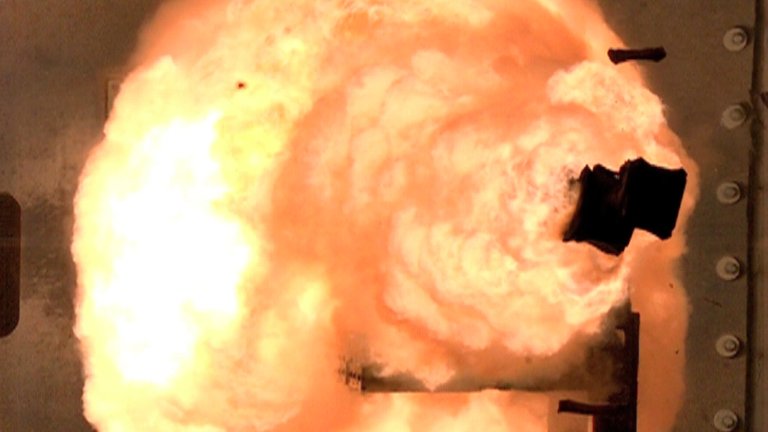
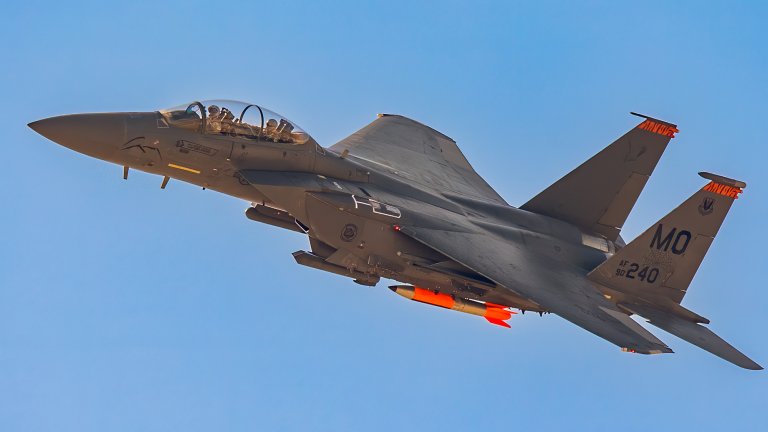
The Navy’s death ray weapon keeps burning through laser records, on its way to the ultimate goal of searing through 2,000 feet of steel per second.
The Free Electron Laser’s latest milestone involved running its electron injection system for eight hours at 500 kilovolts. That will help the laser become more powerful and more deadly, as Wired’s Danger Room reports.
The FEL will be a multiple-wavelength weapon that can be altered to account for all the variables it would encounter at sea, like aerosols and moisture in the air. The laser doesn’t use any crystals or inverted prisms or any other materials to focus its light — it works like a particle accelerator, moving electrons around a racetrack to speed them up.To make it more powerful, you would add more electrons, and the electron injector takes care of that. The latest achievement proves that lots and lots of electrons can be injected over a long period of time, meaning it’s possible to make the laser much more powerful.
It currently produces a 14-kilowatt beam, and it needs to reach 100 kW to become a viable defense weapon. The ultimate goal is a 1-MW laser.
In December, ONR researchers said they proved their injection system is capable of producing the necessary electrons to fuel a megawatt-class laser beam, and they’re months ahead of schedule.
Five amazing, clean technologies that will set us free, in this month's energy-focused issue. Also: how to build a better bomb detector, the robotic toys that are raising your children, a human catapult, the world's smallest arcade, and much more.


Online Content Director: Suzanne LaBarre | Email
Senior Editor: Paul Adams | Email
Associate Editor: Dan Nosowitz | Email
Assistant Editor: Colin Lecher | Email
Assistant Editor: Rose Pastore | Email
Contributing Writers:
Kelsey D. Atherton | Email
Francie Diep | Email
Shaunacy Ferro | Email
The goal is to cut through 2000 feet of steel per second? Are you sure that's not a typo? That seems like a lot. Any reference on that? And why so much?
Never mind. I read the linked article from Wired. Wow! That's a lot of laser power. Still not sure why they want to cut through 2000 feet of steel a second though. Is that to vaporize (future) electromagnetic rail gun slugs incoming at mach 8?
@laurenra7: 2000 ft a sec sounds right to me and here is why? The laser would be mounted as a "defensive weapon" used to target income hostile object such as French Exocet anti-ship missiles or the new Chinese anti-carrier missile. With multiple high speed targets the system will have to acquire, lock on and fire a quick high enregy burst of maybe no more than .05-.10 secs before it has to move to the next threat. Not a lot of time for the laser to damage its target but if it can cut through 2000 ft a sec then 0.1 sec is about 200 ft of steel, which easily excedes the size of any in inbound missile or jet. It would also exceed the width of a good may naval vessels.
Reading the same sorry on fox they said that the current laser can burn through 200 feet a second, so I don't think that 2000 fps is an unrealistic goal.
"During a private tour of the Jefferson Lab in Newport News, VA., on Friday, FoxNews.com saw scientists blast unprecedented levels of power into a prototype accelerator, producing a supercharged electron beam that can burn through 200 feet of steel per second."
Read more: http://www.foxnews.com/scitech/2011/02/18/navy-breaks-world-record-futuristic-laser-getting-real/#ixzz1EMJNx45U
can't we get a demonstration?
I, for one, would LOVE to see a laser with that kind of destructive potential in action.
whats the point of 2000 ft per second? that would destroy anything in the sky almost instantly, and could cut a ship in half(if it can fire for a long enough period of time)
seems like 10 wimpy lasers would deal with multiple threats better than one giant one struggling to point at all the targets in time
@st.sample
You must not of gotten the memo about fox news having the habit about reporting the wrong info to it's users
@funkyskunk
While cutting ships in half would be pretty sick, with the range of an Exocet, Styx etc. (around 100-200 km I believe?) anti-ship threats are generally far beyond the line of sight. The kind of ships that these would be mounted on (CGs and DDGs) can already deal with incoming warheads, this is ultimately one more weapon that would be integrated into the existent Aegis defensive bubble.
Okay it has to have a target with a clear line of sight right? P34 BR3W3R
I wonder if they could use the laser to slice an enemy ship in half?
So, all you have to do is fire rounds from strategic positions and the firing of the all mighty laser could destroy their own communication satellites or any other space junk in the laser's way.... The problem with these "great" weapons is, do you really know what is beyond the target? Every hunter is supposed to think about that question.
(Future New Flash: Invasion by space aliens caused by assumption war was declared after their ship tagged by laser.)
Cut through 2000 feet? At what diameter and at what distance? Seems to me if it cuts through 5 feet of steel that should be ample, considering that almost any aerial threat will be made from either a fraction of an inch of aluminum or carbon fiber. So if currently it cuts through 200 feet per second then it can cut through 5 feet of solid steel in 2.5 milliseconds or through an engine, then wing and the fuel inside. It seems like accuracy is more important now than power.
well of course. when power was more important than accuracy, it was because you were trying to bash the walls of the opposing kingdom down, and walls are pretty hard to miss.
@everybody who has posted a comment on power of laser: 2000 feet a second does seem extreme but you have to remember the primary goal of this thing is too shoot targets down. No imagine a enemy curise missle coming at your ship at mach 8 or in the future EVEN faster. you absoutly do NOT have 1 full second. they want to be able to take down a missile instantly. Also remember not all metals have a melting point as low as steel. The target may be FAR more heat restance and treated. even the side of a war ship. also think about this: the laser doesnt stop until it hits something. you are moving you laser cannon around and you fire it: you fire it for 1 millisecond. its enough to burn a big enough point into your target, lets say a missile. But if your laser takes a long time to burn through it, it is no longer a single point of light. it going to be tracking wildly and it might miss. you are going to laser beams flying PAST the target. thats bad. they may be aming for 2000ft of steel of sec, but they are probably looking at firing times of 5 miliseconds or something like that for small targets
@St.samples Do you have something more credible than fox news?
Fox News is not exactly accurate or reliable.
FEL vs Alderaan.
How do you think it would do?
I am still puzzled why they keep showing this thing mounted in place of a Sea-wiz barrel....is it for the 3-axis motion?
So if the earth were made out of steel we'd be able to drill to the center in 3 hours? I wonder how long it would take to charge up a 3 hour burn.
The more reflective the surface, the higher the needed output. If you want a laser that burns through mirrors, it has to be obscene.
Also, moving targets move - you only get to apply as much heat as you can keep traked. .01 second can burn something going rather fast, .001 second can burn something going extremely fast. What is the point of a speed of light projectile (electrons) if it cannot kill at the speed of light (including possible future scenarios of fire/counterfire).
More power = more range.
Think of how you would counter this. It should have enough range that it can take out any sub-nuclear threat that is exploded before impact for shock-wave effect damage. It should be fast enough to take out multiple small targets from a scattering shrapnel-esque munition (like shooting down every pellet of a shotgun blast) or multiple simultanious threats, and powerful enough to take out the mass of any mass based munition that is less than orbital.
Yes, I know that includes weapon types not-in existance, but the military's goal is never next-step, but always "how do we defeat the move that comes after the next-step."
@battleshield I am not sure why they use that pic. They have run a story about this laser 3 or 4 times by my count and they use the SAME pic every time. I guess now that we associate that pic with this laser program they keep using it.
@Oakspar77777 yeah. that is the exact same thing I posted....
@ Oakspar and inaka-rob
What do you think they're making missles out of these days anyways? Highly polished diamond infused titanium with foot thick walls that weigh 120 tonnes and fly at mach 8? Funkyskunk2 had the right idea, cheap and plentiful. They already can shoot down aircraft so lets run with that and get the bugs out and produce cheap units that can be made en masse. One laser may miss but ten won't and ten 14kw lasers equals 140 kw. When they are ready, then ramp up the power.
Its not just the technology to consider, tactically the idea has to work as well and the idea needs to be field tested, we might encounter an enemy who can produce a cheap countermeasure that instantly renders our multi trillion dollar super laser obsolete.
Why build 1 Panzer when you can build 10 Shermans, but here we go again building a weapon so advanced we cant find an enemy advanced enough to use it on.
Consider this scenario, 10 years from now a U.S. destroyer is patrolling the waters around North Korea fitted with a ship slicing 10MW laser, the ship cost billions to produce. All of a sudden 4 60's era fighters with anti ship missiles pop over the mountains from opposite directions, closing at mach 1. The radar operator alerts the captain, who has to make a decision on whether or not to engage, this takes 7 seconds and the jets have now launched their missiles. We'll say the laser instantly destroys the first missile. It now takes 3 seconds for the unit to turn 180 degs to shoot the second fired missile (remember this laser does not use mirrors so no reflecting it to the target, the emitter must turn). When the laser turns to fire on the third there is something wrong, apparently salt water has been corroding a small wired connection in the turning motor where a badly designed seal had been leaking, with only 3 units in existence the other 2 had never had that problem so it was unforeseen. The laser still acquires the target but with an extra second of lag time. The target is instantly destroyed but missile #4 slams into the superstructure killing the bridge crew and laser operator. The Navy's new 100 billion dollar ship is sunk by a 5 million dollars worth of cold war leftovers.
I think oaksparr is the only insightful one here.
You can have an amazing weapon, but you can find it destroyed by the most simple object.
Example 1
super computer vs can of coke --> cokes win
Real scenario
Laser vs mirror --> mirror wins
Now, the missile doesn't even need highly polished diamond infused with titanium. All it needs is good ol' glass w/ aluminium and the laser's power is reduced by a chunk. Not to mention some unlucky thing is going to get hit by a reflected/fracted laser beam.
To make it easier, you don't even need to make the missile reflect. All you need is to destroy the beam itself by breaking the laser's uniformity.
1. the mirror will only work until the laser melts it and it is no longer effective.
2. the ship will have more than just lasers, so if the laser won't work, the crew will just resort to more tried-and-true weapons.
Don't forget, the laser has to be focused first before it can fire at anything effectively. If you don't focus, then you are not putting all of the power into a single point, which is really what makes the laser a deadly tool.
Guys...contrary to physics on television, (where I learned my grammar) I believe that in real life a reflective surface heats up twice as fast. It has to absorb enough energy from the beam to reverse the beam on itself.
I also suspect that the reason the beam needs to be that powerful is because it can only fire for microseconds at a time before overheating. Also, I suspect that it can only fire once in the hours it takes to charge.
Think of it as a science project at the moment, not a weapon for real life.
@Ian1108 Space is a hot commodity on any Navy vessel, even the very large ones. Ten weak units vs one powerful one is a no-contest.
Ian1108, consider this...
What if Chuck Norris's beard deflected all of those missiles back into their respective planes and then the debris landing in the ocean spelt out "USA RULES" large enough for a commercial satellite to photograph?
See? I can do it too. That, and 60 degrees of rotation per sec sounds pretty slow for a missile tracking weapon...
Also, an Indian battleship was just sunk by a merchant ship running into it. Stuff happens to expensive things too.
Is that photo real?
I think it is extremely unwise to showcase our military achievements. If you make the enemy wonder about your capabilities, then the chances of being attacked is minimized.
I would hope that we are demonstrating first or second generation achievements and that we are really on fourth or fifth generation testing.
Holy shit, it's a baby, sea-borne Death Star! *Pulls out a lightsaber and extends blade, executes a ridiculiously awesome series of tricks, then whipps out a blaster pistol and headshots a stormtrooper with it*
we are almost ready for that alien invasion. just need a couple dozen more of these and some laser pistols and we'll be good lol
Other reasons for a laser that cuts through 2,000ft of steel per second:
Range; the beam may become diffuse over long distances and may be absorbed by atmospherics.
Water; maybe it needs to penetrate heavy weather and maybe it will have the capacity to pierce the ocean to take out torpedos and even submarines. Moreover, it may be powerful enough to shoot "through" the horizon, piercing the sea to take out threats beyond the laser's line of sight.
Speed; yes there could be multiple targets and the less time it has to focus on a single target the more targets it can attack (as suggested by many others), but maybe an incoming warhead requires more damage than a lazer-drilled pinhole. Perhaps it has to be diffused so that the damage is more widespread and also be able to disintegrate hyper-speeding inertial darts.
The article says nothing about the diameter of the beam so it could be microscopic to drill through 2,000 feet and a 3-inch diameter beam might only cut through a quarter inch of steel at 45,000 feet.
I have a couple of questions:
What if a military offensive is launched during a storm or in less than clear conditions? i.e. fog, or heavy cloud cover
How viable is the laser at that time?
Does the laser have to be charged for a "one-time" use? or is there a way to have a sort of significant "battery pack" to harness all the energy for multiple shots when dealing with multiple targets?
Wasn't the laser used in the U.S. offensive during the Panama invasion? I think the U.S. military has advanced considerably during the last several decades that they've got the kinks out of these glitches but maybe they're not willing to disclose them because of the "active" Chinese ears listening to everything the U.S. has.
U.S. will always be the leader in science!
I feel that a death ray is an un-needed invention. We already have weapons that can defend us. I also think that the laser would do more damage than wanted, especially if it became more mobile because your shot would burn through whatever its target was and would continue on to destroy whatever else was in its path. I think this weapon is un-needed and the money should be spent on other, more important issues that need to be fixed (like un-employment, poverty and hunger).