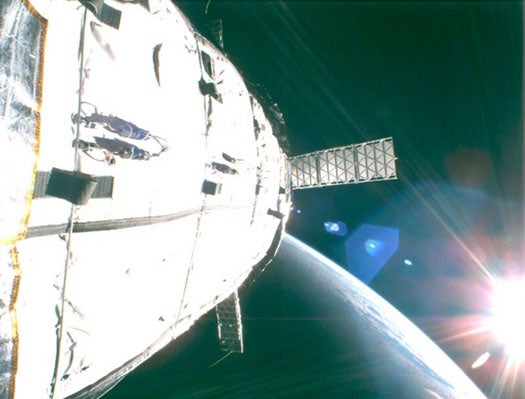
Bigelow's Inflatable Space Modules The proposed ISS module would be a larger, updated version of the Genesis prototypes Bigelow has already tested in low earth orbit. Bigelow Aerospace

Think Robert Bigelow’s much anticipated, sometimes ridiculed idea to build an orbiting space hotel from inflatable, habitable modules is something of a pipe dream? NASA apparently doesn’t think the technology is bunk. The space agency is reportedly in talks with Bigelow Aerospace to acquire one of its expandable modules for installation on the International Space Station.

That’s big news for both NASA and Bigelow. The Vegas-based aerospace firm has been working since 2009 to create inflatable space habitats for its own hotel as well as for corporate clients and government space agencies, going so far as to propose concepts for inflatable moon bases. It has launched two orbiting prototypes, Genesis I and Genesis II, but so far no government or corporate entity has bought into Bigelow’s technology.

NASA, for its part, is looking for inexpensive and proven ways to expand the usable space aboard the ISS. A Bigelow Expandable Activity Module (BEAM) could do exactly that. NASA has already evaluated the possibility of robotically attaching a BEAM (somewhat larger than the Genesis prototypes) to the ISS, likely to Node 3.

No deal has been penned yet, but if one is it will not only mark an important partnership between NASA and the commercial space industry—the mission to install the BEAM would take 24 months to prep, meaning the Shuttle program would be long retired and a commercial carrier would have to ferry it to the ISS—but a huge milestone for Bigelow. The Genesis prototypes have already proven the sturdiness and durability of non-rigid aluminum structures in space; an endorsement from NASA and its international partners would naturally be huge.

[SPACE]

8 Comments

Great. It is the best what NASA can do: help private companies develop their projects. And ISS is a great test ground. They help Ad Astra with VASIMR, Space X with Falcon 9 / Dragon, Boeing with CST-100. While there is no mission at the moment, all this hardware is needed for any future mission. We will be ready when somebody points at an celestial object and says: there we go!

I agree. The idea of sending up a privately built capsule on a privately built rocket sounds pretty cool. Kinda makes me think of the movies and shows with everyone having different spacecraft. There's only been a couple different manned spacecraft flying at one time for the whole planet! Soon that number will double and triple thanks to private firms getting into the mix. Delicious.

yeah, I think the commercial space industry is really gonna make a spark for missions and projects in space. With credibility from NASA, that will be even more true.

TransHab was cancelled by NASA then licensed to Bigelow, who now has patented a slew of improvements - everything from utility runs to spaces in the hab to hide in during solar flares and how to mount windows.

Their first Sundancer module is manifested to go up on a SpaceX Falcon 9 in 2014, to be followed by 2 other modules and a docking hub/power bus. Together they don't make the hotel the rags harp on, but a commercial space station where those who can't get time on ISS can go.

Nasa will need to expand the pool in Houston to fit the extensions :)

One generations plants the trees, the next enjoys the shade.

I want to be the first space hotel employee. I have a great resume and qualifications! dobermanmacleod@gmail.com

Ok, I have a couple of questions that might sound nuts but I really can't resist, because I just may be nuts. We all have known through all these years that the Saturn V, with the mighty F-1 engine; is the best super heavy lift rocket we've yet designed, correct? And that somehow all the blueprints and molds for those fantastic multimillion dollar engines were somehow destroyed, apparently by accident? So why is it that we can't take a casting from the authentic F-1 standing at Kennedy, refine a 3-D mapping of it's bell housing from that, make the necessary adjustment for temp, and create a new series of molds till we get an exact replica of our authentic F-1 bell? This is not the early to mid 70's anymore. Seriously, our nation understands that we needed to advance our technology, and the shuttles were great vehicles for their task. But at the same time we are now paying huge fees to another nation to boost mass we can more efficiently lift with our own proven design. By all means, keep working with the startups, but keep our Program's independence as well. We are supposed to be looking to get the most out of everything we have, unless I misunderstood the President. I'll tell you all this. I may just be a dumb machinist in metal or wood with some tool and die experience, but you turn me loose on that F-1, and I'll make you another one.

Not as easy as it sounds, plus the 1 million lb/ft thrust F1 did have problems. After Apollo the F-1A was developed with 2 million lb-ft of thrust, but never flown.

They share one continuing problem that: a high manufacturing cost, along with the same problem with the rest of the Saturn V system. That, and high operational costs, are why Saturn V was discontinued.

The Russian RD-170 engine uses 4 cheaper combustion chambers off a common turbopump instead of 1 huge chamber and sits right in the middle power wise; just shy of 1.8 million lb/ft.

An even more affordable alternative could come from SpaceX, the makers of the Falcon 9, its very inexpensive Merlin 1 engines, and Dragon spacecraft. They've offered to build a 1.7 million lb/ft Merlin 2 engine for NASA along with a family of rockets that would exceed even Saturn V's capacity (specifically - the Falcon XX)


June 2013: American Energy Independence

Five amazing, clean technologies that will set us free, in this month's energy-focused issue. Also: how to build a better bomb detector, the robotic toys that are raising your children, a human catapult, the world's smallest arcade, and much more.


Online Content Director: Suzanne LaBarre | Email
Senior Editor: Paul Adams | Email
Associate Editor: Dan Nosowitz | Email
Assistant Editor: Colin Lecher | Email
Assistant Editor: Rose Pastore | Email

Contributing Writers:
Rebecca Boyle | Email
Kelsey D. Atherton | Email
Francie Diep | Email
Shaunacy Ferro | Email

circ-top-header.gif
circ-cover.gif
bmxmag-ps