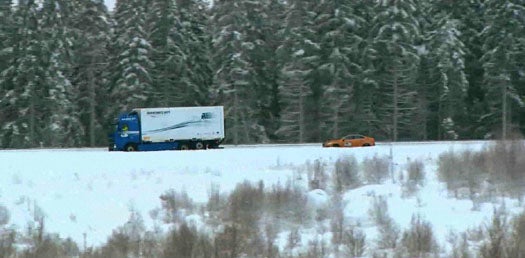
SARTRE'S 'Road Train' in Action Volvo/SARTRE

Technology that links a chain of semi-autonomous vehicles to a lead car has undergone its first trials at a Volvo test track in Sweden. The "road train" system, which allows cars to link into “trains” in which the lead car sets the pace and direction for the cars linked behind it, could be deployed on European roadways by the end of the decade.

The idea is to cut fuel use, cut congestion, and make highways safer by allowing those traveling long distance on highways to link up with other drivers going the same way. Once a driver falls in line behind the lead vehicle and establishes a wireless link, an adaptive cruise control system kicks in to match the leader’s speed while a battery of sensors ensure all vehicles in the train maintain a safe distance from each other.

The following vehicles then follow the leader autonomously, leaving the drivers behind to take their hands off their wheels, pull up Netflix or the newspaper on the iPad, and otherwise take it easy until it’s time to retake control of the vehicle and leave the convoy.

In this initial test a single Volvo car was linked to a truck using the EU-backed SARTRE system (Safe Road Trains for the Environment), which is being developed by a larger European partnership involving universities, technology companies, and, of course, Volvo. The test was a success at the low speeds tested – you can see the driver taking his hands from the wheel of the Volvo and, somewhat nervously, reading a newspaper in this video of the test – but because of the complicated differences in traffic laws across more than two dozen EU nations, it could take several years to iron out a legal framework enabling the deployment of the tech.

[BBC]

15 Comments

Ok, good system but i have a few questions:
1. what happens if the lead car gets into a car accident, gets pulled over, or turns off of the road and the person in the second car is asleep? then what?
2. If the first car brakes suddenly at 70mph, how fast do the other respond?
3. What if the first vehicle speeds? Who gets pulled over?

I was thinking sorta the same thing. So this system is not autonomous, its just syncing up with another driver on the road and letting them control your vehicle.

I think the only way it would work is if the lead vehicle was providing a scheduled service such that all others start out in the same parking lot and then follow the same route to the same end point. Like an actual train, but a little more dynamic. I can see other complications though, like what if one of the vehicles in the train didn't have enough gas? What happens when a car pulls out of the train?

Think aboutit, they have already thought about wether the first car will deviate from the path will the others follow, obiviously it will have you put in a destination and then search the nearest "chains" for the one that would take you the farthest. And if the car is manually removed from the chain, the would be a failsafe that could allow the next car to warn the driver that he will have control or simply take control and keep moving onto the original destination. *sorry for errors*

I really hope this technology does not come to fruition. The honest truth is there are just too many variables on roadway systems. The only way this could ever work is if everyone were using it, and I honestly would never. Driving is a privilege and a pleasure for me. Not to mention I live in a state with is infamous for "reckless" driving, although honestly we're better than the smallest state in the country next door.

So how does this system handle on of the vehicles being cut off by a driver who is not on the system? If the vehicles are maintaining a safe distance then there should be plenty of room for three or four Massachusetts drivers to cut in and take an exit before the computer system knows what happened.

I'm also curious to know why the creators of this technology are attempting to create something we already have: trains.

How much cost will these systems add to the vehicles? I tend to believe that the people who can afford and would be interested in these vehicles would be able to afford their own chauffeur, who will even go so far as to open the door for them AND carry their luggage! Let's see the computer system carry luggage.

Perhaps this is an automated form of the funeral procession. The lead car must be ready to lead. Anyone cutting into the line would be breaking the law. Also, automation requires order, and maybe this is beyond human use given the selfish behavior so often displayed on the road.

I think the only way for something like this to happen nationwide or worldwide is if a combination of two technologies occur. First, EVERY car would have be required law to have this technology or at least a transmitter that cars with this system could detect. Secondly, every car with this system would be required to also have an autonomous driving system to accout for unplanned variables like pedestrians, animals, road hazards, and anyone who failed to install a transmitor.

At this point, we all could truely take our hands off the wheels, save time, and save energy too. They might even be able to up the speed limits with both these systems in place.

I think a easier solution to AI automobile trains for long trips would be to use trains for long trips.

Not trains as passangers - that already exists - but trains as transport for manned vehicles. A "drive on" train car, much like a ferry, would use existing lines to allow manned vehicles to travel signifigant distances at greater speed and fuel economy.

The passanger gets the comfort of his own vehicle for the trip and has his vehicle with him at his destination. What he looses in ticket price he makes up for in reduced fuel cost and time.

I hate to come off pedantic, but these are very silly questions, because the article clearly states, "Once a driver falls in line behind the lead vehicle and establishes a wireless link, an adaptive cruise control system kicks in to match the leader’s speed while a battery of sensors ensure all vehicles in the train maintain a safe distance from each other."

If the lead car gets into a wreck, pulls over or turns off the highway, the cars following it would come to a stop, pull over or take the turn.

If the lead car did any of that, how quick will the cars following respond? Immediately... at the speed of light. After all, it's an automated, wireless system, which means it uses electronics and radio signals, which would send signals back and forth between cars in milliseconds.

And you know, with a system of this nature, speeding laws on highways would be superfluous.

Additionally, a system that could detect and respond to other vehicles and the actions of those drivers, which a system of this nature could do, it would reduce the affects of "reckless" drivers and make us more "wreckless". If a person recklessly cuts through the "train", the cars following would detect with their "battery of sensors" that another car was cutting into the train and would adjust distances accordingly.

Oh, and by the way, there are no trains going between Wichita, Kansas and Salina, Kansas, but there are usually a couple of thousand or so cars making that trip per day. There are a lot of communities where trains are not only non-existent, but also cost prohibitive.

As for the cost, of course not all cars could be equipped with this tech, but the tech should and would be designed to detect other objects on the road whether it's as small as a deer or person (although it's seems illogical for a person to be standing in the middle of an interstate road way.) or as big as another vehicle. And if detected, your car would respond accordingly, either by alerting the driver or bringing the vehicle to a stop.

I do wonder how successful this would really be in the real world.

What if the person in the lead car is suicidal and decides to drive off the road and there are 10 cars in the train behind them, will all 10 cars now go off the road?

The designers could argue that they have enough sensors in the cars to stop this from happening, in which case I would argue then, why do you need to have a manually dirven lead car, if you have enough sensors in the following cars for them to be able to detect their location, proximity to the side of the road, proximity to on-coming cars, if the sensors can detect all of that, then why not just use GPS to plot a destination and let all the sensors determine where the road is that will get them there and avoid traffic.

I mean you just have to look at plane hyjackers, we as passengers put our lives in the hands of the pilots, if those pilots decide that they don't like the destination we had planned, then we could end up crashed somewhere or as hostages in a foeign land. At least with planes you have security to restrict those incidences, how can you control that in cars, make everyone sit a polygraph test before being able to be a lead driver?

I actually think the best way of doing this would be to set up wireless routes where by you put wireless transmitters on telegraph poles or street lighting and it is that, which provies the grid for these autonimous vehicles.. no need for a lead driver, no need for AI, it just becomes a life sized slot car set, where the slots for guiding the cars are just wireless transmitters.

Although I would still question why they just don't use GPS and all their sensors.. But hey...

Grant.Upjohn wrote, "I would argue then, why do you need to have a manually dirven lead car"

I doubt the system would need the lead car be driven manually, but the real reason for the "train" is efficiency. As any race car driver knows, drafting off the car in front reduces drag.

Good luck insuring that mess in the US.

I can think of quite a few scenarios that would stress this system pretty hard -- hopefully they'll test for them!

Think of deer suddenly appearing in front of the leader, or any of the other vehicles, for just one difficulty. There are others.
(I know -- nothing can possibly go wrong -- go wrong)

I would think that ALL of the drivers would have to be ready to assume control fairly quickly.

Also, what if the leader had a corner carver and was pushing the limits on a twisty road. Would the sheep cars be smart enough to slow down and eventually disconnect?

Finally, there's the matter of making the association. I can see commercial groups with scheduled lead changes, etc. But, I'm having trouble visualizing ad hoc groups.

A few things need to (and eventually will happen):

- Cars will "Know" the condition of other cars (talk to one another "I'm running out of GAS!!" or "I CRASHED!").
- Cars will use GPS Navigation and cameras and sensors to keep them in line and away from other cars.
- But by the time all the things for a car "train" are implemented we'll all have google like cars, that use onboard maps, GPS, and sensors to do all the driving for us. They will only "talk" to other cars to keep a flow of traffic going and to direct traffic.

I believe that someday we will all have an auto pilot feature.


June 2013: American Energy Independence

Five amazing, clean technologies that will set us free, in this month's energy-focused issue. Also: how to build a better bomb detector, the robotic toys that are raising your children, a human catapult, the world's smallest arcade, and much more.


Online Content Director: Suzanne LaBarre | Email
Senior Editor: Paul Adams | Email
Associate Editor: Dan Nosowitz | Email
Assistant Editor: Colin Lecher | Email
Assistant Editor: Rose Pastore | Email

Contributing Writers:
Rebecca Boyle | Email
Kelsey D. Atherton | Email
Francie Diep | Email
Shaunacy Ferro | Email

circ-top-header.gif
circ-cover.gif