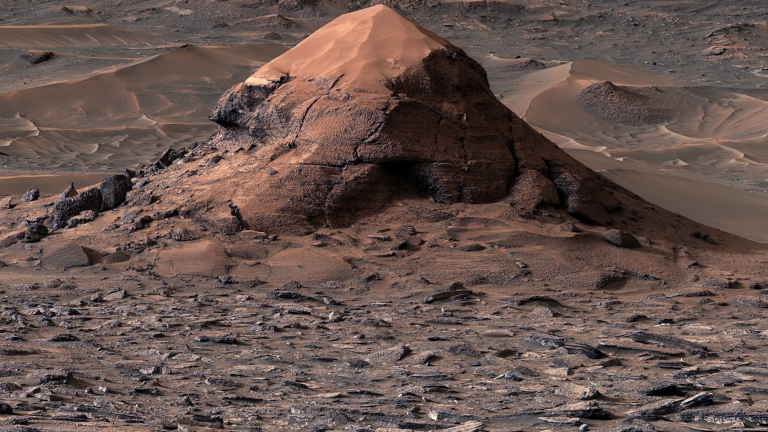
More than three decades after scientists concluded that NASA’s Viking missions to Mars had found inconclusive evidence for the existence of organic compounds on Mars, a new study says not only are there organics on Mars, but Viking found them back in the late 1970s and scientists completely missed them.
The new study of the Viking program’s finding was initiated after the August 2008 discovery of perchlorates in Martian soil by the Phoenix lander. Perchlorates are salts whose powerful oxygen-busting capacity that tends to combust organics.
The Viking team had no reason at the time to think Martian soil was perchlorate-rich, so the tiny trace chemicals they found in the Viking experiment were dismissed as contaminants from Earth. The new study asserts that they were combusted organic compounds, fingerprints of compounds leftover from contact with perchlorates in the soil.
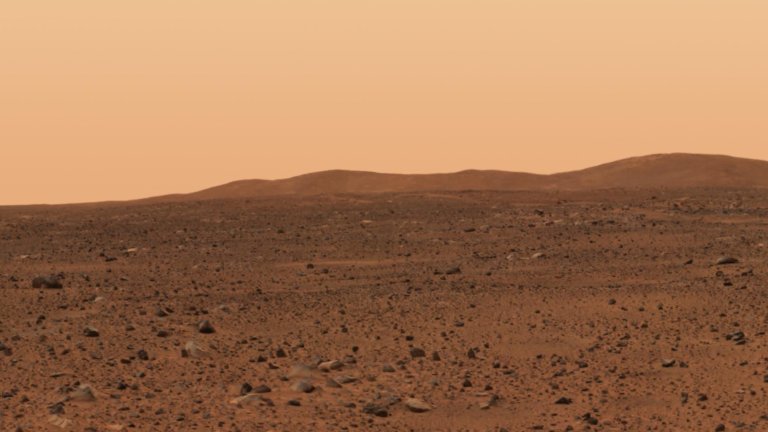
To recreate the experiment, researchers used perchlorate-enhanced soil from the Atacama Desert in Chile, a region considered one of the best Mars analogs on Earth. That soil showed the same telltale fingerprints of combusted organics that the Viking experiment found, suggesting that the Martian soil also contains organics.
However, the researchers emphasize that organics are not the same as life (those following astronomy news over the past couple of months know what happens when NASA whips the blogosphere into a frenzy over rumors of finding signs of life elsewhere in the universe). They are simply organics, which could lead to a better understanding of Mars' chemistry.
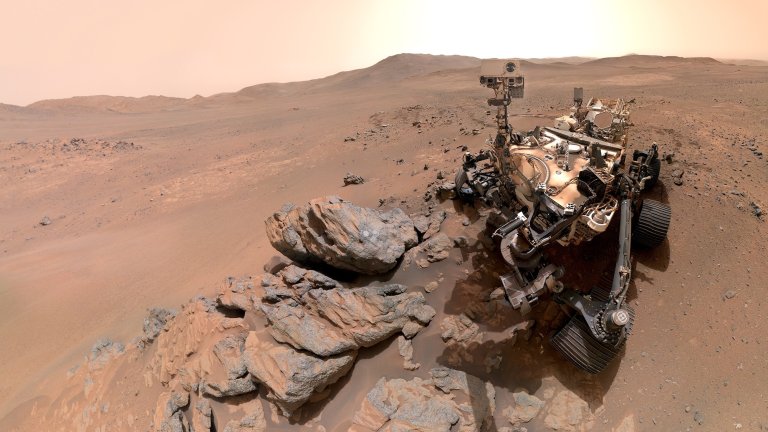
Viking’s failure to find organic compounds was the main argument against sending further missions to Mars to seek them, which has potentially cost researchers years of research time. Fortunately, the search for organics on Mars wasn’t completely abandoned; Mars Science Lab launches in November of this year, and its instruments will resume the study of Martian chemistry, including organics.
Five amazing, clean technologies that will set us free, in this month's energy-focused issue. Also: how to build a better bomb detector, the robotic toys that are raising your children, a human catapult, the world's smallest arcade, and much more.


Online Content Director: Suzanne LaBarre | Email
Senior Editor: Paul Adams | Email
Associate Editor: Dan Nosowitz | Email
Assistant Editor: Colin Lecher | Email
Assistant Editor: Rose Pastore | Email
Contributing Writers:
Rebecca Boyle | Email
Kelsey D. Atherton | Email
Francie Diep | Email
Shaunacy Ferro | Email
so is it possible to get organic compounds without life to create them?
Organic compounds are chemical compounds containing the element carbon. Carbon is a very common element, and is needed for all life as we know it, but life doesn't create carbon it uses it.
sooooo essentially this is saying that 30 years ago we discovered chemical compounds with elements commonly occurring in the universe, and we never even saw them until now. sweet.
pretty much
@timias,
"but life doesn't create carbon it uses it."
Does life "create" anything?
Seems to me that all life just uses already existing chemistry ;)
Isn't that funny how that worked, rocks brought back from the moon had trace amounts of water, H2O, they dismissed them because they said they may had been contaminated here on earth. Today they claim water ice is everywhere on the moon.
Next they will be telling us some of the objects moving around in Phoenix Landers Microscopic Imager here may be microscopic life.
http://www.youtube.com/watch?v=zhfSjJeQf58
Ron Bennett
¶ 2 sentence 2, mixed construction, omit "that".
Also, cool!
Awesome news, hopefully somewhat scathing to those whom then pushed for less money spent on Mars Missions as a result.
@B.V. Does life "create" anything?
Depends on your definition of anything. Carbon is an element, which requires a nuclear reaction to create or destroy. Life to the best of our knowledge only uses chemical reactions (not nuclear), which basically reconfigures which elements( atoms) are attached to each other to form various molecules.
All matter uses existing elements, but only certain processes will create certain molecules as far as we know.
This "discovery" is pretty vague, but it seems that no signs of life have been found, just compounds containing carbon. In other words "no big deal".
FYI Methane is an organic compound, we even consider it a fossil fuel (which is a joke), but it doesn't take life to create it just look at the atmosphere of most of the planets in our solar system.
So NASA decreed in the 1960s that there was no water on the Moon and hence the Moon could not sustain a lunar base or be used for fueling spaceships on the way to Mars. Hence all lunar exploration programs were cancelled.
Then we recently determined that there is water on the Moon, after all.
In the 1970s, NASA decreed there was no sign of life on Mars. Now we've determined that yes, there were very strong signs of life in the original data.
Does anyone else see a pattern here?
@engeneerzero
is the pattern that when you re-examine old date with new technology and techniques, sometimes things that were previously dismissed yield suprising results? seems perfectly reasonable to me. In 30 years the scientist's toolbox has advanced signifigantly.
I think its important to continualy examine and re-examine these sorts of things in order to continue learning more aout our universe.
depends if they have electromagnetic vehicles already and dont want to waste unnecessary money on the cover story
@engineerzero
Organic compounds do not equal signs of life
As I recall, the scientist who set up the experiment 30 years ago came to the same conclusion and argued vehemently that the discovery was valid but was overruled and discredited by others who claimed contamination. The scientists may have themselves been contaminated with a little old fashioned professional human jealousy.