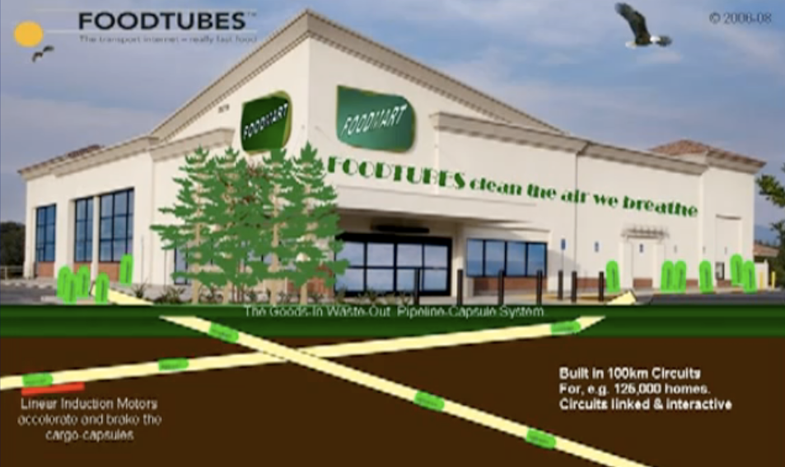
Foodtube Stop A series of tubes could connect grocery stores to homes and businesses, providing a food and freight pipeline modeled after water, sewer and oil pipelines. via YouTube

Hungry? Better turn on your linear induction motor and send a metal capsule through an underground polyethylene tube to retrieve some groceries.

That’s the vision of Foodtubes, a UK program that seeks to reduce carbon emissions by building a pipeline-capsule system to deliver food and freight. A series of tubes could ferry 6-foot-long metal bins among neighborhoods, entire cities or even to different countries, moving goods at 60 mph using linear induction motors and intelligent routing software. Foodtubes says it’s “really fast food,” brought to you by the Internet of Things.

“In the long term, we could see an ostrich slaughtered in Cape Town, and delivered to Edinburgh,” said Noel Hodson, Foodtubes’ CEO, in an interview in EWeek Europe.

The group wants to start in the London suburb of Croydon with a $625 million pilot network connecting all the borough’s food shops, schools and buildings. Such a network would remove diesel trucks from the road, cutting carbon dioxide emissions by 8 percent a year and reducing congestion, the project’s leaders say.

It sounds crazy, but Foodtubes points out that other commodities — oil, water, gas and even sewage — have dedicated pipeline networks, and new 3-foot-diameter tubes are installed all the time. Dedicated Foodtube pipelines would require little maintenance and could earn $125 million a year, Hodson said.

Apparently the group initially considered vacuum tubes, like the kind you use at a drive-through bank teller, but realized it would be impractical on a massive scale. Instead, capsules would be accelerated with linear induction motors, which would be controlled by computers.

Two oil firms are apparently interested, EWeek Europe reports — the very companies that could stand to lose if diesel trucks are removed from the road. Foodtubes is talking to two firms about providing a pipeline in Canada’s permafrost and in the Middle Eastern desert, Hodson said.

[EWeek Europe

27 Comments

This is a very innovative and practical idea. I think connecting all the places may bit much to get going on a large scale, but certainly connecting "hubs" may work.

I also feel that it may possibly work if using only hubs. There is simply no way that this makes an iota of sense unless the tubes can be used almost constantly. Certainly a tube to one's house or to the vast majority of businesses is not going to have the kind of volume to ever come close to paying for itself. However, a hub system certainly might.

This is obviously not a new idea. Many years ago, even I envisioned such a tube system to move goods more quickly across the US. It would be a large scale replacement for trains and long-haul trucks that would allow individual shipments to go anywhere in the country on electrical power, underground even, at a hundred miles an hour. And if even I had the idea, I'm sure thousands or millions of others have had it too.

But no way will this ever be practical to homes or most businesses.

Oh, crap. I think this idea was started because someone wanted to validly say, "The Internet is no longer a truck! It's a series of tubes!"

I hope someone sends them an Internet to complain about the bad joke...

-IMP ;):)

good idea...but i don't approve slaughtering our ostriches.

I could see this working in European(and other similar countries) where people often go shopping for just one or two meals at a time. Americans would never adopt it unless you could adapt those tubes to SUV size. Anyone here got a Sams Club membership? Thats going to have to be an oil-pipeline size tube to fit a Sams Club size load. 5 gallons of mayonnaise and a half-cow worth of beef all in one trip!

How cool would it be if it did actually catch on around the world! You could order in ingredients from anywhere!

We'll call it the World Wide Web...no...Al Gore already invented that. Have to come up with something catchy...give me a bit and I'll get back to you on it.

The creativity is great but it seems too far-fetched. They are comparing current pipeline technology with this much more complicated system. This is not a pipeline but a 'rail' line. A rail line to everyone's home ... who's going to pay for that! I think it's an ideas that will find a much less ambitious niche as indicated in previous comments.

The idea is great but i agree with many of the comments, it is too complex to be practical and on top of that it can't be used everywhere due to unstable environments, i.e. earthquakes.

I my self will probably never see the telepod and simply beam food to the refrigerator, but until then I'll just keep on watching Stargate. :)

Cool idea. However as Far Out Man said, it's a logistical nightmare, and there's also a bigger problem...

No security at all!

Terrorism through the mail is currently prevented by the mail handlers and the main hubs. With these tubes, a terrorist could send a bomb via a tube from Ireland (or wherever) straight to a crowded mall in London (or wherever)

Seems a little unsafe. And, not to mention, what happens if someone hacks the computer controlling the system, or sicks stuxnet on it?

Nice idea, but do it with garbage first like Roosevelt Island or Disney World.

How bout those people who dare to get into the tubes themselves....

I'm sure people said the same thing about cable television years ago, and probably the same about railways long before that. Why can this not work? People pay good money to have fast internet connections via fiber optic cables all over the world, and the cables had to be buried at some point. What's the difference? Install a hub in every neighborhood like they do with the internet, then each house connects to the hub.

About the terrorism aspect - why not make it so a package is only able to be sent if the recipient has verified the shipment? If I didn't order it, I don't want it, and it can't be sent to me.

@ Greatusername: couldn't terrorists just do that now with the regular mail, if they package it well enough to disguise it?

Pneumatic tube mail has been used since the 19th century. It has been mostly discarded because it was a dumb idea.

I can't really see it being revived in the form of grocery tubes.

What about repairs? Those systems mentioned in the article that are in place (sewage, water, ect) are in disrepair here in the US. It would likely be very expensive to upkeep this system. If it was anything but just a tube in the ground then you could probably multiply upkeep costs significantly. This system would be nice, even in hub form, but I don't think its practicle yet.

Sounds cool :)

Here's an interesting article on this subject: www.lowtechmagazine.com/2008/02/a-world-without.html

Some potential but in heavy urban areas think about what's already down there. Utilities such as electric, water, gas, fiber optic telco and Cable TV, control circuits for traffic, sewer, water runoff and, in some places, transportation as in subways. Having been responsible for trying to engineer new telco stuff through these mazes I can say that, it's doable, you can do most anything you want, but it's very complicated, expensive and time consuming.

I think it would work very well. If extended practically it could connect interstate commerce here in the states. It could also change the dynamics of how and were industrial sites, neighborhoods and shopping areas are built.

Interesting indeed!

The trans-Atlantic delivery tube, hurrah!

I don't think the problem is technical,and the benefits would be enormous.The main obstacle would be financial,especially now,when the economy is in the toilet.Governments can't afford to maintain the existing infrastructure.Can you say "pipe-dream",no pun intended?

lol. The internet will no longer be the only thing that is "a series of tubes". And killing an ostrich? That's totally bizarre and off-the-wall. Rather ride one.

THE very first thing that pops into mind when I read this is Terry Gilliam's Brazil. If you have seen it you know EXACTLY what I am talking about. (and FYI if you haven't seen the 142-minute version you haven't seen the movie)

This would put so many people out of work.

Digging up the streets of cities and suburbs to install tubes to push goods (in rectangular boxes ??) to physical locations is a *dumb* idea.

For starters, it is a lot less effort to continue to use *wheels* on the surface to minimize the amount of energy required to perform delivery.

Second, what happens when a tube gets clogged ?

Third, a new type of caddy vehicle/enclosure would need to be designed, and only packages fitting in the dimensions of whatever the standard caddy size could be sent.

The center of gravity of such caddies would create friction/inertia problems throughout the system.

Just imagine the old pneumatic department-store ticket systems going to accounting and back. This is PROGRESS ?

Sorry, but, someone is pulling someone's leg here ( I hope )

They can't even get POWER LINES underground in most places, they sit on poles like 100 years ago! This is why my power goes out after every rain ...

What makes you think this will work? It won't! In addition to the points above, what about rats, cockroaches and water seepage? Then what happens when dead rats clog the tube in the middle of the road? All they need is to say a terrorist will roll a bomb via this tube under a building or road and no one will go for it...

Lets deal with unsafe wires first ...

Grow your own!

This would be a filthy mess.
It would be a better option to "print" your food with a 3d printer.

Very old idea this--read: Looking Backward: 2000-1887 by Edward Bellamy, 1888.


June 2013: American Energy Independence

Five amazing, clean technologies that will set us free, in this month's energy-focused issue. Also: how to build a better bomb detector, the robotic toys that are raising your children, a human catapult, the world's smallest arcade, and much more.


Online Content Director: Suzanne LaBarre | Email
Senior Editor: Paul Adams | Email
Associate Editor: Dan Nosowitz | Email
Assistant Editor: Colin Lecher | Email
Assistant Editor: Rose Pastore | Email

Contributing Writers:
Rebecca Boyle | Email
Kelsey D. Atherton | Email
Francie Diep | Email
Shaunacy Ferro | Email

circ-top-header.gif
circ-cover.gif
bmxmag-ps