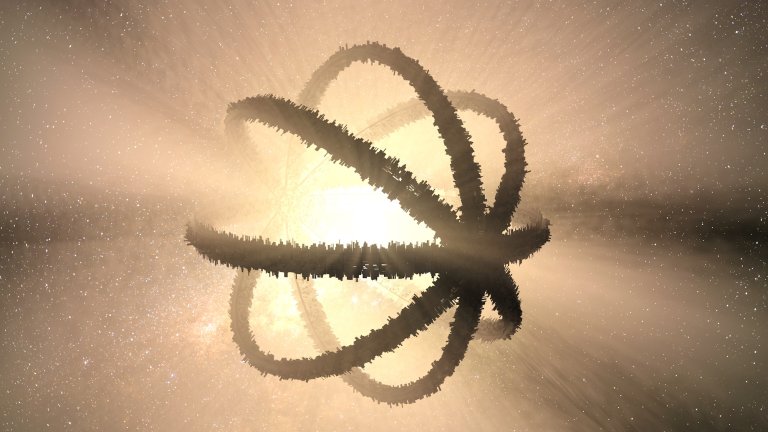
The ESAIL Antigravite/Szames

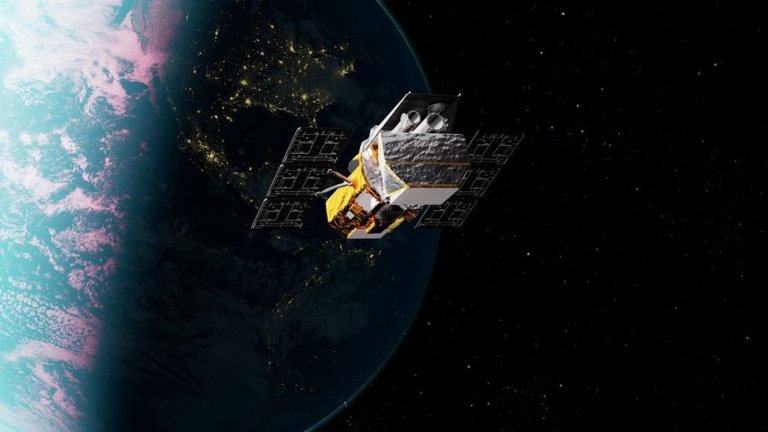
IKAROS would do well to watch its back, for the Japanese solar-sailing spacecraft may just have some competition that's fast enough to catch up. The EU is funding a three-year project at the Finnish Meteorological Institute to build the fastest man-made device in the universe: an electric sail, or ESAIL, that researchers say could make Pluto in just five years' time.

Like the more well-known solar sail, the ESAIL is propelled by solar radiation and therefore requires no chemical or ion propellant. But rather than actually unfurling a huge membranous sail to catch photons from the sun to provide thrust, the ESAIL repels protons.

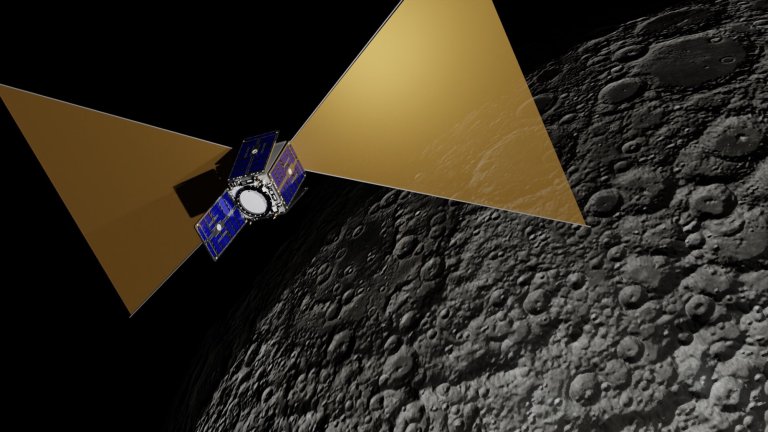
The ESAIL consists of a bunch of thin metallic tethers that unfurl in a huge circular array around the craft. A solar-powered electron gun aboard the tiny central spacecraft keeps the tethers charged at a high positive potential. Since particles of the same charge repel one another, the protons in the solar wind push on the tethers, propelling the sail away from the sun.

Since the sail itself is extremely lightweight, it doesn’t take much – in theory anyhow, as these principles have yet to be tested in space – to get a ESAIL-powered spacecraft humming along at a respectable pace; some have estimated that after a year in flight an ESAIL could hit about 19 miles per second.

But first the team will have to make it work, a task the EU has put $2.25 million behind. If successful, they’ll have one hell of a fast spaceship. Whether it will be able to do the Kessel Run in less than 12 parsecs remains to be seen.

41 Comments

Assuming this works out the way it's described here (it "could make Pluto in 5 years time"), it would only take 16 days to get to Mars when it's at its closest. Sounds interesting :) .

-IMP ;) :)

I wonder how they control acceleration! would it be made to transport humans?

Hmm. A very good concept. But a few questions. One, is if it becomes less effective the further it gets from the sun (The more diffuse the solar wind).

Second is how this will work with solar wind in front and behind it. As soon as it gets set up, and repels the solar wind, it will create a sort of "solar vaccum" in front of it, so it won't be pushing itself back as much as forward; going away from the sun should be sound.

But how about going towards the sun? You cannot simply reverse the polarity, because making the ship attractive to the solar wind will mean it will act more like a magnetic sail, attatching to the ions as they speed past, creating at best, as much thrust away from the sun as towards it.

The only way to rectify that off the top of my head, would be to make the craft a dipole; have a negative net in front and a positive net in back, so that it attracts the cations coming towards it, and then repels them. The fields would have to cycle on and off, but you essentially get a reverse rail-gun.

Overal, a very interesting idea. This allows magneitc fields to do the force exchange, instead of colliding particles. Less mass and less wear-and-tear. Should be interesting to see it developed.

hmmm, so lets see, Pluto is 5,906,376,272 kilometers (average of Aphelion/Perihelion) which is 39.4816 AU (1 AU equals distance from Sun to earth) and it takes 5 years to get there.

The closet star system, Proxima Centauri, is 6,864 times further away than Pluto so based on that it would take almost 34,320 years for this craft to get to the nearest star.

Of course, to turn around and come home if nothing is found there it will take another 34,320 years.

I doubt mankind would be around then.

Result: End of mankind.

This is upmost revolutionary!! A spacecraft that is supper light and super fast without the use of propellant is the way to the 22nd century. This is great thinking on behalf of all researchers and engineers involved in this project. I hope the new TSC companty will be able to mass-produce these. I look foward to the day when this type of technology will get us to mars in a fast pace.

Please realize that it takes a long time for the craft to reach high speeds. Therefore it would not take only 16 days to reach Mars.

Still I think that this system or something similar will definitely be the way to travel long distances in space.

You are forgetting one very important thing with your Mars talk.
Let's say that you could accelerator at 3 G's constantly, sure, you could make to Mars in a few weeks. Assuming of course that you want to either crash directly into Mars over fly it by three weeks during the 3 weeks of 3G deceleration.
Keep in mind that at the 1/2 way point you must slow down exactly opposite to get to Mars stopped.
Unless you want to survive say 2 weeks of 4G decel, which I think would make the people crazy.

12/09/10 at 7:21 pm

hmmm, so lets see, Pluto is 5,906,376,272 kilometers (average of Aphelion/Perihelion) which is 39.4816 AU (1 AU equals distance from Sun to earth) and it takes 5 years to get there.

The closet star system, Proxima Centauri, is 6,864 times further away than Pluto so based on that it would take almost 34,320 years for this craft to get to the nearest star.

Of course, to turn around and come home if nothing is found there it will take another 34,320 years.

I doubt mankind would be around then.

Result: End of mankind.
------------------------------------------------------------
i see your point but keep in mind that because this is a craft that operates on solar radiation it would become useless after leaving our suns influence. i dont think that anyone is saying this is a viable way to travel to another star system.

With a bit of fine-tuning, I bet you could adapt this concept to work with magnetic fields too. One could use the solar wind to accelerate out away from Earth, then use the magnetic field around Jupiter to slow down again. Such a method could give you a cheap flight to Europa or any of the other Jovian moons. Sadly, it would not work for Mars, which has practically no magnetic field.

Photons or protons...

is there so much protons in solar radiation..???

════════════════════════════════════════════
why, mr. Anderson, why, why do you persist?
Because I Choose To...
Regards
════════════════════

How do ya keep the sail open and charged?

Well, I think this might work traveling between solar systems. You aim the ship towards another star, when the ship gets there you simply turn around and use that star to propel back to our system. Of course the propulsions would have to be strong enough to go between the two stars. In other words, it would be like kicking a ball down the street to your partner, and then him/her kicking it back to you; the kicks would have to be strong enough, else the ball would stop in the street.

I haven't done the calculations, so I'm not sure how strong the “kicks” would have to be.

wow, only $2.25 million, that's cheap, considering what the technology could be capable of.

How would it ever get back then if it is so strongly repelled by the sun? Back to the drawing board boys!

Consider a conventional ramjet.

A turbine at the front drawing in and compressing oxygen, mixing with fuel and propelling out the back.

Let's build a fusion rocket/turbine with one of these sails at the front (Possibly spinning for greater propulsion with a fusion reaction being generated behind it (The center of the device).

The device would then repel any incoming photons/fusion energy and propel it out the back.

Just a thought depending on the discovery of fusion power.

At least apply this tech to a modified VASIMR engine.

The biggest problem is deceleration...

deceleration is easy, and it's one of the few cases where the awesome scifi phrase "REVERSE THE POLARITY" actually works think about it, you'd basically be pulling on the sail by making it have a negative charge. it's so funny because i was just reading about the phrase on tv tropes. i'll have to add this as an example!

Wow... Wonder what we could've done with $1.42x10^13

@ghost well spotted. +10scifi points!

The real point that people should be looking at is why Solar wind is better(?) than traditional propulsion.

No matter how much energy you have, from chemical power or nuclear reactors--whatever, you NEED propellant. To state it simply, you cannot move your center of mass while in space. (Pretend you and your propellant are at the fulcrum of a see-saw. You must keep it balanced. If you weigh a lot more, it has to go out a lot further in the other direction).

For the more sciency- definition. In order to go in one direction, you have to push some sort of mass in the other direction with equal momentum (m*v). If you want to add 10m/s to your 1000kg craft, you must send 1000kg of propellant the same speed in the opposite direction. (or more realistically 1kg of propellant at 10,000m/s).

And carrying propellant sucks, because you have to accelerate it with you. You have to spend fuel to carry your fuel. Think of it as extending the range of your car by keeping a gas tanker in tow. Most of the extra gas goes to propelling the tanker full of gas.

Solar wind is a very diffuse amount of particles in motion, ie mass. In short, it is free mass sitting in limited but usable quantities throughout the solar system. It is free propellant than you simply must throw in the opposite direction; you don't have to carry it with you.

The main concept of this advancment is improving space flight. My guess is this will be addapted for collecting cations from solar wind, to be fed through Ion Engines, allowing nuclear powered craft to move throughout the solar system without needing [as much] propellant on board.(Extra energy put on board can make it go faster, it just needs a medium to exert a force on) In the meantime, its still useful to have low-capacity craft that can ferry small payloads (probably probes and data hubs) around the solar system. And in less than a decade. Its going to be fun to watch space travel over the next 20 years.

Once in motion, always in motion so the distance from the Sun will reduce the protons hitting the sail, however that will not affect the current speed only an increase in speed. And 19 miles per second is 68,400 mph per hour which, yes, may take some time to achieve.

Not sure about the comment about a vacuum created in front of the sail as how can you create a vacuum in space that is already a vacuum?

Also why stop at Pluto and not go onto another star in the solar system? Plus how could you stop without protons coming from another sun on the front side of the sail?

Finally so what if it takes 34,000 years for us to get across the solar system? In about 3.5 years the Earth will burn up with the Sun exploding so we might as well get to getting now. :-)

Could there be a way to "furl the sails" once out of the solar system wind bubble? That way, you could minimize protonic drag when approaching another solar system.

19 miles/sec is only 68,400 miles/hr. That speed could be achieved with chemical rockets.

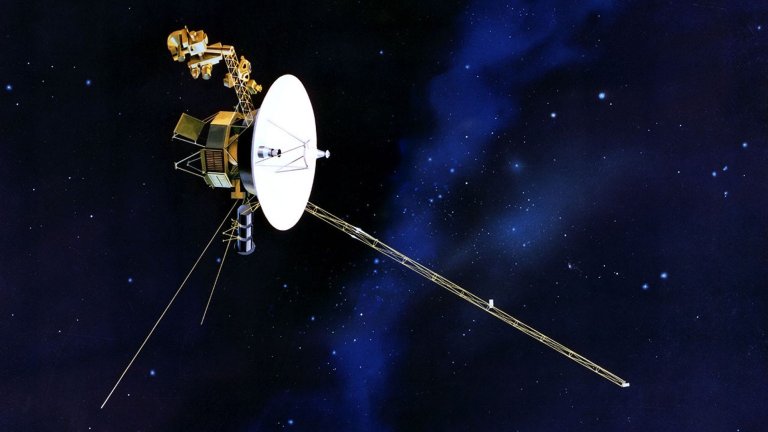
Yeah, I got that same number 68,400 mph. The voyager spacecraft is traveling at about 40,000 mph without any solar sails and way beyond the influence of our sun.

In this context, this speed doesn't seem too impressive, especially considering that to even reach those speeds would require consistant and long-term acceleration.

It would be much more impressive and significant to have technology that allows us to reach those speeds from the start.

But we need to accept baby steps, if it eventually brings us to the stars.

"We embarked on our journey to the stars with a question first framed in the childhood of our species and in each generation asked anew with undiminished wonder: What are the stars? Exploration is in our nature. We began as wanderers, and we are wanderers still. We have lingered long enough on the shores of the cosmic ocean. We are ready at last to set sail for the stars. "

-Carl Sagan

At this point, other star systems are beyond reasonable attempts at exploration.

If Voyager is going 40,000mph, and we sent this thing at 68,000mph, Voyager would be overtaken (and rendered irrellevant) in a short period of time. However, assuming that human progress continues, in 20-30 years a new form of space travel will likely pop up making both irrellevant.

Therefore, until we reach a speed at which a destination can be reached in less time than it takes to create a new technology that increases speed sufficiently to overtake that device, we are better off not wasting time and effort on slow shots into the dark.

The real advantage to solar sails is that they are fuel-less. With solar sails, solar panals, and time you can feasibly have inter system travel that does not require external refueling.

@hollycow

19 miles/sec is only 68,400 miles/hr. That speed could be achieved with chemical rockets.
________________________________

Too true, however chemical rockets do not have a virtually infinite fuel source, and xenon boosters are far more expensive. This sail being propelled by solar wind and recharged via solar power is a fairly inexpensive technology that has a lifespan limited only by its ability to avoid damage (or other instances of murphy's law). As long as it maintains relative proximity to the heliosphere it can operate indefinitely with constant acceleration.

@Oakspar77777

Agreed, unfortunately interstellar travel is simply going to have to wait for alternate means of conveyance. Speed just isn't going to do it. Barring some GUT that breaks all current laws of physics (always hoping), the max speed of conventional travel is still the speed of light. Even at that speed it would still take many many many fold lifetimes to reach even relatively close objects.

Still holding my breath for singularity travel or matter teleportation here.

Maybe my perspectives will change if we manage to tackle the Higgs.......

@Nighthawk

The recently discovered earthlike planet is only 20 light years away. So obviously there are entire solar systems that are close enough to reach within 1 lifetime. Of course, attaining that speed may never be possible and I agree with your general point that we have to find a means other than speed for interstellar travel to even be relevant.

@Oakspar77777 - I believe that is the premise of Orson Scott Card' "Ender" series of books.

Each advanced ship created surpasses the previous generation (both in speed, maneuverability and weapons capabilities). As they make their trip across the galaxy the newer ships pass up the older ships and make it to the battlefield in advance of the older ships. Eventually the first generation (slower) ships arrive and commanders are forced to work with ships that are like 50 years older than the ships they worked with before. It's like warfare in reverse - a rather interesting concept.

@bob clemintime: Not only does it take a long time to reach high speeds, it will take equally long time to decelerate to (relative) low speeds. [V] is irrelevevant. [delta V] is very.

It doesn't help you much to reach Mars at 19 miles per second, just to wave the planet goodbye at the same speed... unless you break (see: Newton).

Read about this FMI project a couple of years ago, and I must say that I'm happy it's getting some traction. Go Finland!

I think you guys are missing the point, this can be a cheaper way to send stuff around our own solar system, it has the bonus of being able to eventually outrun chemical propulsion for niche applications. Once you go beyond our solar system into the interstellar winds you just ditch the sail and run on momentum if you want. It will never be used for human spaceflight but if we loaded a capsule full of dormant viruses and bacteria and rifle them at nearby potential planets then it is an alternate way of seeding the universe (ethics are another debate).

I can't wait for 3.0 au/s travel like in EVE Online! Just a dream... yea right!

@michaelgorby 12/10/10 at 11:21 am - remember that the Voyager probes were also gravity assisted. I wonder how much faster the E-sail could go with gravity assists?

Those arguing it isnt`t fast. Please know it could travel at those speeds at only 1 year of operation. ONE YEAR doesn`t mean it will stop. It could potentially achieve much higher speeds at 3 years of operation and so on. This is absolutely ground breaking research and could, if achievable, have great implications for space missions of the future.

Since it doesn`t use fuel in the traditional sense it could slow down and take satellite`s into orbit of certain moons of Jupiter or Saturn and accelerate again after completing it`s research. The same for asteroids and comets. Much more so then ion powered craft. Allowing them to easily visit many destinations in our solar system.

Extremely useful for long and distant missions. The New Horizons mission to Pluto will only fly past Pluto. This technology since it doesn`t burn fuel could allow it to actually decelerate at about half way point and finally go into orbit around Pluto. That would be a massive breakthrough in technology.

Great idea !!!!
We can make at least some giant solar energy powered jellyfish, as our galaxy satellite - The front line ushers to welcome the aliens, or the first defence line to deter them from kidnapping us

The distance variations between Mars Earth and Pluto are very great. The trip to mars would likely be very slow and likely take more than a year and 8 months, then the opposing electrons between the electron gun furls and the solar electrons would exponentialy propel the craft at an ever increasing rate theoretically multiplying in speed in equal time frames to Pluto in 5 years, in theory. A few years ago a ion firing powered space craft was launched into deep space and it has been speculated that it will do the same exponential speed exceleration but at a very gradual rate by comparison.

Eienstine said that a maned spaceship would have to be spherical in shape to travel at the speed of light in space. If a bubble rises in water at a faster rate. Then how faster much can a ship in a bubble pass through a vaccum in space? It is interesting that this design has many of the spherical aspects.

People are both right and wrong in the conventional wisdom that appears to have popped up here w/ regards to the tech's utility in interplanetary missions to mars and other SS locations.

This tech cannot be used to slow down - it **cannot** be used that way - unless and until the craft is traveling faster than the solar wind. Otherwise the backward pull (assuming reversed polarity) granted by the protonic (hydrogen plasma) solar wind behind the spacecraft will be exactly offset by the **forward pull** of the protonic solar wind in front of the spacecraft. In fact, these are the same particles that briefly accelerate approaching the craft and then decelerate after passing the craft by.

Theoretically, with a magnetic sensor that perceives when the proton density is decreasing, deceleration can be accomplished by flicking the switch off and on... but this also has problems, not the least of which is: there is no way (in this design) to reverse the polarity. Thus... we're scruud for slowing down.

However, Aerobraking does work to slow craft down... not from 19 miles/sec, but from substantial speeds.

The wonderful bit about this technology is not the speeds. People have rightly noted that this requires no exhaust, which dramatically lowers fuel requirements. Fuel is heavy. It costs $$ to launch each kilogram into orbit.

Thus, the real advantage of this tech is in the **cost** of sending crafts on interplanetary missions. The weight saved can be used to:

1. save money for the sponsoring country/company
2. increase the science payload
3. install a braking mechanism that could not otherwise be added (so that the craft can remain on target location instead of flying by)
4. increase the data bandwidth by using a larger/ better/ more powerful transmitter than otherwise could be added

or 5. some combination of 1-4.

Note that the bigger/more powerful the ESAIL the faster the acceleration and the greater % of the solar wind speed can be reached.

While this version is anticipated to reach 19 miles/sec, 250 mi/s is the speed of the so-called slow solar wind. Accelerating past this would be tricky if not impossible since the velocity would sometimes be greater than the craft (and thus would help accelerate it) and sometimes be smaller (thus decelerating the craft...or accelerating it in a direction opposite to its course). And even accelerating all the way to this mark would be somewhat difficult, though the fact that a significant fraction of the wind travels faster would probably make speeds of 250 mi/s possible.

That would mean less than 3k years to reach another star. If you had a large & efficient system for harvesting solar wind speeds and added a large & efficient VASIMIR engine, you could get that down below 1k years...but only if we can up the VASIMIR exhaust speed as much as we think we might be able to. Otherwise, this ESAIL tech would not only be fuel efficient, but it would also have the fastest top speed of any space propulsion system currently understood well enough to build.

Curiously, @ 1k years, with approaching medical technologies including deep sleep, tissue rejuvenation, and others, it might actually be possible to launch a crew to another star and have the same crew arrive, still alive, to perform a given mission. Deceleration would add little to the mission time, since it would be accomplished entirely within the destination solar system. Given the right engine type, refueling at the other end might even be possible.

These are the kinds of breakthroughs imaginable with this technology.

Decelerating in system is *not* a use for this technology, though as mentioned above, it could allow a sponsor to afford an engine or aerobraking system whose entire purpose was to slow the craft down at the destination. We don't currently know of a way to re-use an aerobraking technology, and things like VASIMIR have limited fuel, but if one didn't rely solely on ESAIL and instead used a mix of technologies, it might be possible to visit a destination then set sail for another all on the same mission using the same craft. It simply wouldn't look the way it has been imagined above.

--)->

Sounds like a great idea. I just hope once you factor in a ship structure for humans, tons of equipment, etc, that it still is as fantastic as it sounds.

We could go to the moon and mine tritium and make clones and never let them know they are human simulations working for a corporation.

The fastest man-made device? That's spectacular. It can get you to Mars in 16 days? Even better!

But, unless I read over something about this craft turning around and running away from Pluto's cold lonely stare, it looks like any trip on this thing would be one-way.

This could be good for cargo transport, but that's about it.

Also wouldn't be too useful when traveling between stars (which I believe should be humanity's goal after we've mastered Mars and Europa), unless you used this as a stage 1, to get out of the solar system, and used something like antimatter engines to get the rest of the way to the next system.

This sail could ride a focused proton beam and reach much higher accelerations for higher final velocities. That would mean that travel time to the nearest stars could be measured in as little as decades.

But come on, we're going to have faster-than-light travel.

Men doesn't that pic look like a space battle or what.


140 years of Popular Science at your fingertips.


Popular Science+ For iPad

Each issue has been completely reimagined for your iPad. See our amazing new vision for magazines that goes far beyond the printed page


Download Our App

Stay up to date on the latest news of the future of science and technology from your iPhone or Android phone with full articles, images and offline viewing


Follow Us On Twitter

Featuring every article from the magazine and website, plus links from around the Web. Also see our PopSci DIY feed


February 2013: How To Build A Hero

Engineers are racing to build robots that can take the place of rescuers. That story, plus a city that storms can't break and how having fun could lead to breakthrough science.

Also! A leech detective, the solution to America's train-crash problems, the world's fastest baby carriage, and more.


Online Content Director: Suzanne LaBarre | Email
Senior Editor: Paul Adams | Email
Associate Editor: Dan Nosowitz | Email

Contributing Writers:
Clay Dillow | Email
Rebecca Boyle | Email
Colin Lecher | Email
Emily Elert | Email

Intern:
Shaunacy Ferro | Email

circ-top-header.gif
circ-cover.gif
bmxmag-ps