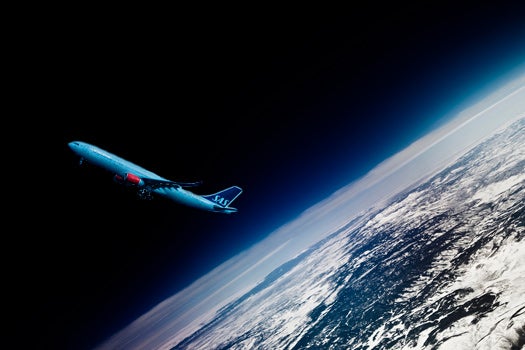
NASA is looking for a way to get into space without having to use those pesky, bulky rockets. That means hypersonic travel, which was added to NASA’s Aeronautics 2010 proposal solicitation yesterday. The type of craft that NASA's hoping for would be able to fly at five times the speed of sound--fast enough to make the jaunt from New York to Sydney in two and a half hours. We've seen some exciting hypersonic concepts before, as well as an unfortunate failure from DARPA, but with NASA money behind the research, extraterrestrial hypersonic flight could really get somewhere.
Allocating $5 million a year for the next three years, the Hypersonics Project is mainly interested in “airbreathing access to space” and “entry, descent and landing of high-mass vehicles entering into planetary atmospheres.” Crafts of this nature would be able to fly through the atmosphere the way conventional aircrafts do--imagine a turbo-charged Concorde jet--and descend and land safely on Mars’ surface. NASA is also pushing for these crafts to be reusable. Of course, this poses some difficulties, as outlined in the call for proposals:
“The hypersonic heating environment, coupled with the emphasis on reusability, creates additional severe technology challenges for materials, material coatings, and structures that not only carry the aerodynamic loads of the air but also repeatedly sustain high thermal loads requiring long-life and durability while minimizing weight.”
That’s a lot of obstacles to overcome, but as NASA puts it, “space access launch vehicles must be lightweight, fully reusable and easily maintained if low-cost access to space is to be achieved.” If the technology is successfully developed, it will be a huge leap forward for the transport of larger payloads, especially useful as we move ever closer to that eventual human exploration of Mars.
[NASA via Fast Company]
Five amazing, clean technologies that will set us free, in this month's energy-focused issue. Also: how to build a better bomb detector, the robotic toys that are raising your children, a human catapult, the world's smallest arcade, and much more.


Online Content Director: Suzanne LaBarre | Email
Senior Editor: Paul Adams | Email
Associate Editor: Dan Nosowitz | Email
Assistant Editor: Colin Lecher | Email
Assistant Editor: Rose Pastore | Email
Contributing Writers:
Rebecca Boyle | Email
Kelsey D. Atherton | Email
Francie Diep | Email
Shaunacy Ferro | Email
Photoshop failure...Whomever did this picture could have at least removed the deployed landing gear from the photo.
Graphene solves everything.
hahaha 4L3X, good eye :)
Indeed, when you creating photos that will be seen by huge number of readers, try to do them right ;)
Idea as idea is not bad, but lots of water will flow trough Thames until we find solutions for that kind of problems.
--------------
http://staupisati.com/
LoL @ landing gear...
If we could solve the lack of braking... that all orbital craft have on re-entry... but that'd require fuel of some type, meaning extra weight if launched with the craft, but maybe if we could get fueled up IN space instead... then we'd be able to manage braking rockets or something...
This reminds me of the 5th Element movie, when Korben & Leeloo board a spaceship/space plane and goto Fhloston Paradise. Sounds pretty cool!
ChuckLiddell - I think “air breathing access to space” means the use of an air breathing booster to reach the edge of space where a rocket engine takes over.
My two cents on the picture is why not use a photo of the Concorde instead of what looks to me to be the Boeing 777-300ER?
Those are not wheels ... they are electro-static attitude thrusters ... sure ... THAT's what they are.
I envision the ballistic/exo-atmospheric leg of the trajectory as requiring precise attitude control, outside significant atmospheric density.
I mean ... Dint Space Ship One have some wild attitude gyrations, outside the thicker atmosphere?
I see these trajectories as being something like a "Flying Fish" ... leaping, somewhat awkwardly, out of the water and, then, splashing back into the sea.
So ... To me, ... Exo-atmospheric attitude control is the main (and delicate) challenge, in this implementation.
But, yeah ... THIS IS THE REAL SPACE ELEVATOR !
This is a pretty cool picture (except for the landing gear). It will be interesting to see how NASA figures this one out.
**Note to NASA: Next time do a better job of photoshoping pictures**
NASA should stay out of space and just look inward to the deep sea and rename itself the "National Aeronautic Deep Sea Administration" or NADSA.
There is nothing out there in space worth spending trillions of dollors on. Nothing that mankind can reach economically anyway. It's a waste of money.
I didn't notice the landing gear until you all mentioned it :P Does it really matter?
It will be amazing an extraterrestrial hypersonic flight from New York to Sydney in less than 150 minutes. To the Moon, Mars and beyond, I think mankind needs to develop more innovative, fast and new space technologies for traveling longer distances.
www.youtube.com/watch?v=9ScAHXN_kAY
just a thought why not use a space elevator? if you make a hole comparable to an oil well wouldn't that give enough room for a super strong rocket or something? like attach it and just gun it....no sounds dumb lol
Wow... Funny picture, an Air Bus out of the atmosphere!
The captain is a San Antonio Spurs fan.
Nothing new. Nasa has been wanting this for a long time. Besides the landing gear but, there is a big difference between rockets and jets.
I think maybe Nasa should try to get that huge Airbus, and get it go to max altitude and max speed then fire off rockets to get it into space. :) Until they actual plans, they money to fund it and actual pictures or drawings then maybe we might have a an article but that's what this is. Just another story.
My luggage is stuck in orbit; and after that $100,000 per bag charge!
Excellent! NASA's newest boondoggle & full employment plan for the aerospace industry will most likely use a combination of unobtainium and liquid oxygen on take-off, then switch to a scramjet at the appropriate altitude, using highly compressed atmospheric oxygen to burn thousand-dollar bills. Until it kills its first crew spectacularly, thereby sealing the names of a new generation of High Schools.
...Unmanned space flight, anyone?
What NASA described here is already being developed in the UK by a company called reaction engines.
The first vehicle is a space craft called Skylon which uses an engine call SABRE and the hypersonic jet is LAPCAT which uses SABRE minus the rocket part.
I see Scientology!
But seriously: invest in Skylon.