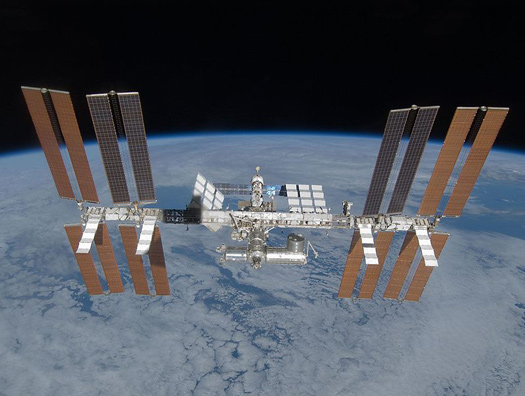
International Space Station NASA

Now that we’ve begun 3D printing anything and everything here on Earth, it’s time to move to the final frontier: printing space stations in orbit. It was only a matter of time. Now new company Made in Space is seeking investors and beginning tests to make space printing a reality, according to Space.com.

It just makes more logical and economical sense to print parts for spacecraft and space stations in space, says the company's founder. If parts do not need to withstand the G-forces of being launched, their mass can be reduced by 30 percent. NASA could just launch the gray goo known as feedstock into orbit, to be dealt with later. Manufacturing parts in space also means that anything that breaks wouldn’t have to be shuttled down to Earth for repairs. The broken part could be recycled back into feedstock, and the printer could just crank out a new one.

When we eventually make it to Mars, we could take the printers with us to create dwellings out of Mars dirt, or to print out robot components. Despite these big plans, Made in Space is still in its early stages. It’s already printed out some space-ready parts, but it needs to see how the printers will perform in zero gravity. If the printer passes that test, the next step could be a trial aboard the International Space Station.

[Space]

11 Comments

There are still a few major hurtles to this tech being useful in the ways they suggest.

1) Materials. Why 3d printing pasts in plastics - solar cells, computing products, and other critical replacement parts require integration of plastics and metals. The range of what a printer could create would have to drastically increase (having a different printer for each would be cumbersome).

2) Recycling is not that simple for current 3d printers which work from stock to product - going from product to stock is not as simple as shreadding and melting into feeder rod shape.

3) The tech is VERY far from being able to take raw elemental material and turn it into anything. The complexity of identification of material, seperation and purification, and then processing into base stock makes the "turn Martian dirt into something useful" idea a pipe dream.

I still love the idea of on demand, to spec, household production - but the tech is not there yet - particularly on the recycling end.

Imagine TSA losing it's collective mind over those toner cartidges. As a question do I need a passport to engage in space tourism?

This is such a great idea.

I would think printing in zero gravity would be easier.

Making things from Mars dirt would be like concrete. The glue would be the cement and the dirt would be the gravel.

A Mars space port could be created by robots and printers so that when earthlings land for the first time, a dwelling already exists. And it doesn't have to be a structure that can withstand launch and landing.

That doesn't seem very useful. If you're going to 3d print it you gain very little from doing so in space instead of doing so on Earth unless you can procure your building materials in space.

3d printers are much more useful for printing replacement parts. You don't want to bring quadruple backups for everything to Mars; it's much better to print the parts and bring "ink".

@soylent;

Read the article carefully. The advantage of printing parts in space, is that they would not have to be built strong enough to withstand the G-forces of a launch. The article suggests that this would save 30% of the mass.

You make a good point about the replacement parts.

What currently existing 3d printer technology produces parts strong enough to use as space craft structural components? Some of the powdered metal devices might works, but all parts I have ever seen a part made from "gray goo" that I would trust my life to (I have have worked with a number of rapid proto typing devices).

Hull, structure, and other support components should be easy enough for this technology to generate. These parts are some of the heaviest and most cumbersome to put into orbit via launch vehicle. Circuit boards and the like are small and so can be ferried to space and stored aboard ship/station more easily than a replacement support beams, pipes, or hull plates.

I remember reading about nasa doing something like this. Sending a printer up to the space station to print tools to fix things on the station.

This article doesn't give enough information. As far as the materials limitations, NASA has been working for a while on Electron Beam Free Form Fabrication (EBF3). EBF3 uses a tightly focused electron beam to fuse wire to to build up objects. One major advantage of this technology is that it can create alloys on the fly.

It was in testing phases last I heard and it sounded like putting it up there was the next step. Is that the 3d printer they sent up or was it one that prints in plastic? I wish the article had been clearer on that.

Sounds almost as safe and inflatable space stations

they would have no problem gathering elements from space itself, or the moon, to build anything. carbon based lifeforms we are, yes. carbon=lead, diamond blah. we all know school science. plastic could be an issue without the old crude, but who wants a plastic space station? or a polytunnel to mars?


June 2013: American Energy Independence

Five amazing, clean technologies that will set us free, in this month's energy-focused issue. Also: how to build a better bomb detector, the robotic toys that are raising your children, a human catapult, the world's smallest arcade, and much more.


Online Content Director: Suzanne LaBarre | Email
Senior Editor: Paul Adams | Email
Associate Editor: Dan Nosowitz | Email
Assistant Editor: Colin Lecher | Email
Assistant Editor: Rose Pastore | Email

Contributing Writers:
Rebecca Boyle | Email
Kelsey D. Atherton | Email
Francie Diep | Email
Shaunacy Ferro | Email

circ-top-header.gif
circ-cover.gif