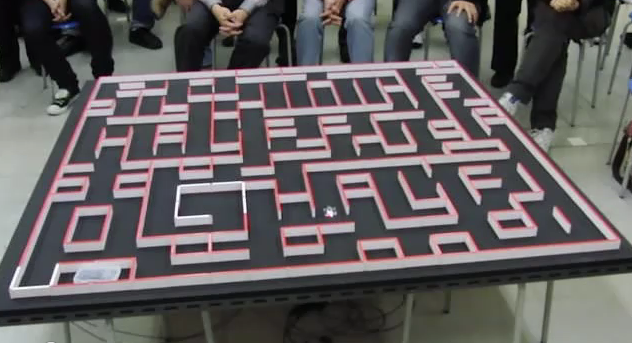
The micromouse competition is an international event wherein a teeny automated robotic mouse has to survey and then navigate a maze as quickly and adorably as possible. This video shows the fastest micromouse we've ever seen, blowing through the maze in mere seconds.
Of course, the micromouse still has to take a few test runs and survey the landscape before it can perfectly race from start to finish. But it is, after all, the season of cornstalk mazes, which to a human are about the same size as this model maze is to the mouse. Go find your nearest cornstalk maze, take all the survey time you want, and then try to sprint through it in a few seconds. It doesn't have an overhead view or use GPS like certain other robots, either--it just learns each corridor and remembers the layout it sees.
This video was taken at a local micromouse competition in Chubu, where the "EggTorte" team won first prize with this impressive showing.
Five amazing, clean technologies that will set us free, in this month's energy-focused issue. Also: how to build a better bomb detector, the robotic toys that are raising your children, a human catapult, the world's smallest arcade, and much more.


Online Content Director: Suzanne LaBarre | Email
Senior Editor: Paul Adams | Email
Associate Editor: Dan Nosowitz | Email
Assistant Editor: Colin Lecher | Email
Assistant Editor: Rose Pastore | Email
Contributing Writers:
Rebecca Boyle | Email
Kelsey D. Atherton | Email
Francie Diep | Email
Shaunacy Ferro | Email
im goin along with what others have commented about in the linked sources.. its gotta be talkin back to a server computer wirelessly. . .right?
It could have gotten luck, however I think someone cheated.
Wow! This is far too impressive! It's gliding through that maze.
THIS IS AWESOME!!!!! I really want one. It would be incredible if the programming in this micromouse could be implemented in objects like cars. Predetermined collision detection could stymie accident rates and greatly improve upon the risks of transportation.
Wow, this little mouse seems alot smarter than most of the people I know. It surveyed the course and then zoomed through it. It is very impressive, and I can see this technology going a long way and being used in many other areas of science.
wow, this is truly incredible. a robot mouse that can remember a specific part of a maze for future reference? that says something about how much technology has improved! i think it's kind of scary that it may have a better memory than me and other people i know, because this says that technology may someday become superior to humans.
Is it really that amazing? we have devices which store giggs of infomation in a small spaces and mini remote control cars. all that the mouse has done is navigate the course for 3 mins, then worked out the fastest route and replayed the infomation. Just like a computer version of the wooden labyrinth game.
wow. thats pretty cool that a robotic mouse can remember where the walls are located in the maze and can navigate its way through in a matter of seconds.
this is so cool and very incredible that a robotic mouse can do this.
It's not amazing, but it's at least ten years ahead of ten years ago, and it's adorable!
Pretty cool that they are all self contained as far as the processing goes, no wireless acording to the rules posted at:
www.ntf.or.jp/mouse/micromouse2010/ruleclassic-EN.html
also posted on the wiki page for micromouse.
Fun stuff!
( http://www.vipstores.net )
you can find many cheap and fas hion stuff
(ni ke jor dan s-h-o-e-s)
(NB A NFL NHL MLB j-e-r-s-e-y)
( lv Chanel Guc ci Coach h-a-n-d-b-a-g)
(cha nel w-a-l-l-e-t)
(D&G s-u-n-g-l-a-s-s-e-s)
(ed har dy j-a-c-k-e-t)
(UG G b-o-o-t)
free ship ping
YOU MUST NOT MISS IT!!!
back in 2002, we built one of these as our senior design project....it was much larger than theirs is/are. the guy who did the programming for it built a flood fill algorithm that tracked the movement of the mouse through the maze. The maze itself is crucial to the mouses success..it is laid out in a grid and the car has IR sensors on it that pick up the walls. when there is no wall, the algorithm remembers it and then based on its inputs, the mouse continues to make decisions until it gets to the finish. Then, the program has recorded the path and all it has o do is repeat the good path.(atleast thats how it worked 8 years ago)