
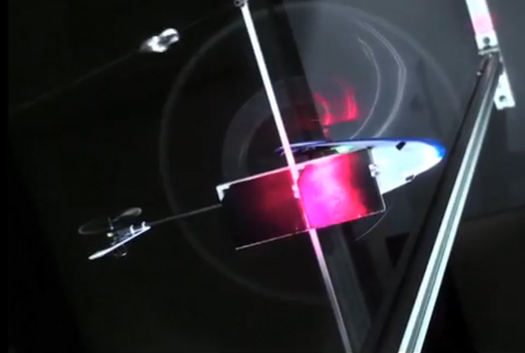
An unmanned aerial surveillance drone is only as good as its power source, and as such many technologies are being considered that could drastically extend the duration of drone missions – for instance, DARPA’s Vulture program has helped develop a giant solar plane that, theoretically, could fly for five years straight. But Seattle-based LaserMotive thinks laser power is the answer, and to prove it they recently kept a tiny 22-gram helicopter aloft for hours by beaming power to it via a laser.
LaserMotive knows a thing or two about turning laser power into mechanical energy; last year the firm beamed energy to a robot that climbed nearly 3,000 feet up a cable suspended form a helicopter, a feat impressive enough to win $900,000 from NASA. Now LaserMotive is demonstrating that similar ground-based lasers could beam energy to either fixed-wing or hovering rotary-wing UAVs high in the sky, keeping batteries topped up with juice so that they never have to land, with flight durations limited only by the durability of the aircraft’s motors.
Take the tiny laser-powered helicopter. LaserMotive kept the aircraft aloft for six hours at last week’s AUVSI Unmanned Systems Conference in Denver using a 7-centimeter beam of near-infrared laser that automatically tracked the helicopter as it moved up and down. The helicopter eventually failed, but only when the motor gave out. The laser never stopped beaming energy.Better motor tech could lead to unmanned systems that fly missions that last days or weeks, powered by ground based energy beams that keep them running indefinitely. Portable UAV systems could allow troops operating at forward operating bases to send small surveillance platforms skyward to hover overhead, giving them an eye in the sky over their temporary quarters. Troops on the move could feasibly keep drones aloft above their convoys, powered from lasers mounted on the vehicles.
Of course, we could also just use lasers to blast UAVs out of the sky.

Five amazing, clean technologies that will set us free, in this month's energy-focused issue. Also: how to build a better bomb detector, the robotic toys that are raising your children, a human catapult, the world's smallest arcade, and much more.


Online Content Director: Suzanne LaBarre | Email
Senior Editor: Paul Adams | Email
Associate Editor: Dan Nosowitz | Email
Assistant Editor: Colin Lecher | Email
Assistant Editor: Rose Pastore | Email
Contributing Writers:
Rebecca Boyle | Email
Kelsey D. Atherton | Email
Francie Diep | Email
Shaunacy Ferro | Email
first.
woot go laser motive, very impressive. I think they won a prize with implications for the space elevator for their tech.
What about using a similar concept to a scheme planned initially for harvesting solar energy in space with photovoltaics and beaming it to earth using microwave energy? It could be applied for this purpose then there could be fueling spots in the sky without the need to send a fueling platform out to the field/battle site.
hmmm... transmission of microwave energy thru Space Elevators, that sounds familiar. I think that was from Gundam 00.
Of course...when it gets cloudy or foggy, the UAV will lose power and crash.
So much for that.
Maybe if the batteries were very efficient and powerful, would it be able to "weather" the storm long enough for environmental conditions to get better and the laser can continue to power it.
Also...powering a 22 gram UAV is a lot less complex than a 400-900 lb. UAV (I don't know what the Reaper/Predator drones weigh, but I'm guessing it's no where near 22 grams).
What happens if there's a power failure?
Down goes the Drone.
BOOM.
If there was a power failure they would probably still have a backup battery on board. The batteries they have now have definitely gotten a lot smaller but obviously having the ability to beam limitless power via laser is probably a better solution than the current system used in this video. But for the time being I think we are good!
http://www.ndep.us/Flying-Fuel-Cells
interesting. They finally are powering things using lasers. Perhaps next they can start working on beam in g energy from space using lasers.
@SisaR: Yes, the idea mentioned of using microwaves to transmit solar energy from space is old as dirt in sci-fi and sci-spec, but if someone's made a workable prototype, that's a completely different thing.
This use of lasers for power on the ground, though - how cool it is depends entirely on how much energy is actually lost in converting electricity to light or IR and back again, and how much of the drone's weight carrying capacity is taken up by the receiver vs. the weight of a battery. Well, that, and the cost of the system. I suppose it's possible that a larger number of battery-powered drones on shift would produce the same effect, but if the receiver is substantially lighter than the battery would be, there's a clear advantage there for small monitoring devices.
I can't imagine that they haven't considered fog cover. I imagine it would be less problematic than weather could be for a solar craft, there must be some backup battery to draw it back if it loses power, etc.
MASER
No, this one's near-IR. It's at the other end of the visual spectrum, and it's, y'know, in the visual spectrum. (Near-IR seems a bit odd - almost less than red? So it's just very red? But the oddity of the phrase aside, it's still a laser.)
Note I didn't say "laser" in ref to the microwave transmitter.