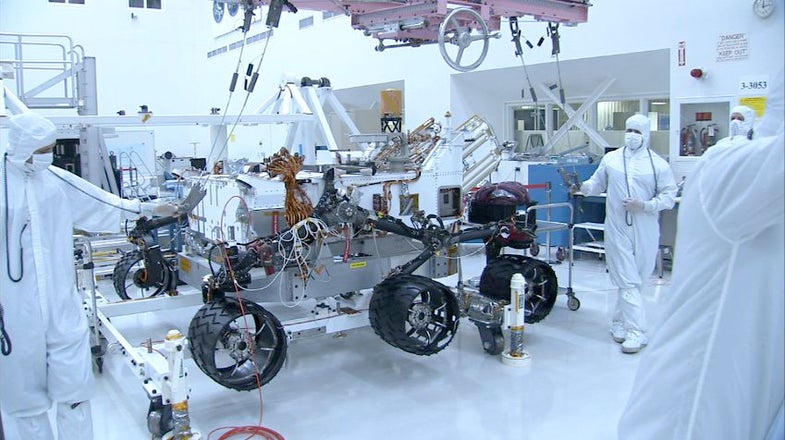
Curiosity's Brand New Wheels NASA

The next Mars rover, Curiosity, has been outfitted with a new cutting-edge mobility system that's enough to make off-road enthusiasts drool with envy. The rover, which will carry ten times the payload mass of Spirit and Opportunity, is about the size of an SUV, and too heavy for an airbag landing.

It has a set of six wheels that are 20 inches in diameter -- larger than a car tire. Each wheel has its own motor, giving the rover independent six-wheel drive, and "cleats" that provide grip and help keep the rover from slipping when climbing over rocks or sand hills. The rover can also do swerving maneuvers and turn in place a full 360 degrees.

Like the Spirit and Opportunity rovers, Curiosity will have a "rocker-bogie" suspension system, which keeps it from tipping over when rolling over large rocks or hitting dips in the Martian terrain. But unlike the earlier rovers, Curiosity will use its wheels as landing gear when a rocket-powered descent lowers it directly onto the Martian surface via a tether in August 2012. When Spirit and Opportunity touched down on Mars in January 2004, they were cushioned from the bumpy landing by the airbags that held them. But despite the protection, airbag landings introduce additional risks during the egress phase -- the period of time between the actual landing and driving the rover off the lander onto the Martian surface. Egress involves a series of tactical moves and steps, so the flight team must give the rover commands and assess the resulting data before proceeding with the next step.

Curiosity will be slowed by a large parachute after its descent through the Martian atmosphere, as were Viking, Pathfinder, and the Mars Exploration Rovers. Rockets will then control the craft's descent until the rover separates from a "sky crane," which will lower the rover to a soft landing -- wheels down -- on the surface. The precision landing will put Curiosity down within a precise 12-mile ellipse, whereas Spirit and Opportunity could have landed anywhere within a 93-mile-long ellipse.

As the primary component of NASA's Mars Science Laboratory mission, Curiosity will land in a location where water-related minerals have been detected by Mars orbiters. The rover's 10 science instruments will then examine the site for clues of modern or ancient habitable environments. The scheduled launch window is between November 25 and December 18, 2011.

10 Comments

Precise being the key word here....

Lots of detail on the buggy, less on where and what it will be doing. Would like more on that.

I like to see 3 or more telescoping jack poles put on the new rover bottom. So if it gets stuck in extreme soft, dusty soil, it has a way to push itself up and side ways to firmer soil or a means to shoot a hook and line, to pull itself out, sand trap.

Eventually if it gets trapped, send up a balloon with a camera and take better landscape pictures from a higher angle.

Have solar panels on the balloon, further a ways from the ground dust to keep the batteries charge and use the wind and its vibrations to keep the solar panels clean.

Ya, know..... When we add fertilizer, sun and oxygen on earth to our farms, things grow and explode with life.

I like see brought to Mars a "Steril Mars Petri Dish." Expose the “Mars Petri dish" to several days of mars air and then seal it up inside the rover and put in a sun and oxygen environment and see if anything grows. I also like to add some "Mars Dirt\Soil" to a "Mars Petri Dish" and do the same thing in Mars. Perhaps life does exist on Mars, but its very sparse to see. If we just give it a little help to grow, we can discover it’s already there to see.

Bubba, oxygen is a lethal poison that will sterilize whatever Mars microbes you might get; if anything grows it's just going to be microbes from Earth that hitched a ride.

When the oxygen level first rose to significant levels on Earth it caused a mass extinction event of anaerobic organisms.

@soylent Yeah just keep it simple with some water and warmth. See what happens.
Ya know after we do a bit of exploring on Mars and determine what we already know... that it's mostly sterile if not completely. We should engineer some super organisms and send them over there to see if we can't get some increases in atmospheric pressure. What say ye popsci denizens? I mean why not right? in 20 years we'll have done a fairly thorough study of Mars' current ecosystem and we'll be able to bio-engineer super bacteria that are highly radiation resistant, can handle low pressures and temperatures while being pretty easy to transport.
What do you think are the ethical quandaries--if any--in doing such an experiment?

Why hasn't Jordan been booted yet?

I agree A_Rock, throw them at the poles and have them depend on carbon dioxide to live. They'll produce oxygen for us, then we just need a ton of nitrogen to make it like our atmosphere!

p.s. this is me being naive and wishing it could be this easy :(

Hey it couldn't cost more then the missions we're already doing because the technology is being developed separately from nasa and you'll be able to just attach the system as a tag along like high school and college students do sometimes. And if it works then HEY! We beat out evolution! I think it's a cool idea myself ^.^

ajohnson1986

from Sioux Falls, South Dakota

I thought there was the little problem with the fact that mars doesn't have a very strong magnetic field so solar storms strip off large portions of its atmosphere whenever it gets hit?

Also, now that the rovers are getting bigger I'm excited to see the massive jumps they can do. should be exciting. :)

Massive jumps ^.^ Awesome! Well yeah there is that problem @ajohnson That's why I would like these little critters to be extremely radiation resistant and to produce far more greenhouse gases then normal. If the sun keeps ripping away atmosphere then we'll just have to make more :D Eventually maybe we could set up large enough solar arrays to build our own magnetic fields but I have no idea what the logistics of that are. But if we ever get really good at it we could possibly give the moon an atmosphere as well. It would need to be made of much heavier gases so we would most likely need a breathing unit still But at least--just maybe-- you won't need a pressurized suit. All of these ideas are just flights of fancy. I'd like to think, though, that it's not outside the realm of possibility. Just reason.

I’m just curious how successful Curiosity landing will be with the heavily mass Skycrane setting it down, when all you need is three large parachutes and a landing device called the Skyclimber which would have much less mass and land the rover wheels first at a much less cost.

See Skyclimber here:

www.shineinnovations.com/5512.html

See animation of the Martian Landing Skyclimber here:

www.youtube.com/watch?v=P_kfW31FgEw


138 years of Popular Science at your fingertips.

Innovation Challenges


Popular Science+ For iPad

Each issue has been completely reimagined for your iPad. See our amazing new vision for magazines that goes far beyond the printed page


Download Our App

Stay up to date on the latest news of the future of science and technology from your iPhone or Android phone with full articles, images and offline viewing


Follow Us On Twitter

Featuring every article from the magazine and website, plus links from around the Web. Also see our PopSci DIY feed


February 2012: The Future of Fun

Science is reinventing play, from extreme sports to gamification to ridiculous roller coasters to the playgrounds of tomorrow, and this issue is chock full of fun. Also, on a less fun note: Did global warming destroy my hometown?


circ-top-header.gif
circ-cover.gif