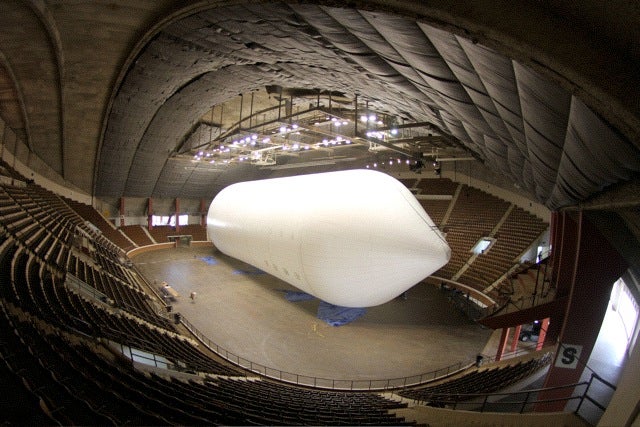
Airships of the future are getting a little closer to reality. A new time-lapse video shows the world's largest airship being inflated in an Alabama cattle barn, and the ship's manufacturer says it will be ready for test flights soon.

It took six hours to inflate it, but the video is condensed to about two minutes.


The Bullet 580 ship, measuring 235 feet long and 65 feet in diameter, is made of a thin type of Kevlar and will be able to fly at 20,000 feet, according to its manufacturer, E-Green Technologies. It will eventually carry a NASA payload that will study moisture content in soil.


The ship is maneuverable, meaning it can reverse directions and take off and land vertically. Its propeller fans are mounted along the center of the hull rather than under it, so its nose doesn't bob up and down when more power is applied (think of those tipsy gift-dropping blimps at NBA games). The pilot can control the airflow emitted by the fans, so there's no need for traditional rudders, as the Register points out. That also negates the need for ground crews using ropes.

E-Green also claims to have a solution for the helium problem. Helium makes the ship float, but because the ship gets lighter as it burns its fuel, some helium would have to be released for it to land. Helium is expensive, however, and it's difficult and costly to replenish the gas for another flight. E-Green says the Bullet will have a Water Condensate Recovery System, but the company won't elaborate on what that means.

Other airships, like Lockheed Martin's P-791 use thrust or hover systems to make a landing without sacrificing helium.

The Bullet can be piloted or operated remotely. It can carry a payload of 15,000 pounds up to 2,500 feet, meaning the ships could be useful for heavy-lift transport at low altitude. Or, it can fly at 20,000 feet with up to 2,000 pounds of cargo. It can be outfitted with various instruments for surveillance or science. The ship will sell for $8 million, and E-Green plans to build an entire fleet that can be leased for $300,000 to $500,000 a month, Discovery News reports.

[Cosmic Log, The Register]

26 Comments

It looks like a giant crayon!
I bet I could make an airship.

It looks like a giant crayon!
I bet I could make an airship.

It looks like a giant crayon!
It would be fun to make an airship.

whoa my computer messed up sorry for the same comment three times.

I wasn't aware there were any "airships of the future" on the way. I wonder how much fuel it would take to do the heavy left transport. Maybe it would be more efficient than trucks.

Someone has some severe compensation issues - no wonder it is white.

@oak Indians statistically would build the biggest airship actually.

it would be wonderful to use hydrogen that at the same time could be used as fuel. Provided of course a way to make it
not flammable, perhaps by using a special material inside the blimp

Solomon, you could make the hydrogen with a mixture of helium to make it more inert, since the hydrogen will rise you can syphon it out of the top for use as fuel. I know that some passenger aircraft are using a system where air is bled from the engine and forced through these tubes that only let nitrogen through, they then use that nitrogen to fill the fuel tanks to prevent vapors from combusting if any wires are shorting inside of the tank.

The worlds largest airship is trapped.......in a cattle barn!

i don't know why we aren't already using airship for commercial travel

@Jedigeek93 Because they are slower than JET-powered planes?

A water condensate recovery system could possibly work in conjunction with the HVAC for the cabin. Perhaps air is forced through a cooling coil or some other method which will condense water vapour from the air. This would increase the weight of the airship. Some large scale chillers in a humid climate can produce a surprising amount of water. At altitude or in dry climates however the effect would be greatly reduced.

Where does the title "World's Biggest Airship" come from. This thing isn't even a third the size of the largest ships that were made.

@amberjack
Maybe it's the worlds biggest inflatable airship?

The "Water Condensate Recovery System" is no mystery to those familiar with airships. It's a method of condensing and storing water from engine exhaust gases to help balance the weight loss from burning fuel. It was used in airships back in the 1930s, and if you look at a photo of the Navy airship "Akron," you can see the condensors mounted on the side of the hull.

"A new life awaits you in the Off-world colonies. The chance to begin again in a golden land of opportunity and adventure. Let's go to the colonies. This announcement has been brought to you by the Shimago-Dominguez Corporation. Helping America into the new world."

Why couldn't a fleet of these airships be used to fight forest fires? With their weight carrying ability, and hover time, they seem suitable to carrying lengths of hose and able to shower water down onto hot spots in a forest fire thereby extinguishing it or, at least, containing it?

I realize thermals might create a controllability problem, but isn't it worth a look? Maybe that can be overcome too.

Oh goody! Airships! Nineteenth-century tech, only this time with GreenTM bells 'n' whistles like central fans and a helium recovery system. Color me...uh...kinda bored, actually.

Not to say this isn't reliable, solid work, but I'm baffled by folks excited by bringing the days of the early industrial revolution -- trains, airships, windmills -- back. Is it the steampunk retro cool or something?

Bah. Wake me up if we ever get back to noisy powerful transportation tech. Say, hypersonic exoatmospheric transport that blasts off with a stupendous BOOM and gets you from New York City to Sydney in 90 minutes flat. That would be exciting.

A quick look at reference material gives:

Hindenburg class: 803 feet long, 135 feet in diameter, useful lift of 22,000 pounds.

Bullet 580: 236 feet long, 65 feet in diameter, useful lift of 20,000 pounds.

So, not bigger than historical airships.

Among modern airships, Lockheed-Martin's HALE-D is 240 feet long, and 70 feet in diameter. It was supposed to fly last summer, but never made it out of the hanger, due to lack of funds. It was inflated, however, just like the Bullet 580. The HALE-D is a prototype of the 600 foot HAA.

OK, PopSci, how is the "Bullet 580" the "biggest", again?

It's not bigger (size or lift) than the Hindenburg class, nor is it bigger than the HALE-D, which hasn't been off the ground, either.

Got any fact checkers working there?

Err, looks like a giant condom.

Looks like ants eating a giant marshmallow in reverse.

Let the UFO sightings begin, lol.

"the Bullet will have a Water Condensate Recovery System, but the company won't elaborate on what that means"

hm...
I'll take a SWAG at it...
They want to maintain buoyancy.
Since they are burning sumthun in the way of hydrocarbons into a gas…, as mentioned, the craft “is” getting lighter.
If one has your basic “Water Condensate Recovery System” on board, then one must be condensing some water along the way. All one must do is collect an equal mass of water vapor (aka humidity) out of the resident atmosphere to balance out the fuel mass lost.

It would really be neat if they were running the engines off hydrogen.
Then they could collect water – crack out the hydrogen = then fly indefinitely.
Of course the weight of the requisite solar cells and electrophoresis hardware would keep the airship firmly on the ground.

Still solar cells, batteries, and electric engines might be an option.
Then the down side would be thermal expansion of the helium.
As it is, the bullet is a more thermally neutral white bag.
With a layer of solar cells (which are dark – not terribly efficient – and relatively heavy), the waste heat off the cells would heat up the helium during the day – resulting in similar buoyancy issues.

To those who may have doubts to this being a BARN - it isn't. Garrett Coliseum is a multi use facility, a barn is none of those. It's usually plays host to rodeos and travelling circus acts.

Ok guys.. For a start "inflated" in this case is simply the air inflation which every non-rigid airship goes through to prove hull integrity and pressure test. It was never meant to leave that building except in the truck that brought it there. Second - water recovery for buoyancy control is as old as the hills. The water is recovered from engine exhaust - ever see your car dripping out the exhaust pipe? In fact as a product of combustion and heat transfer, 1 gallon of gasoline can deliver 0.7 gallons of water as long as the humididty is present in the first palce. Traditionally the systems have been heavy and unreliable. If you see a picture of the big rigids Akron and Macon, those black panels up the side are water recovery radiators. Third, it looks like the shape will be very inefficient aerodynamically with a plane cylinder with a cone at each end - bit crude by todays standards. Last of all, diverting the thrust from engines is a very inefficient way to steer anything especially when you have all the lovely airflow for nothing over light weight fins. Nah... can't see that puppy doing much except stir up interest in the obscure. Oh and last of all, check out the size of the fully functional certified air called Zeppelin NT.


June 2013: American Energy Independence

Five amazing, clean technologies that will set us free, in this month's energy-focused issue. Also: how to build a better bomb detector, the robotic toys that are raising your children, a human catapult, the world's smallest arcade, and much more.


Online Content Director: Suzanne LaBarre | Email
Senior Editor: Paul Adams | Email
Associate Editor: Dan Nosowitz | Email
Assistant Editor: Colin Lecher | Email
Assistant Editor: Rose Pastore | Email

Contributing Writers:
Rebecca Boyle | Email
Kelsey D. Atherton | Email
Francie Diep | Email
Shaunacy Ferro | Email

circ-top-header.gif
circ-cover.gif
bmxmag-ps