The plant could produce more than 98 million gallons of drinking water per year
Sand City Water Supply Let's get a taste of the Pacific, without the salt City of Sand City, Calif./Charles Pooler/ERI

Thirsty Californians living in Sand City began satiating their thirst with Pacific Ocean water starting this week, following the official launch of the state's first full-scale seawater desalination plant. The city hopes to ensure that people won't notice any difference in quality or taste compared from the reservoir water that usually comes out of their taps, according to Scientific American.

The brackish water treatment plant is expected to provide up to 98 million gallons (370 million liters) of drinking water per year, and cut down on that amount of water drawn from the Carmel River and Seaside Aquifer reservoirs.

Desalination works in this case by forcing seawater through a semipermeable membrane to separate out the salt. The $11.9 million plant operated on a test basis for more than a year, but only recently received permission from the California Department of Public Health to connect directly to the water grid serving the Monterey Peninsula.

Sand City has the good fortune to sit near a brackish coastal area where water is less salty than typical seawater -- and that means less energy and costs to desalinate. The city plant also uses reverse osmosis as its method of choice, rather than more expensive distillation which involves evaporating the water to separate it out from the salt.

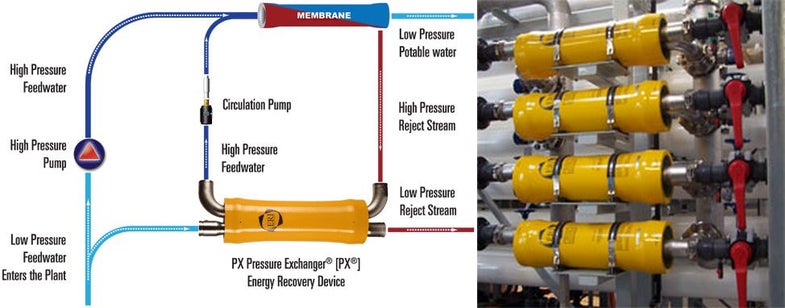
The plant takes two additional steps to reduce its impact on marine life and to boost energy efficiency. First, it adds a special solution to the leftover salty brine that matches the salinity of Monterey Bay. And second, it uses special rotors to recover 98 percent of energy from the flow of salty concentrate, and puts that energy toward pumping seawater through the reverse osmosis membrane.

Desalination has become more and more attractive as a thirsty world looks for new freshwater sources. There's even a mini-sized desalination chip designed by MIT researchers that could provide drinking water for remote villages in the wake of disasters.

IBM researchers and scientists at Saudi Arabia's national research organization have also been working on water filtering technology that could create a breakthrough in solar-powered seawater desalination. Considering that an estimated 1.2 billion people still lack access to safe drinking water, we'll take what we can get.

[via Scientific American]

9 Comments

This is great news, hopefully this catches on and is cost effective, love to see it come to Florida where fresh water supply is always a problem, especially during long droughts like went just went through recently.

subheading should say plant and not planet, I believe

anyone know how much fresh water california uses yearly? i'm just curious how much this will actually affect their fresh water conservation

This is an awsome idea, I really like how it gets back energy for it to keep working.

@hamstrahammer Thanks, the subheading has been corrected.

As a partial answer to your question, a USGS report from last year stated that California used about 32.9 billion gallons of fresh water per day in 2005.

$11.9 million? Am I reading that right or is that a typo? That sounds alot less expensive than I would have thought. Now I'd like to know if this is a small test plant. Is it experimental? Will it get cheaper and larger in scale.

Zengrath,

Florida actually has the first of this kind of Desalination Plant (It was the first and only in the US).

But it sounds like California is going to surpass Florida quickly on this, as there are 10 plants planned for in California. I didn't notice that this plant is more efficient then the one in Florida, but of course that could be just because of what they learn each time they build and use one of these.

"$11.9 million? Am I reading that right or is that a typo?"

Sounds reasonable. It's only producing 370 000 cubic metres of water per year.

The energy consumption is 2-3 kWh per cubic metre of fresh water; a bit less for brakish water.

Energy consumption can be lowered by a factor ~3 but that means you reject brine at a much lower salt-concentration; this means that you must take means you must take in, filter and clean a much larger volume of water which is much more costly than using more electrical energy.

can they sell sea-salt as a by-product?
do you have any idea how many people pee in the Pacific Ocean?
lol i only said that because nobody else had. not like drinking desalinated urine is any different than drinking desalinated corona..


138 years of Popular Science at your fingertips.

Innovation Challenges


Popular Science+ For iPad

Each issue has been completely reimagined for your iPad. See our amazing new vision for magazines that goes far beyond the printed page


Download Our App

Stay up to date on the latest news of the future of science and technology from your iPhone or Android phone with full articles, images and offline viewing


Follow Us On Twitter

Featuring every article from the magazine and website, plus links from around the Web. Also see our PopSci DIY feed


February 2012: The Future of Fun

Science is reinventing play, from extreme sports to gamification to ridiculous roller coasters to the playgrounds of tomorrow, and this issue is chock full of fun. Also, on a less fun note: Did global warming destroy my hometown?


circ-top-header.gif
circ-cover.gif
bmxmag-ps