Two forms of flight come together for a glorious moment in the sun
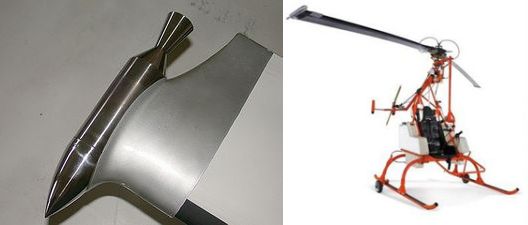
Rocket-powered Copter Go on, fly me! Swisscopters U.S.

Mating a rocket with a helicopter sounds improbable, but only until you watch the Dragonfly DF1 take to the skies. DVICE reports that the rocket-powered copter received airworthiness certificates last November, and may go on sale as early as this year.

The copter makes use of tiny hydrogen-peroxide-powered rocket motors on the tips of the blades, which replaces the traditional engine-powered rotor. Large fuel tanks surrounding the pilot allow the Dragonfly to travel at up to 40 mph for 50 minutes.

Whether or not Swisscopter U.S. gets a commercial version off the ground this year, we would bet that PopSci's own John Carnett will be putting in a call to the company. The staff photographer and inventor has previously taken his jet-powered ATV out for a wild ride or two in the woods, and this chemical copter is right up his alley.

[via DVICE]

19 Comments

I will take 2, yesterday.

--GTO--

I remember seeing DIY plans for something like this years ago. The difference was the motors were pulsejets.

Is this just an interesting engineering gimmick or is there some advantage to this?

Can it Auto-Rotate if the rockets fail ? Can it still fly to a safe landing if one rocket fails ? How long does it fly for with a full load of fuel ?
It seems less complicated than a copter with an engine and traditional rotor blades ,is it more reliable or safer ?

I think using rocket grade H2O2 will be a rather expensive propellant it is one of the least efficient rocket fuels actually used. Hydrozine is a much better monopropellent too bad its toxic. Even the best rocket fuels are quite a bit less mass efficient than a bad air birthing engine. There were some ramjet powered helicopters developed in the 1950's that seemed to work quite well.

Good luck at the smog check.

I wonder if the pilot's eyes burn after flying this machine. Looks like a high power to weight ratio. The enviro green nuts should like the water and oxygen it produces - that is even better that their "golden" fuel hydrogen. How corrosive is Hydrogen Peroxide on rotating shaft seals?

I lost some of my hearing just listening to the video.

Wait?... I thought if the blades rotated from the tips not from the center, you would not need a tail rotor? Or is that a tail rotor? I'ts like the german's concept aircraft, the Dragonfly? or something it's a tri rotor tip jet interceptor design... many helicopters like this have been done in the past without tail rotors but they did have big V-tails they were gasturbine driven with exhaust coming out of the tips of the rotors... really neat concept and pretty good performance there was one flaw or one thing that limited them from being mass produced though can't remember what it was.

@ GreenAce92
You still need the tail rotor to counteract the spinning moment of the rotors. The fact that they spin counts, not what drives them. Overall, cool idea but noisy and no, I don't think it auto-rotates very gracefully!

ZenZaBill, you have it backwards. No tail rotor is needed because the fuselage is not applying a torque to spin the blades therefore there is no need for an "anti-torque" device also known as a tail rotor. It depends on when drives the rotor system. That is why the many designs from the 40s and 50s did not have tail rotors. This design is really simple and effective, however the major down side to this design is the sound.

You need a tail rotor for yaw control with no air speed when hovering.

Hi, I see a lot of wrong information about this rocket helicopter, we at TAM built the rocket engines so we know very well how it work, first the hydrogen peroxide is NOT a corrosive, is NOT a fuel, is NOT flamable and is NOT toxic in any way.
Now since the power is applied to the tips of the blades this helicopters DON'T have any torque because the rotor is free and not linked to any shaft or gear box, the small tail rotor that you see is only for turns but NOT for counter rotate and this rotor can be eliminated and a vane can be added to deviate the air flow and it will do the same work.
Now about safety, 86% of all the traditional helicopter accidents are caused by tail rotor failures, since this helicopter don't need the tail rotor for stable flight it is a lot safer than any other helicopter

Also since this helicopter have collective pitch and is NOT linked to any shaft, clutch or any device that must be disengageg prior to a autorotation this helicopter can autorotate almost instantly making the dead curve of the traditional helicopters inexistant in this helicopters.

This rocket engines are extremelly reliable and in fact this is not known of a single failure, anyway this helicopter can sustain flight and land with a single engine and it is proved that a single engine gives the same RPM at the rotor than the two rockets.

In the past it was done with ram jets but the jet engines where so heavy that the rotor blades failed at the tip or the root attachment, this rockets produce more power than the ram jets at a fraction of the weight, so all in all this helicopter is the safest helicopter ever developed and we are woking on the free maintenance rocket engines, no catalyst, no special or concentrated hydrogen peroxide, just commercial grade low concentration hydrogen peroxide will be powering this helicopters very soon.

If you have any technical question you can visit the site at tecaeromex and go to the rocket helicopter menu

Also in the contact address I can answer all your questions.

Regards

Juan Manuel Lozano

that shut 'em up

Its referred to as a 'hotcycle rotor' either using hydrogen peroxide with a catalyst or some other form of hot jet. Was also developed by U.S defence department in late 50's and 60's to be dropped to downed airman in order to help them get out of enemy territory. Its cool that its a personaly helicopter an a company is 'trying' but im not sure if its science or convention - e.g been done long while ago.

Thats the prob with not learning history your cursed to repeat it.

@Tecaeromex: Thanks for the info. I had a couple of questions. First, it doesn't seem very efficient. All that fuel for a 40 min flight? Is the efficiency expected to improve? I guess w/out engines and a drivetrain you could probably afford to carry a higher volume of propellant. Second, what are the theoretical cruising speeds of a commercial 'copter? I'm assuming once again the speed for this craft was low due to its size and its purpose as a demonstration vehicle.


138 years of Popular Science at your fingertips.

Innovation Challenges


Popular Science+ For iPad

Each issue has been completely reimagined for your iPad. See our amazing new vision for magazines that goes far beyond the printed page


Download Our App

Stay up to date on the latest news of the future of science and technology from your iPhone or Android phone with full articles, images and offline viewing


Follow Us On Twitter

Featuring every article from the magazine and website, plus links from around the Web. Also see our PopSci DIY feed


February 2012: The Future of Fun

Science is reinventing play, from extreme sports to gamification to ridiculous roller coasters to the playgrounds of tomorrow, and this issue is chock full of fun. Also, on a less fun note: Did global warming destroy my hometown?


circ-top-header.gif
circ-cover.gif