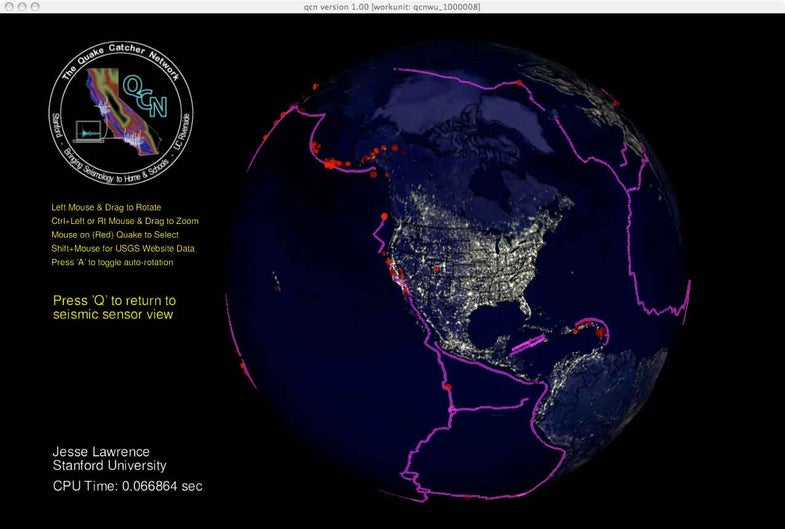
Here's one genius computer program you might consider pushing virally for science's sake. The "Quake Catchers" program aims to make earthquake detection a lot easier and cheaper by taking advantage of accelerometers built into MacBooks and other newer laptops, the Los Angeles Times reports.
The accelerometers that are embedded in everything from iPhones to the Nintendo Wii aretiny devices that detect movement. Having software that takes advantage of the tiny devices on thousands of laptops could complement the current system of earthquake sensors installed along fault zones.
Elizabeth Cochran, an earth scientist at the University of California in Riverside, got the idea of harnessing accelerometers for an earthquake network by watching the "Seismac" program on a friend's MacBook. But whereas Seismac allows you to shake the MacBook and get accelerometer readings for giggles, Cochran hopes "Quake Catchers" can help science and maybe save lives.
The "Quake Catcher" software is designed to record all vibrations on a computer, but only uploads the info if many computers in the same geographic area record "dramatic shaking."If the idea catches on in schools, businesses and homes, it might even become part of an early-warning system that detects the outward ripple of an earthquake. Even laptops that don't have accelerometers can get a $50 sensor with a USB cable that acts similar to an accelerometer.
About 1,000 people have already signed on as "Quake Catchers," and Cochran's group hopes to possibly blanket California and beyond. That doesn't mean we won't still need our quake-proof buildings, but the software represents readily adaptable technology that's available now. We'll just keep dreaming of our active cloaking that counters earthquakes.
Check out the Quake-Catcher Network here.
[via Los Angeles Times]
Five amazing, clean technologies that will set us free, in this month's energy-focused issue. Also: how to build a better bomb detector, the robotic toys that are raising your children, a human catapult, the world's smallest arcade, and much more.


Online Content Director: Suzanne LaBarre | Email
Senior Editor: Paul Adams | Email
Associate Editor: Dan Nosowitz | Email
Assistant Editor: Colin Lecher | Email
Assistant Editor: Rose Pastore | Email
Contributing Writers:
Rebecca Boyle | Email
Kelsey D. Atherton | Email
Francie Diep | Email
Shaunacy Ferro | Email
At first this looks like a light idea, but if done right it could bring alert and assistance cheaply and quickly to the third world. It’s all in the data; if enough data is collected it could predict tsunami. More sensors and more data, and could lead to better modeling and prediction. Perhaps even the flip side, a magma wave, could be addressed. If a tsunami moves at 500 miles per hour how slow does the flipside magna move? Does it travel along fault lines as of they were rivers to the next earth quake? The possible benefits for a large group of people and are worth the experiments.
I think a really good extension of this would be to desktops becasuse desktops are often situated on the ground and would be more reliable if the hardware was more readily avaliable. Maybe a future integration of accelerometers in cases for just this purpose?
@tmarti69 Yes - good thinking - let's get all of those third world countries with plethoras of macbook users to be sure and sign up. Or, maybe they can spend their year's earnings on a USB dongle to be economical.
@parrotmac - Another winning idea. Now, let's just convince Dell and others to add accelerometers as a feature on their new models since customers will be demanding to pay for this feature so as to join the new earthquake boy scout network. Or, perhaps you can just buy the stupid dongle and sign up. Your accuracy will be rewarded.
@famous - bad day at the morgue?
As I understand , currently only certain Mac PPC and Intel laptops are supported -- recent ones which have a built-in accelerometer. You can participate by downloading and running a free program on your computer. The Quake Catcher Network is a research project that uses Internet-connected computers to do research, education, and outreach in seismology.
This is a great idea in my opinion. Another good idea would be to donate some computers to 3rd world countries so that the information would be complete.
| Written by Dimitri from Eat Healthier Foods |
It seems like it could potentially be a really good development. It's smart but I'm not quite sure how practical it is. As I read the other day at www.hometheatersreviews.com the technology is there, but whether it can be implemented is another matter.
Fabulous news! To predict any natural disaster before there is a lost of life is just fantastic. I do not pretend to understand how the technology works, however I am grateful that there is such talent in the world to create and impliment such applications.
www.atlantic-ec.com