
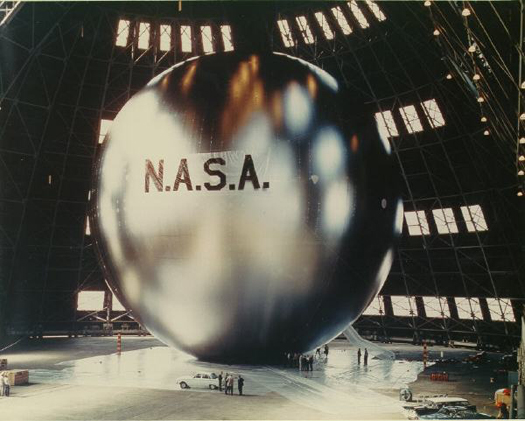
As we've been hearing for months, 2010 is going to be a year of belt-tightening for NASA. But now, with the release of the new NASA budget, we can see that even with substantially less money, NASA still has some cool technologies on the way. In particular, this budget allocates money for inflatable space stations, research into mid-orbit refueling, and the development of a slew of new autonomous space vehicles.
Inflatable space station modules rank high on NASA's wish list for an important reason: they're cheap. However, don't let the price fool you. Despite costing less, the modules can be larger than current models for the same weight, provide just as much protection, and even be tested with the currently deployed ISS. Plus, private sector companies have already started developing the technology.
NASA also wants to automate many of the tasks currently performed by humans, essentially replacing the Space Shuttle with unmanned autonomous spacecraft. This new budget dedicates money for a remote rendezvous and docking system, as well as an autonomous precision landing and hazard avoidance system.
And, like every American who's getting hit at the gas pump, NASA wants to spend less on fuel. In the new budget, they approach that problem in two ways. The first is by paying for the development of an in-orbit refueling system. This could significantly increase the lifespan of currently existing satellites, and save NASA the time and money required to launch a new mission every time something runs out of gas. Additionally, NASA is allocating more funds to programs that would make fuel out of materials already found on the Moon and Mars. By only having to bring half the fuel for the trip, and gassing up with material found at the destination, NASA hopes to significantly cut the cost of interplanetary exploration.
The new budget contains a number of other interesting programs, some of which seem like reactions to the new age of lower cash flow, and others that appear to signal a true coming of age in automation technology. Either way, it's as interesting as any 517-page government report can be.

138 years of Popular Science at your fingertips.
Each issue has been completely reimagined for your iPad. See our amazing new vision for magazines that goes far beyond the printed page
Stay up to date on the latest news of the future of science and technology from your iPhone or Android phone with full articles, images and offline viewing
Featuring every article from the magazine and website, plus links from around the Web. Also see our PopSci DIY feed
Science is reinventing play, from extreme sports to gamification to ridiculous roller coasters to the playgrounds of tomorrow, and this issue is chock full of fun. Also, on a less fun note: Did global warming destroy my hometown?
Haha ha ha ha ha... We actually sold the patent for inflatable modules to Bigelow. Bigelow was going to do that anyway. Don't give the budget credit for it. A lot of robotics in the budget, which is not new. No humans mentioned in the budget for some reason... Lets do away with Constellation in favor of stuff we were already doing! Great idea. Shocks that Pop Sci endorses this BS.
"The new budget contains a number of other interesting programs, some of which seem like reactions to the new age of lower cash flow, and others that appear to signal a true coming of age in automation technology. Either way, it's as interesting as any 517-page government report can be."
Well, it looks like pop sci does not fully endorse it after all. New age of automation and low cash flow. Hahahaha
So no more manned missions? That seems to take the fun out of it.
I'm surprised we hadn't done this sooner. We should start a program of some sort that gives people, or robots, jobs in space to collect materials from other planets in our solar system. That's what I think is the next step for mankind.
I'm visualizing grain of sand sized speck, moving at an uninhibited velocity, hitting an inflatable space-station, rapid depressurization, surface compromise, and said station resembling a flower opening as it explodes out one side...
Fuel, Air and Water don’t need rockets to be conveyed into space, and outside the atmosphere they can be stowed in inflatable bags. A space station can be inflated and assemble in near orbit and then deployed.
This can be done by pumping rather than climbing into space with a sky pipe or partial sky pipe and space tether hybrid. Pumping is going to be way faster than climbing and, provide fuel to reach geosynchronous orbits routinely and with limitless amounts water to provide shielding beyond our magnosphere. The pipe provides the hydrogen fuel just out of the atmosphere at about 70 miles up where aircraft can pick up bags of fuel to fly to orbit or to the moon. In addition the pipe can pump air into space to finish a fuel cycle capable of climbing up the remaining tether with the by product of plentiful clean water. Waist water, ice, can be aimed back at space debris and push debris back into the atmosphere and to earth.
But, we need plans that include putting heavy water deployed on the outside of the inflatable space station either by multiple hull inflation, gels to contain water, and or, an artificial gravity by rotation. An inflated craft like this with nuclear fuel could rotate and have artificial gravity water on the outside to shield against solar flairs, and could routinely and safely go to Mars and back.
It needs decals to make it look like the Death Star.
Its about time that we start to see some really innovative thinking at NASA. So what happens to the ballon when hit by a small piece of metal or debris in orbit ?
great.. inflatable space junk.
Let's hope this is the best, and not the worst.
The best: NASA is a cranky old purchasing-based agency which is policy bound and spends money without actually doing anything... a new approach is needed to get America on the move in space once again.
The worst: Obama lies about his support for Constellation (he did explicitly support it and full funding for it during the election).
He then defunds the politically well connected big aerospace suppliers in favor of the little guy hobbyists.
And then he defunds the politically unprotected hobbyists.
Thus bringing "social justice" to the budget.
We will see.
The inflatable structures being considered are essentially bullet-proof vests wrapped over and over each other. In impact tests, they've actually done better than their metallic counterparts.
The 'old' way of doing things (Constellation) had a decent shot of producing moderate gains after spending amazing amounts of money. This new way has a decent shot of opening space to Earth's economic sphere and making space a place.
Hillkid. If you knew anything about constellation you would know it isnt the "old" way of doing things.
"New" is not always the best anyway. But this program was going to be new and take us to the Moon and later to Mars.
With this budget NASA is given to "new" private companies with no plan for getting anywhere beyond LEO.
The PEGEOS, the late model of this, is reflective like a mirror, and the concept should be altered for the inflatable telescope. One side is reflective and the other is clear a magnetic coating on the back side of the mirror side allows active distortion of the mirror to be distorted to a parabolic shape. Meanwhile a color coating on the mirror surfice creates a polar topographic grid sensitive to one wave length of light. Then a strobe and computer track distortions ripples in the grid and correct the resultant digital images from the camera. We could use the lack of atmosphere and blow up telescope fifty times larger then Hubble telescope.