“Whispering Gallery” Microresonator Can Measure Individual Nanoparticles
The sensor on a chip can both detect and measure single particles smaller than a single virus
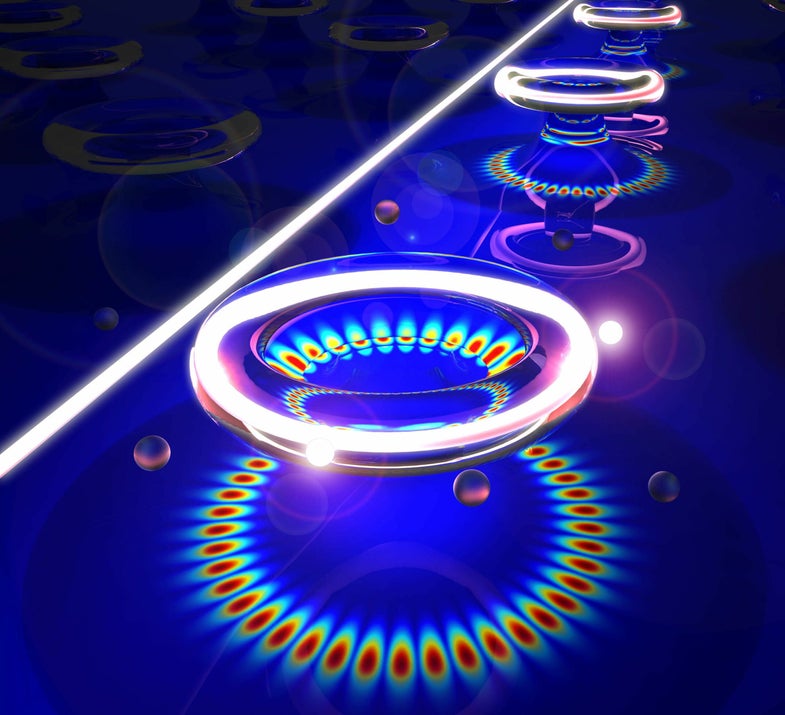
Forget all the nanotechnology devoted to fighting cancer, and just consider that nanoparticles have invaded makeup, anti-odor socks, sunscreen, plastic beer bottles and home pregnancy tests. Now scientists have developed a way to assess the health and environmental impact of such nanoparticles: a tiny microresonator that can detect and measure individual particles smaller than a single virus.
The microresonator is a lab-on-a-chip that harnesses the “whispering gallery” concept that’s displayed by buildings such as St. Paul’s Cathedral in London. The cathedral’s domed gallery can carry whispers easily across to the other side, but normal-volume voices end up garbled after bouncing around the dome multiple times.
Similarly, microresonators can bounce laser light many times around a circular “waveguide,” such as a glass ring. A laser frequency must perfectly fit the circumference of a ring to achieve this whispering-gallery mode.
The glass resonator can detect nanoparticles attached to the ring, because the particles disturb the laser light wave and changes the resonant frequency. Scientists gauge the size of a particle based on the frequency change, but run into problems with vibrations, temperatures or particle locations that can affect resonant frequency.
Researchers at Washington University in St. Louis engineered a different approach by creating a flawless resonator etched out of glass layers on silicon wafers. They reheated the microresonators with pulsed lasers to liquefy the glass, and allowed surface tension to pull the rings into smooth shapes.
Such a high-quality resonator allows researchers to use mode splitting detection. That method measures the difference between light traveling clockwise and light traveling counterclockwise within the resonator — a nanoparticle would split the mode and create different measurable frequencies among the clockwise and counterclockwise light waves.
Any “noise” from vibrations or temperatures affects both modes equally, so that it essentially cancels out. This creates a more reliable and accurate detector for nanoparticles, and may hopefully help establish better safety standards for humans using any products containing nanoparticles.