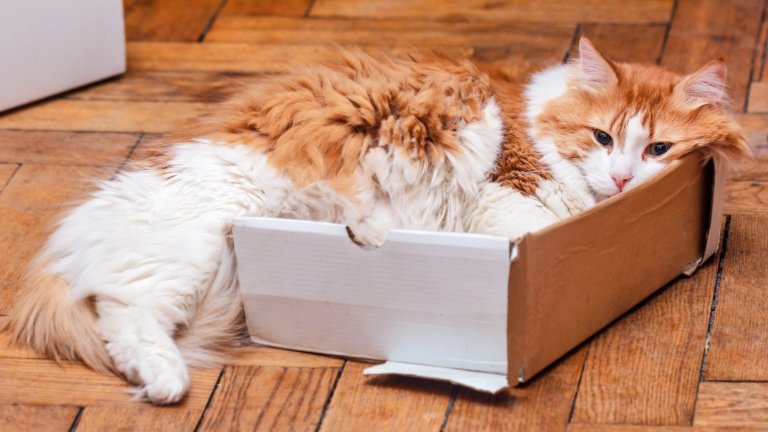
Using 144 terabytes of RAM, scientists simulate a cat's cerebral cortex based on 1 billion neurons and 10 trillion synapses

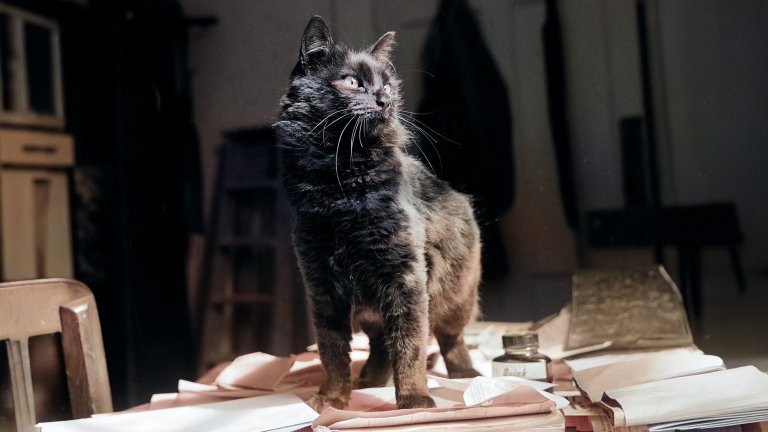
Simulating Cat Minds Can I haz brainz? IBM

Cats may retain an aura of mystery about their smug selves, but that could change with scientists using a supercomputer to simulate the the feline brain. That translates into 144 terabytes of working memory for the digital kitty mind.

IBM and Stanford University researchers modeled a cat's cerebral cortex using the Blue Gene/IP supercomputer, which currently ranks as the fourth most powerful supercomputer in the world. They had simulated a full rat brain in 2007, and 1 percent of the human cerebral cortex this year.

The simulated cat brain still runs about 100 times slower than the real thing. But PhysOrg reports that a new algorithm called BlueMatter allows IBM researchers to diagram the connections among cortical and sub-cortical places within the human brain. The team then built the cat cortex simulation consisting of 1 billion brain cells and 10 trillion learning synapses, the communication connections among neurons.

A separate team of Swiss researchers also used an IBM supercomputer for their Blue Brain project, where a digital rat brain's neurons began creating self-organizing neurological patterns. That research group hopes to simulate a human brain within 10 years.

Another more radical approach from Stanford University looks to recreate the human brain's messily chaotic system on a small device called Neurogrid. Unlike traditional supercomputers with massive energy requirements, Neurogrid might run on the human brain's power requirement of just 20 watts -- barely enough to run a dim light bulb.

[via AP and PhysOrg]

30 Comments

Quite an achievement.

Still, I find myself feeling sorry for the virtual "cat" - if you create an animal-brain-based system that's capable of learning from experience, feeling basic emotions, etc., then shouldn't it have the same rights as a flesh-and-blood pet?

If so, then wouldn't leaving that virtual creature shut up inside the computer with no body, no sensors, and no way to interact with the outside world constitute a form of animal cruelty?

At least it's "thinking" slower than an organic cat's brain. Still, even if 100 days as a disembodied neural network only feels like one day of sensory deprivation, I doubt it's a pleasant experience.

I wonder if the ASPCA will start standing up for the rights of virtual critters....

Hmm so when they simulate these brains just what are they doing? Do they have any stimulus? What data is collected? If you let the thing run for 100 years would you have a perfect 1 year old virtual cat?

So, will Blue Gene get the sudden urge to lick itself?

Is the cat dead or is it alive? Plus keep the mouses away from it! Plus how will the cat brain survive an electrical power outage ( provoked by earthquakes, hurricanes, terrorism, rats chewing the power cables ).
For sure they will develop a full human brain simulation and this questions are valid for it too. Will it be capable of murder? Will it talk? Will it listen? Can you believe it? It knows everything that Google knows?!?!?!?

@finitesolutions

Does it know what God knows?!?!?!?!?!?!?!?!?!?

At last, we'll know the secrets of the universe. From a cats point of view of course.

All well and good but will it come to the sound of a can opener??

...EF

i just wet myself lol take this data and put it into a robotic cat thing and ill buy it because im alergic to cats but want one make it fake cat fur plz

@finitesolutions

ever hear of Schrodinger's cat? ;)

"I'm sorry, Dave. I'm afraid I can't do that."

It cant be a true cat, it does not have stimuli, can lick itself, doesnt even know what legs are.....I believe they say "model a cats entire brain" because it matched the
COMPUTING POWER
of a cats brain, not the real thing, if it, was is fact intelligent, they would have already built a "robotic cat" with muscelse, bones tendons nerves and joints that would act as the inputs, stimuli etc. that it needs to be intelligent as a cat is. The program wirelessly communicating with the body

popsci I blieve, is skewing the evidence, it just CANT behave like a real cat.

I repeat, it has the same COMPUTING POWER in the form of "neurons" as a cat....not its intelligence

This is the biggest news in biology in 10,000 years...they found a cat with a brain.

That news just rocks me to the core.

the computer thing is no big deal compared to this

LOL @ Q42 If you are the God that created the brain, you get to decided if it lives or dies. If this is morally questionable, then tell me why we don't demand the same from our own God(s)? Instead we have alll sorts of suffering in the world... I guess he's just testing his super computer.

I believe Douglas Hofstadter would say that because it doesn't receive the same stimuli as a cat unless it was a robot in a cat's body (and why would we do that?) it can never have the same habits, thought patterns etc as a cat. Just like how two twins with identical DNA become very different people through their experiences, so will this machine and a cat, but on a much vaster and profounder level. If this were done for a human's brain it would most likely not produce much comprehensible to us. Remember the words of a certain 20th Century philosopher...

"If a lion could speak, we would not understand him."
-Ludwig Wittgenstein

No that's very different, the matter used as a medium in the simulation is virtual in a physical sense. This is merely float point units stored in memory in binary conglomerates across complementary metal-oxide transistors that are implemented nowhere near biologically similar neurons, deductively if you could write out and perform the simulation in sand with a stick, the calculations would be performed in the same digital-to-information methodology as a processor.

Well, hopefully it's more obedient than your average cat.

And doesn't shred the couch.

@Q42 I doubt they'll get any more involved as they do for starving NeoPets.

@TechnoFreakFace You have a point but I think aren't hitting it entirely on the head. They aren't modeling it to show emotion, ect, but have built the same structure as a cat's brain in order to understand the connections between the synapses and the brain cells. Once these connections are understood then perhaps they will start implementing outside stimuli and the like but for now I would assume that they can simulate all that too (for instance: telling the cat's "brain" that its legs are stretched out or that cat nip is awesome).

Just what we needed: an extremely expensive computer with a detached aloofness that, with a single glance... er... screen prompt, reminds you that more than 2000 years ago its ancestors were worshiped as gods. And it has never forgotten.

Copy and save that picture! In about 5 years, that much computing power will be installed in giveaway toys at Burger King, and robocops will RULE!

The comments are fascinating and in a funny way - Brian H nailed it. With advancements today - we'll miniaturize this down to something easier to transport. Maybe by then they will have improved upon the logic, the intelligence and the processing power so that they can make a dog.

YES!!! Canine lovers unite!

Xspot

from neverland

In spirit of Edison I would say, every cat knows one good way to make a cat, and we are learning 1000+ ways how it can't be done.)
It would be interesting to know, how can a simple intelligence remember anything an use those experiences to improve itself. Perhaps if they could manipulate those memories, intelligence should rapidly increase. But I can't imagine what kind of fuzzy being that would become, constantly changing everything that it was and is.
There is a problem, how can a virtual creature experience pain and suffering or describe fear as hole inside and nothing on the outside, to be able to evolve and learn anything from experiences. Also interesting are the experiments done on Salamanders, when they cut their brains and put it back in, even in the reverse position, upside down and so on. Salamanders recovered and quickly learned to feed again (holographic brain?), even with a much smaller piece of it.
When we move, electric signals are traveling from our brain and than flow through every cell of our body. If I understand the process correctly, only certain cells are contracting, due to electricity field changes in fluids between membranes and other cells are stretching, as a result of contraction. That is how a body moves, but question is why, how brain coordinate a movement, how it decide to do what and than how and where it sends a proper signals. At fortunately, processors in the big room above can not contract, but perhaps cat could stretch his vector legs in simulations, like second life.
An animal is an animal, every cell in its body cannot be anything else, so it can't behave much differently, but every intellect can feel emotions of other living being and adjust its behave appropriately. So if a virtual being could somehow sense emotions of interacting persons, it should adjust its movement and reactions just as well as a real living being would, body shape and restrictions wouldn't be so important. In other words, even a virtual cat must feel desire to be a cat and perhaps it doesn't need so much space and terabytes to do that.

!?!?!?!?!?!?!?!?!?
awesome
!?!?!?!?!?!?!?!?!?

What does Blue Gene/IP think about?

Food ... Food ... Food ...

Sleep ... Sleep ... Sleep ...

Pat me ... Pat Me ... Pat me ...

That's about it! (maybe BIRD! SQUIRREL! or MOUSE! every so often too)

No very much output per Terabyte of ram....

What good is a cat brain if you can't eat it?

It would have a great achievement of technology if they had done what they advertised. But I am curious to find what could happen if a fully intelligent, to the point of being almost sentient, what the government would do, and would it be covered under the constitution??

Referring to the last paragraph in the article, though the human brain's system appears to be "messily chaotic," I would bet that it is the most efficient system possible for its job.

I think that these scientists need to create a robotic cat and somehow channel the power of the supercomputer- perhaps wirelessly- into the robot and release it into the wild and let it learn from its experiences. That kind of data might help them simulate a human brain eventually

And I thought I had a sweet computer...

My Computer Their Computer
4G RAM 144TB RAM
640G Hard drive dunno
Athlon X2 dual core Black edition vs. dunno
nice motherbourd
All that for $250

That's what I care about.
I dream that one day with the help of computer we can let our
spirits deathless even the physical had become dust.
To make the computer think like human and also have its own emotions seems impossible now and I wonder if it has ,how could we know.
At least I hope via some devices we can "copy" the brain including the memories and characters。It can be stored in a
hard disk or flash disk.One day in the future it may be reloaded in a new body.


Download Our iPhone App

Stay up to date on the latest news of the future of science and technology from your iPhone with full articles, images and offline viewing


Grab the Tech Buyer's Guide iPhone App

Carry everything you need to make a smart buy on HDTVs, cameras and 14 other product categories right in your pocket


Follow Us On Twitter

Featuring every article from the magazine and website, plus links from around the Web. Also see our PopSci DIY feed


Become a Fan On Facebook

Share links with friends, comment on stories and more


February 2010: Renovating America

Innovative fixes for five of the country's biggest infrastructure messes, plus a look the quest to read the human mind, the LCD screen that might finally kill paper dead, and the world's scariest science.

Read the issue here.

Popular Science Photo Pool


Share your photos in the Pop Sci pool at www.flickr.com!