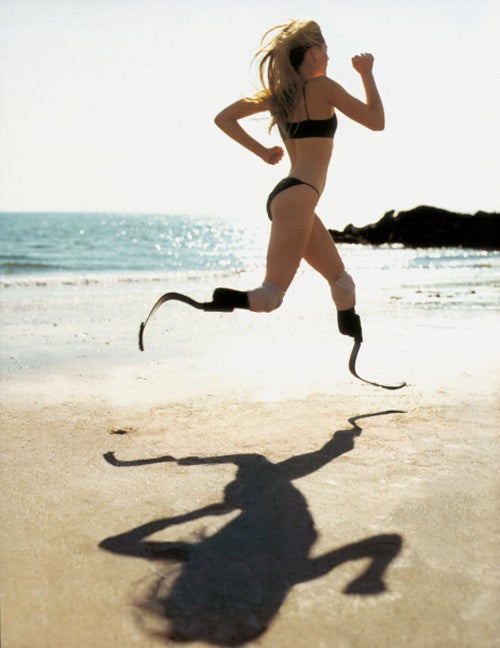
Much of the debate on the place of advanced prostheses for the disabled in competitive sports often downplays arguably the most important perspective: that of the athletes who couldn't compete without them. In light of the recent MIT research project that found prosthetic limbs offering no advantage over natural legs, sprinter and double Cheetah leg user Aimee Mullins has some even more thought-provoking (and first-hand) analysis of the issue.
Mullins is guest editing Gizmodo's "This Cyborg Life" theme this week, and all of her pieces on the implications of modern cyborg enhancements in sport have been insightful. In her latest, she draws some worthwhile comparisons to other variations in skill or ability that are not only legal, but deemed completely normal in other sporting situations--whether it's Tiger Woods's double Lasik surgery or the complete re-write of competitive swimming's record books in the era of swimsuits like Speedo's LZR. She writes:Where do we draw this ethical line on performance enhancement? I'm not sure I can answer that right now. What I will say is that I don't think it's useful to have this discussion around the existing Cheetah Leg, confusing the current non-enhanced technology with future prosthetics that will indeed provide augmentation. As with all evolution in sport, let's decide the parameters of competition when the technology actually exists, when we have metrics that inform us as to what extent augmentation is a certainty. Conjecture has no place in this discussion.
If you read PopSci, you know the future of prostheses is becoming more and more unreal--like something out of sci-fi. And it's only going to get more advanced. We're with Aimee--with today's prostheses giving disabled athletes a fair shake at competing with the best of the best on common ground, the world better prepare itself for a cyborg gold medalist. Because it's going to happen.
[Gizmodo]
Stay up to date on the latest news of the future of science and technology from your iPhone with full articles, images and offline viewing
Carry everything you need to make a smart buy on HDTVs, cameras and 14 other product categories right in your pocket
Featuring every article from the magazine and website, plus links from around the Web. Also see our PopSci DIY feed
Share links with friends, comment on stories and more
Innovative fixes for five of the country's biggest infrastructure messes, plus a look the quest to read the human mind, the LCD screen that might finally kill paper dead, and the world's scariest science.
Read the issue here.
That'd be a little discouraging... you know... training your whole life to be in the olympics and then having your butt handed to you by a cyborg who just happened to have money, good insurance or the drive to say "Cyborg's can, too!" I'd be a little upset and feel a bit worthless.
Is it really so appalling that amputees not compete in sports that require limbs? Every effort should be made to accommodate them in the world. But shouldn’t a foot race, at minimum, require feet? I emphasize their struggle to approach normalcy. Yet, I want to tell them there is just a limit, and this is it.
Like they have been hinting at, maybe now these limbs do not give you an advantage, but one day they can and will ( for those with enough cash) So if there is a time to draw a line it is now. If we cant have chemical enhancements then we shouldn't be able to have mechanical enhancements.
I agree with above, we need to draw the line now and say," no feet can't run in foot race."
If we don't we might start getting a new bread of cheaters.
This is why we need a completely open games where, as long it's not illegal in the country hosting the event, it's allowed. Cybernetic enhancement? Nootropics? Blood boosting? Go for it!
I'm only half joking.
As long as the intent is to get back to a level playing field, I'm for it. Using the term cyborg seems inaccurate. Passive devices should be scrutinized, but they can hardly turn the wearer into some kind of superbeing.
Certainly there will have to be standards, but that's the nature of the competition. This is just another facet to be examined. We've had chemicals, clothing, and now gene manipulation may be possible. As science advances, the possibilities also advance.
Winning will still take effort and dedication. If someone can use some reasonable tech to overcome issues due to birth or accident, I'm all for it. I think that the lasik analogy is quite apt.
All in all, I doubt that this is going to be a huge issue.
There are only so many people who can use these devices
Are amputees hotter than people with legs? The truth is that the Olympics is a commercial event will amputees attract viewers? I'd say yes so they will probably be allowed.
you realize that people with amputated legs have to train just as hard as other Olympic athletes. In fact, they have to develop some muscles more because of their prosthetic legs
I say have a naturalist and "non" naturalist divisions. Where standard humans compete to see who can push their bodies the farthest and then have people see who can use technology to push their bodies even faster! I think it'd be cool having a no-holds-barred whatever you can do to run faster competition. (strictly bipedal) Just go for it!
How many of you that have commented here have actually read the article by Aimee Mullins? I think she makes some valid points. You might not change your mind, but at least you'd be better informed of some of the issues raised here if you do read it.