Until the naked mole rats yield their secrets, humanity will still have to worry about treating and controlling cancer. And to that end, one company may have figured out a novel way to prevent the spread of a highly dangerous form of brain cancer, through the use of pulsing electric fields.
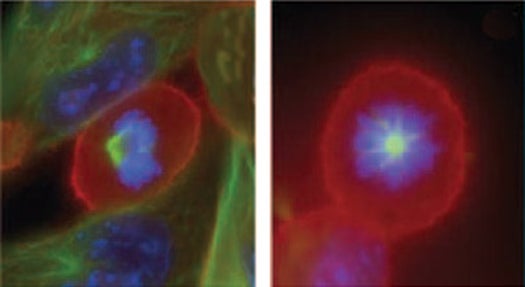
The company, Novocure, just completed early trials of a device that shuts down the division of cancerous cells. The device consists of two electrodes placed directly into the brain, around a cancerous tumor. The electrodes then generate an electric field that paralyzes the cells during the moment of division, thus preventing the spread of the cancer.
The earliest trial began with 10 volunteers, seven of whom are still alive today. Additionally, some early evidence from a lung cancer trial shows that the electric field, when combined with chemotherapy, may prevent the spread of other kinds of cancer as well.
These results are still preliminary, and the device remains unrefined, to the point where users have to carry around a giant battery pack for years on end. However, with Novocure starting a larger brain cancer trial, as well as expanding tests to see if the electric field could work with breast cancer, this is proving a promising area of anti-cancer research.
[via Technology Review]
Stay up to date on the latest news of the future of science and technology from your iPhone with full articles, images and offline viewing
Featuring every article from the magazine and website, plus links from around the Web. Also see our PopSci DIY feed
Share links with friends, comment on stories and more
In our December issue, Popular Science names the 100 best innovations of the year: bombproof wallpaper, self-parking cars, the fastest helicopter, and 97 more. Plus inventor profiles and videos.
Check out the best of what's new here.
The idea of things stuck in my brain skeve me out. Of course a tumor would be just as bad... but when they start implanting cell-phones, I'll be drawing the line. Nothing in my head that I don't know how to program myself.
Novocure has been around a while. The electrodes don't have to be in the brain just on the scalp, picture EEG stickers in a soft covering. The electric field vibrates between 100 and 300 kHz, and interferes with the mitotic spindle. So the cell can't finish dividing and the cancer cells burst like a balloon. Theres a video of it in action on google video.
It also doesn't interfere with normal cells or at least very little. Selectively targeting the fast multiplication of cancer.
Its a very promising treatment. One of the two most promising ones I had found when I was looking.
That really does sound pretty amazing.
Could this be used for cancers other than brain cancer?
Ok lol sorry I just read the last line of the article and answered my question.
I believe nanotechnology is the key to eliminating all disease, i.e. cancer. Little nanites, or nanobots running throughout our bodies keeping us in super top shape, eliminating all sickness and disease, and enabling us to live for centuries or longer. Of course if humans were to live for centuries or perhaps millenia, we would have to have the technology to support our huge population. Replicators from Star Trek would definitely come in handy. Humanity would need to colonize space rather quickly to support it's growing population, and of course to prevent us from being wiped out from a planetary disaster.
As much potential as nanotechnology holds for us, I really dont think we're going to see it on a scale of these "nanites" for a long, long time. Right now, the majority of our nanotechnology is based on creating nano sized structures with specific uses. A "nanite" would not only have to be a complex mechanical structure on a scale we cant even fathom, but would probably need some limited form of programming control. Which inevitable means u need even SMALLER microchips then your already nanometer sized robot.
Electric Fields, however, is something we're quite proficient with. It may still be radiation, but it looks to me like a much safer way to deal with cancer. Not to mention, the less invasive a procedure is the more people love it.
I wonder where this will go next... Perhaps we'll eventually be able to repair cell damage (or at least speed up what our body does itself) with electrical fields.