Magnet-based wind turbine tech moves forward with GE investment
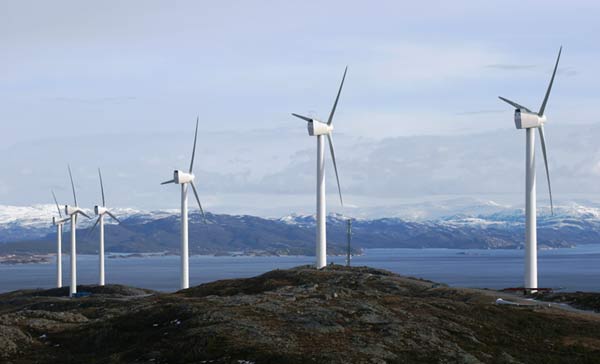
Gearless Wind Power The winds of change could soon shake up traditional gearbox turbines GE

Conventional wind turbines have an Achilles heel in the form of their clunky and expensive gearboxes. But that could change with GE's recent purchase of a company that has developed gearless turbine technology based on magnets.

Gearboxes act as the middleman to convert the slow rotations of wind turbine blades into the faster rotations needed for generators to create electricity. The downside of such gears comes from their high-maintenance requirements due to constant stress from wind turbulence.

By contrast, the turbine design of Norway's ScanWind connects the rotor shaft directly to the generator. The slower rotational speed gets offset by the presence of magnets that spin around at a larger diameter -- and hence higher speed -- to produce more current in the generator coil.

Such direct-drive generators currently cost more than gearbox turbines at installation, and represent a 15 to 20 percent heavier load. But the future payoff may come from eliminating the repair costs and downtime associated with gearboxes -- a very important consideration for offshore turbines beyond easy reach.

GE's acquisition of ScanWind last week signals another step to move gearless turbines beyond the prototype stage. The wind power giant already sells 50 percent of new turbines in the United States, and has also installed more than 12,000 turbines worldwide as the second-largest maker of wind turbines.

Offshore wind farms in Europe represent the likeliest target for GE's latest tech investment, and especially given Europe's need for more wind power to reach its renewable-energy goals. GE plans to roll out a market-ready product by 2012.

Excitement aside, energy giants need not hog all the action. Handy homemakers can build their own wind turbines as well.

[via Technology Review]

Want to learn more about breakthroughs in electronics, medicine, nanotech, and more?
Subscribe to Popular Science and enter to win $5,000!

4 Comments

Umm, Enercon anyone? This is hardly new technology.

I realise that some in the States may not have heard of them. Funny story: so the NSA spied on Enercon in the early 90's, then gave the stolen data to Kenetech Windpower Inc., who then patented the technology in the US (but nowhere else in the world, because everyone else honoured the original Enercon patent), preventing Enercon from selling turbines in the States until 2010. But rumour has it that even after that date, Enercon is still basically going to flip the bird at the US and still refuse to sell turbines there because the owner(yes, it's a private company) is holding a pretty big grudge against the Americans. Justifiably, it could be argued, but hey, that would be editorialising... They can afford snub the USA since there's a multi-year waiting list for wind turbines everywhere in the world, especially for the Enercon ones. Oh, and Kennetech? They filed for bankruptcy in 1996, even though they had the stolen technology that helped Enercon become the third largest manufacturer in the world. I think that deserves a slow-clap...

Anyway, all that is to say that Enercon makes some wicked gearless turbines, and what makes them so sophisticated is that they use electromagnets instead of permanent magnets, meaning that they can throttle their turbines virtually instantaneously by just modifying the excitation of those coils. And unlike others, they don't need several tonnes of rare earth metals from China for every generator.

If you want to see Enercon turbines, the closest place for most of y'all is probably Canada, where there's a whole mess of 'em installed in southern Ontario. They're the ones with the tear-drop nacelle.

Many in the wind energy business seem to think that the now popular horizontal axis machine is the only practicable design with improvements coming in larger blades and taller towers.Yes it is true that they come the nearest to the Betz limit for efficiency, but over a limited wind speed range. Their inherent faults have not gone away. They are not fail safe as they require active systems to protect them when strong winds blow. They also require active systems to track the wind direction.Smaller versions can do this by a weather cocking arrangement, but this is not practical for large turbines. Experience in the North sea has shown that they are inaccessible for more than 10% of the time. Reliability is then dependant on high engineering excellence and rigorous maintenance, neither of which comes cheap. The bottom line is the cost per unit of electricity produced, and whilst the vertical axis machinery is not as aerodynamically efficient, that would not matter if it was producing electricity cheaper. Increasing the effective diameter of the dynamo will only take you so far. The installed price of an on shore turbine in Britain is about £1 million per megawatt rated capacity. Two 500Kilowatt caterpillar diesel generating sets cost about £100,000,and that includes the diesel engines and all the required switchgear. Consider a large cylindrical structure like a cooling tower that had vertical blades to catch the wind and rotate the whole structure. The bearings and generators could be all at ground level. The generators would take power from the peripheral ring at the base and would need less gearing up. Useing several standard generators would have some advantages, because wind power being a cubic function more generating capacity being swiched in only when required will lengthen the life time of the individual generators, if they are switched round in lower power periods. The structure itself can be made of galvanised steel, which is much cheaper than composite turbine blades. Such a device, whilst not having the peak efficiency of the typical turbine will produce at both ends of the wind speed scale, when the horizontal axis machineis stopped.
In simple terms the vertical axis machine is easier to scale because it can be done in two dimensions, not one, and it more readily accommodates multiple standard generators, which can be mass produced. The structural components of the turbine itself could be standardised and modular, with all the cost savings that brings.
Whilst off shore turbines produce more electricity than on shore, it is less than 50% more, but they cost more than 200% to install. Anywhere at sea where there is a lot of wind, there are also waves. It could be that vertical axis wind turbines could be sited on top of wave energy generators.

This is part of why direct wind power is not going to be the cureall for energy needs.

If you want efficiency, you have to take the variable off grid. When wind power is used to create solid-state energy (by, say pumping water to an elevated resevour, which then generates electricity by release of kinetic energy) takes the variability of air and evens it (putting the variability in the depth of the resevour). I know that is impracticle at sea, and there is a loss of energy involved in converting energy, but having a stable grid and the ability to control energy input is the power important factor with renewable resources (particularly in on grid micro generating becomes available and cost effective).

"""Hello,
The Picks that you have provided is really good I shall keep a track of them. Thanks for the article.

Cheers
Ashish

For hot Penny stock picks and daily video alerts visit www.hypergrowthstock.com ""
"


Download Our iPhone App

Stay up to date on the latest news of the future of science and technology from your iPhone with full articles, images and offline viewing


Follow Us On Twitter

Featuring every article from the magazine and website, plus links from around the Web. Also see our PopSci DIY feed


Become a Fan On Facebook

Share links with friends, comment on stories and more


December 2009: Best of What's New

In our December issue, Popular Science names the 100 best innovations of the year: bombproof wallpaper, self-parking cars, the fastest helicopter, and 97 more. Plus inventor profiles and videos.

Check out the best of what's new here.

Popular Science Photo Pool


Share your photos in the Pop Sci pool at www.flickr.com!
tags_sprite.png
POP_embeddedForm_cover_May09.jpg