A DOD-backed project would give ships a regenerating slime layer to help shed unwanted marine life
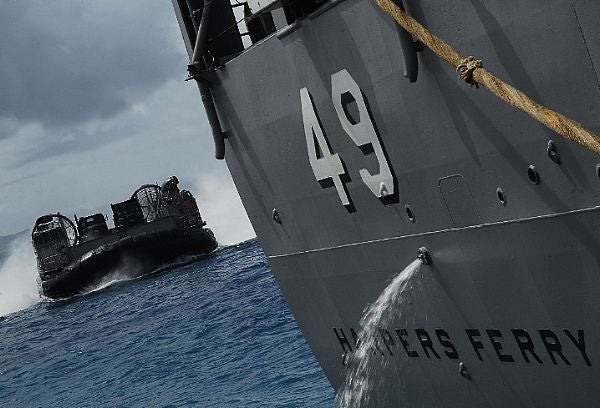
Slick Hull A fine sheen of slime could someday cover Navy vessel hulls such as this, and cut fuel consumption to boot. U.S. Navy

Slime ships ahoy! A vessel that oozes a continual slick layer of slime from its hull could shed barnacles and other marine life forms, and possibly cut its fuel consumption by up to 20 percent.

Such a novel idea tackles the problem of removing marine plants, barnacles and tube worms from ship hulls every year, lest the buildup cut into both speed and fuel efficiency. The fuel savings in particular may look especially tempting for the U.S. Department of Defense, which has backed the project and previously invested in hull-cleaning bots.

The concept takes inspiration from the long-finned pilot whale's self-cleaning skin. Rahul Ganguli of Teledyne Scientific envisions a ship's outer layer covered in metal mesh, and a regular pattern of holes beneath that exude a biosafe chemical which becomes viscous when mixed with seawater. That would create a slimy skin on top of the mesh that continually gets replaced.

Ganguli and colleagues tested the idea with a chemical mix that has seen use on oil rigs, and witnessed a 100-fold reduction in the bacterial species that form the foundation for greater fouling marine organisms. They also showed that they could control how quickly such skin sloughs off.

The technology could mean huge savings for commercial fleets and navies alike. The U.S. Office of Naval Research estimates that such biofilm buildup on Navy ships translates into $500 million annually in extra maintenance and fuel costs.

Who knows, maybe ships could even convert the slimy stuff into an anti-boarding defense against pirates.

[via New Scientist]

Want to learn more about breakthroughs in electronics, medicine, nanotech, and more?
Subscribe to Popular Science today, for less than $1 per issue!

6 Comments

buckrodgers
I believe the person who invented this grew up watching Nicholodeon. Neet idea.

So, any risk this slime can be used to track ship movements from the trail it leaves in the water?

This idea could incorporate another good idea I heard about a few years ago. Researchers took extracts from the hottest chillis and added it to the paint on some boat hulls. Sure enough the barnacles and limpets didn't like the "heat" and did not stick. The ooze may affect onset of turbulence and therefore reduce drag. Putting some hot chilli extract in the slime may help it work against marine life with exotic tastes

I wonder if covering the ship hull w/ Teflon would work also?

Once again and in order to an idea of the usefulness, how much costs the manufacture and use of the layer?

He also said 162 roadside bombs and over 120 kg of explosive materials, five suicide vests and five barrels of acid used in making homemade bombs and Improvised Explosive Devices (IEDs) have also seized by Afghan troops over the mentioned period of time

www.kabin.org


June 2013: American Energy Independence

Five amazing, clean technologies that will set us free, in this month's energy-focused issue. Also: how to build a better bomb detector, the robotic toys that are raising your children, a human catapult, the world's smallest arcade, and much more.


Online Content Director: Suzanne LaBarre | Email
Senior Editor: Paul Adams | Email
Associate Editor: Dan Nosowitz | Email
Assistant Editor: Colin Lecher | Email
Assistant Editor: Rose Pastore | Email

Contributing Writers:
Rebecca Boyle | Email
Kelsey D. Atherton | Email
Francie Diep | Email
Shaunacy Ferro | Email

circ-top-header.gif
circ-cover.gif
bmxmag-ps